Union Minister Piyush Goyal Calls for Deeper India-Japan Business Ties, Invites Japanese Companies to Double Presence in India.
Tokyo:
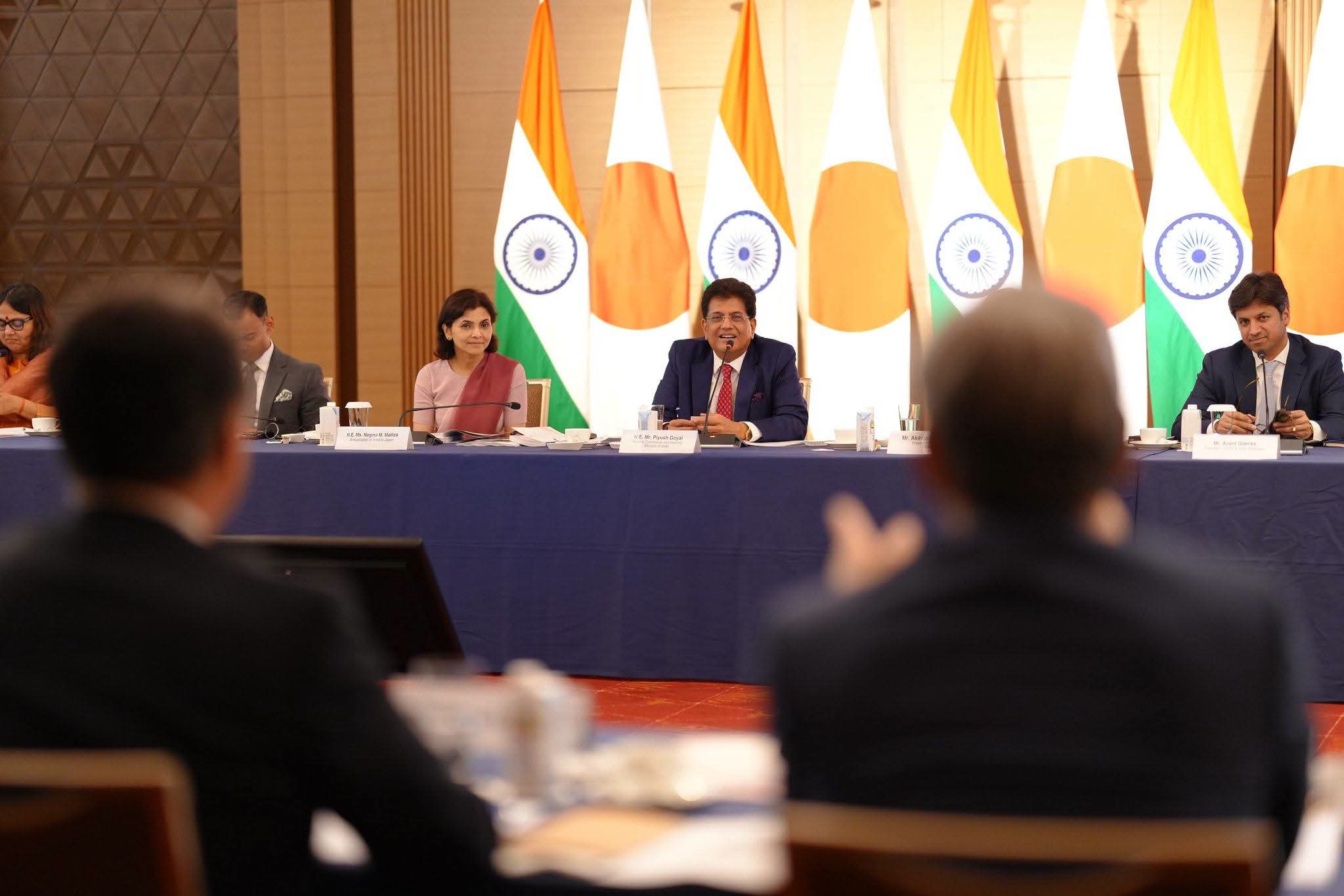
Union Commerce and Industry Minister Piyush Goyal on Monday called for stronger business-to-business engagement between India and Japan, inviting Japanese companies to significantly expand their investments and operations in India.
Addressing a round-table with Keidanren, the Japan Business Federation, which represents more than 1,500 leading Japanese companies, Goyal said the India-Japan partnership has evolved well beyond traditional trade. The relationship now covers strategic areas including economic security, defence, supply-chain resilience, technology, innovation, clean energy and people-to-people exchanges.
Goyal highlighted India’s rapidly expanding economy and improving ease of doing business, and urged Japanese investors to scale up their commitments. He said the number of Japanese companies operating in India should double this decade from current levels, underlining the significant potential for greater economic engagement between the two countries.
He also noted that 2026 has been designated as the “India-Japan Year of Shared Horizons”, marking 75 years of diplomatic relations between India and Japan.
Meetings with leading Japanese companies
During his Tokyo engagements, Goyal held business meetings with senior leadership from Sumitomo Corporation, Meiji Seika Pharma, Mitsubishi Corporation, Tokyo Electron and MinebeaMitsumi.
Discussions with these companies focused on opportunities to expand their existing operations and increase investments in India.
Goyal met Shingo Ueno, Representative Director, President and CEO of Sumitomo Corporation; Toshiaki Nagasato, President and Representative Director of Meiji Seika Pharma Co. Ltd.; and Juro Baba, Representative Director and Executive Vice President of Mitsubishi Corporation.
The Minister also held discussions with companies involved in the semiconductor sector, reflecting the growing importance of advanced technology and semiconductor manufacturing in India-Japan economic cooperation.
At Tokyo Electron, he met Takeshi Okubo, Chair of Tokyo Electron India; Vaidya Bharadwaj, India Project Leader; Takuo Kawauchi, General Manager; Saori Tsuchiya, Director; and Yukiko Otaka.
At MinebeaMitsumi Inc., Goyal met Katsuhiko Yoshida, Director, President, COO and CFO, who is overseeing the company’s semiconductor plant project in India.
The meetings highlighted the expanding scope for Japanese investment in India’s semiconductor manufacturing ecosystem and reinforced semiconductors as an important pillar of the bilateral economic relationship.
Focus on capital goods, machinery and automotive sectors
Goyal also participated in a round-table focused on the capital goods, machinery and automotive industries, bringing together around 70 businesses from India and Japan.
The discussions examined ways to strengthen linkages between Japanese companies and India’s Tier-II and Tier-III supplier ecosystem, while identifying new opportunities for industrial cooperation, technology partnerships and greater participation of Micro, Small and Medium Enterprises (MSMEs).
Goyal highlighted the substantial scope for India-Japan collaboration in capital goods, machinery, automotive and advanced manufacturing. He encouraged Japanese companies to deepen their presence in these sectors and contribute to the development of India’s manufacturing capabilities.
The discussions also explored ways to strengthen India’s manufacturing ecosystem and build more resilient and diversified supply chains through greater participation by Japanese enterprises.
Strategic dimension of India-Japan partnership
During the visit, Goyal also met Ichikawa Keiichi, Secretary General of Japan’s National Security Secretariat, Cabinet Office, at the Kantei, or Deputy Prime Minister’s Office.
The meeting underlined that the India-Japan relationship extends beyond economic cooperation and has an important strategic and national security dimension.
The two countries have increasingly sought closer cooperation in areas such as economic security, supply-chain resilience, critical technologies and strategic industries.
India-Japan economic opportunities highlighted
Later in the day, Goyal participated in a fireside chat moderated by Nikkei Asia, attended by members of the Indian and Japanese business communities and media.
He outlined the expanding contours of the India-Japan economic relationship and highlighted opportunities arising from India’s economic growth, technological transformation and increasing integration with global value chains.
The day’s engagements reinforced the momentum in India-Japan economic cooperation, with a focus on expanding trade, investment, technology collaboration and business-to-business partnerships.
Largest-ever Indian business delegation to Japan
Goyal arrived in Tokyo on August 24 to lead India’s largest-ever business delegation to Japan, comprising more than 200 representatives from Indian industry.
The delegation includes representatives from key sectors such as manufacturing, semiconductors, clean energy, steel, automotive, financial services, healthcare and start-ups.
The four-day visit, scheduled from August 24 to 27, will cover Tokyo, Nagoya and Osaka and aims to strengthen trade and investment relations under the framework of the India-Japan Special Strategic and Global Partnership.
The delegation has been constituted jointly by India’s leading industry associations in coordination with the Ministry of Commerce and Industry. It includes representatives nominated by the Federation of Indian Chambers of Commerce and Industry (FICCI), Confederation of Indian Industry (CII), and Associated Chambers of Commerce and Industry of India (ASSOCHAM).
The visit is expected to provide fresh momentum to investment flows, manufacturing partnerships, technology cooperation and supply-chain integration between India and Japan, while opening new avenues for mutually beneficial growth.