UNICEF Chief Warns Global Debt Crisis Is Becoming a Generational Crisis for Children.
New York:
UNICEF Executive Director Catherine Russell has warned that the growing debt burden faced by low- and lower-middle-income countries is increasingly threatening children’s access to health care, education, nutrition and social protection.
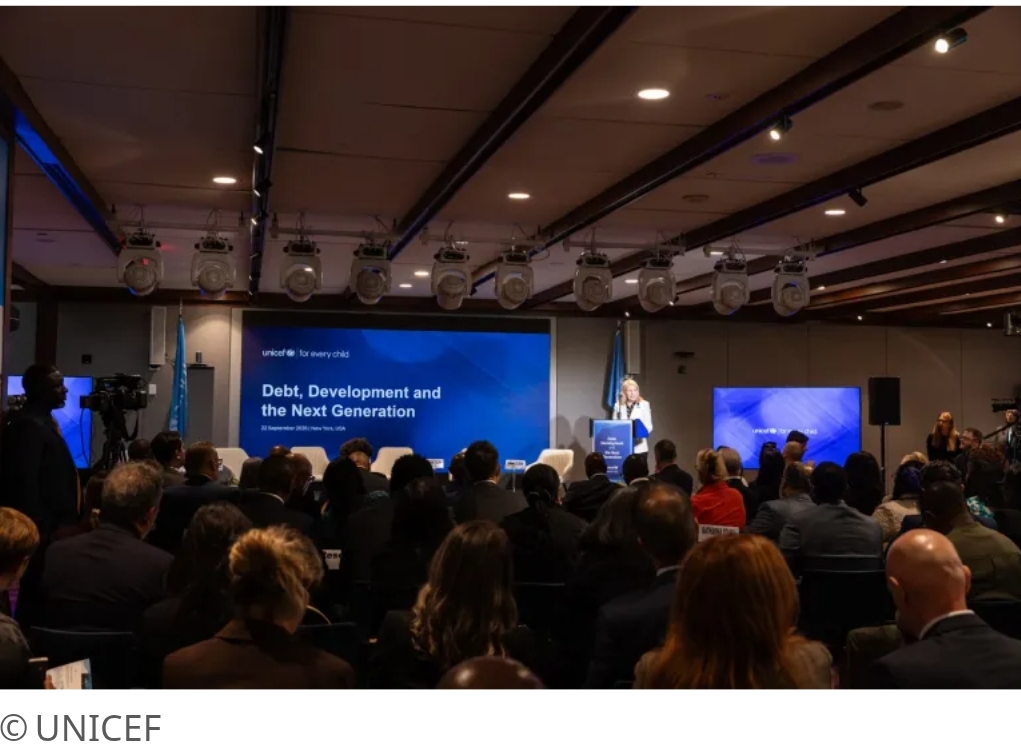
Speaking at UNICEF House in New York at a high-level discussion on “Debt, Development and the Next Generation,” Russell said governments, international financial institutions, creditors, researchers and development partners must treat debt sustainability and children’s development as interconnected priorities.
“Resolving the debt crisis and protecting children’s development are not competing priorities,” Russell said. “They are inseparable.”
More Than One Billion Children Affected
According to Russell, more than one billion children are growing up in low- and lower-middle-income countries where rising public debt is limiting governments’ ability to invest in essential services.
She said that in some countries, external debt service as a share of government revenue has more than doubled since 2010, rising from around 4 per cent to more than 10 per cent.
In 2024, countries that were either in debt distress or at high risk of debt distress reportedly transferred more than $30 billion to external creditors, paying more in debt service than they received in new financing.
Russell said these financial pressures have direct consequences for children, influencing whether health facilities have medicines, teachers remain in classrooms, children receive adequate nutrition and families can access support during crises.
Health Spending Under Pressure
The UNICEF chief highlighted the growing competition between debt payments and essential public services.
She said governments in 34 countries are now spending more on interest payments than on health. Those countries are home to approximately 1.1 billion children and account for an estimated 3.2 million deaths among children under five. Russell also said around 97 million children in these countries are affected by stunting.
“These numbers tell us something important,” Russell said, arguing that children with some of the greatest needs are increasingly concentrated in countries facing some of the heaviest debt burdens.
She described the situation as not merely a financing crisis but a “generational crisis.”
Childhood Cannot Be Delayed
Russell stressed that the effects of reduced public investment in children can extend far beyond periods of fiscal adjustment.
As debt-service payments consume more government revenue, countries may protect some expenditures, such as salaries, while reducing spending on medicines, school supplies, infrastructure and maintenance.
But, she argued, childhood development does not operate on the same timetable as debt negotiations.
“Debt can be rescheduled. Childhood cannot be rescheduled,” Russell said.
She pointed to vaccination, early-childhood nutrition and education as areas where delays can have long-term consequences. A missed vaccination at a critical age, inadequate nutrition during early childhood or a lost year of education cannot necessarily be fully recovered later.
For creditors, Russell noted, negotiations over debt restructuring can take years. For children, the same period can represent an important and irreplaceable stage of development.
UNICEF Calls for a Different Approach to Debt Adjustment
Russell recalled UNICEF’s role four decades ago in challenging the social consequences of austerity through its landmark publication “Adjustment with a Human Face.”
The publication argued that economic reforms should not sacrifice essential human outcomes in pursuit of longer-term financial objectives.
Russell said that principle remains relevant, but argued that policymakers should go further by rejecting the idea that countries must choose between restoring debt sustainability and investing in children.
According to her, spending on health, education and nutrition should be viewed not only as social expenditure but also as investment in the human capacity needed for future economic growth and government revenues.
Reducing those investments, she said, can contribute to a less healthy and educated workforce, lower productivity, slower economic growth and a weaker revenue base.
Pandemic Debt Measures Offer Lessons
Russell pointed to international action during the COVID-19 pandemic as evidence that debt relief mechanisms can be implemented when governments and creditors have sufficient political will.
She also cited Zambia’s debt restructuring experience as an example of how easing debt pressures can create additional fiscal space for public investment. Following its default, an IMF programme agreement and debt restructuring, Zambia expanded school enrolment, teacher recruitment and classroom construction, according to Russell.
She described the experience as an example of how fiscal space can translate into opportunities for children.
Three Questions for International Policymakers
Russell urged participants at the meeting to focus on three major questions.
The first is how debt relief can be delivered quickly enough to have a meaningful impact on children while essential services are protected during fiscal adjustment.
The second is how the international debt architecture can be reformed so that assessments of debt sustainability better account for the long-term economic and social returns from investing in children.
The third is how governments can strengthen debt management and domestic revenue mobilisation while protecting investment in children, including by assessing the potential impact on children before major fiscal decisions are taken.
Investing in Children and Debt Sustainability
Russell concluded by stressing that decisions made during the current debt crisis could shape the health, education, productivity and economic prospects of the next generation.
She argued that investment in children and efforts to address debt pressures should not be viewed as separate objectives.
“Addressing debt and investing in children are not competing priorities,” Russell said. “They are investments in the same future.”
Her remarks come amid continued international debate over how heavily indebted developing countries can restore fiscal sustainability while maintaining spending on essential public services and meeting the long-term development needs of their populations.