New Solid Waste Rules Strengthen Waste Management at Mountain Tourist Destinations; Himachal Gets Rs. 80.67 Crore Support.
New Delhi:
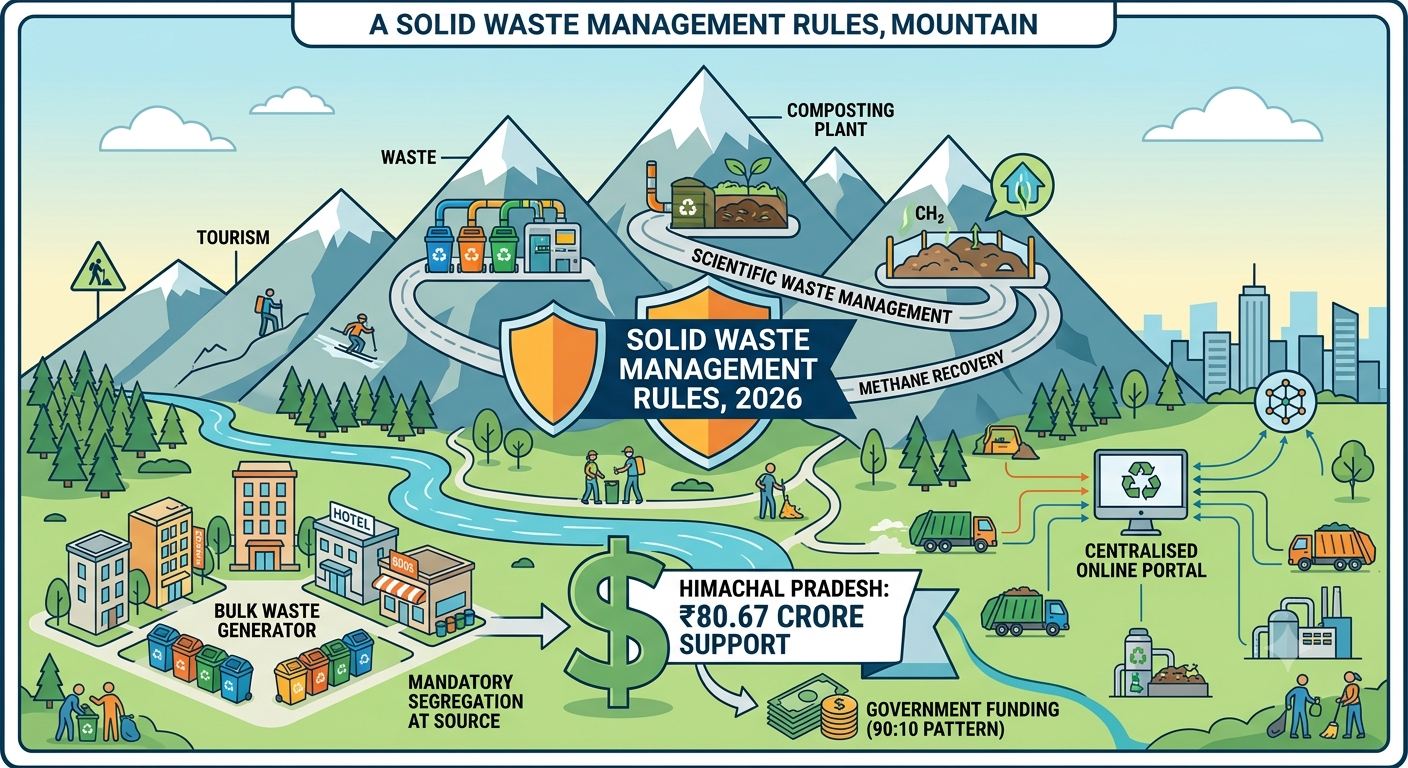
The Central Government has introduced the Solid Waste Management Rules, 2026, providing a comprehensive statutory framework for scientific waste management across the country, with special provisions for hilly regions and island territories. The information was shared by Minister of State for Environment, Forest and Climate Change Kirti Vardhan Singh in a written reply to a question in the Rajya Sabha today.
The new rules assign clear responsibilities to State Governments, Urban and Rural Local Bodies, and Bulk Waste Generators to ensure environmentally sound collection, transportation, processing and disposal of solid waste. A key feature of the rules is the mandatory segregation of waste at source into four categories—wet waste, dry waste, sanitary waste and special care waste.
The rules also introduce the concept of Extended Bulk Waste Generator Responsibility, making large waste generators accountable for proper management of the waste they produce. Additionally, all stages of waste management—from collection and transportation to processing and disposal—will be monitored through a Centralised Online Portal, enabling digital tracking and improved compliance.
Recognising the unique challenges faced by mountain tourist destinations, the rules contain special provisions for solid waste management in hilly areas and islands, where seasonal tourism often puts immense pressure on local waste management systems.
The Ministry clarified that sanitation remains primarily the responsibility of State Governments. However, the Centre continues to provide financial support through Swachh Bharat Mission-Urban 2.0 (SBM-U 2.0) and Swachh Bharat Mission (Gramin) [SBM(G)]. Under both schemes, northeastern and Himalayan states receive central assistance under a 90:10 Centre-State funding pattern for solid waste management projects.
Under the Solid Waste Management component of SBM-U 2.0, Himachal Pradesh has been allocated Rs. 36.50 crore, while Uttarakhand received Rs. 89 crore, Jammu & Kashmir Rs. 131.70 crore, Assam Rs. 118.30 crore, Nagaland Rs. 38.54 crore, Arunachal Pradesh Rs. 33.20 crore, Tripura Rs. 23 crore, Manipur Rs. 23.90 crore, Mizoram Rs. 22.20 crore, Meghalaya Rs. 16.80 crore, and Sikkim Rs. 6.20 crore.
Under SBM(G) for 2024-25, the Central share allocated for solid waste management stands at Rs. 44.17 crore for Himachal Pradesh, Rs. 48.68 crore for Uttarakhand, Rs. 245 crore for Jammu & Kashmir, Rs. 356.15 crore for Assam, Rs. 107.64 crore for Meghalaya, Rs. 75.22 crore for Tripura, Rs. 27.59 crore for Nagaland, Rs. 17.68 crore for Mizoram, Rs. 14.82 crore for Arunachal Pradesh, Rs. 14.79 crore for Sikkim, and Rs. 2 crore for Manipur.
The Ministry also informed Parliament that the Central Pollution Control Board (CPCB) compiles annual reports on the implementation of the Solid Waste Management Rules based on data received from State Pollution Control Boards. These reports include state-wise information on solid waste generation, collection and treatment, including for Himachal Pradesh, Uttarakhand, Jammu & Kashmir, Sikkim and the northeastern hill states.
The government said the new regulatory framework, backed by digital monitoring and targeted financial assistance, is expected to significantly improve solid waste management, particularly in environmentally sensitive mountain regions and major tourist destinations.