Six States Sign Kishau Multipurpose Project Agreement; Major Push for Water Management and Yamuna Conservation.
New Delhi:
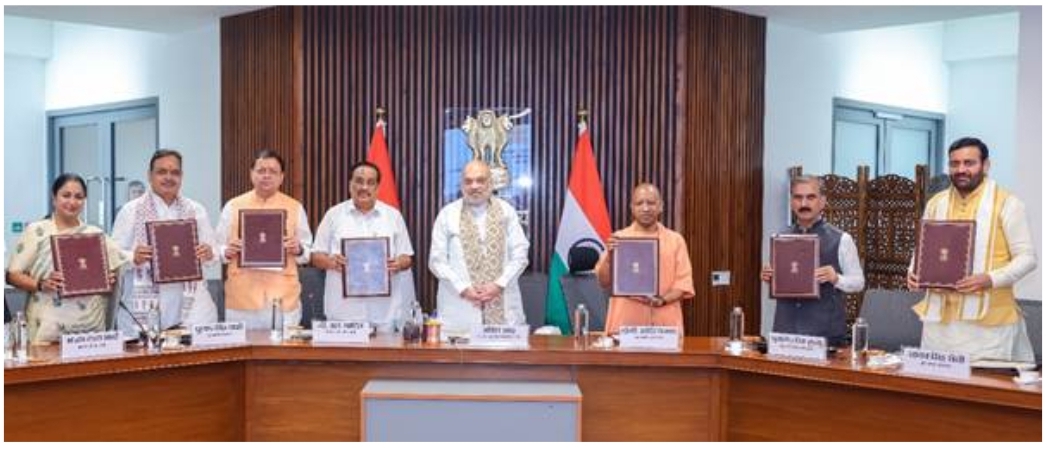
In a significant development for inter-state water management, the Chief Ministers of Uttar Pradesh, Uttarakhand, Himachal Pradesh, Rajasthan, Delhi and Haryana signed the Kishau Multipurpose Project agreement in the presence of Union Home Minister and Minister of Cooperation Amit Shah and Union Jal Shakti Minister C. R. Patil on Tuesday.
The agreement was signed by Uttar Pradesh Chief Minister Yogi Adityanath, Uttarakhand Chief Minister Pushkar Singh Dhami, Himachal Pradesh Chief Minister Sukhvinder Singh Sukhu, Rajasthan Chief Minister Bhajan Lal Sharma, Delhi Chief Minister Rekha Gupta and Haryana Chief Minister Nayab Singh Saini.
The Union Home Secretary, Secretary of the Department of Water Resources, River Development and Ganga Rejuvenation, and Chief Secretaries of the concerned states were also present on the occasion.
Agreement described as a major step in resolving long-pending water issues
Addressing the meeting, Amit Shah described the agreement as a historic development and said its successful implementation would mark an important chapter in the country’s water-management history.
He said the agreement would benefit all six participating states—Himachal Pradesh, Uttarakhand, Uttar Pradesh, Haryana, Rajasthan and Delhi—in different ways. He congratulated the Chief Ministers and C. R. Patil for their role in bringing the long-pending project to the stage of formal agreement.
According to Shah, all six states have given their consent to the project and signed the agreement. He said the Government of India and the Chief Ministers of the six Yamuna-basin states are committed to completing the project at the earliest.
Tenth water dispute resolution highlighted
Shah said that since Narendra Modi became Prime Minister, the Kishau agreement marks the tenth major water-related dispute or issue to be resolved through the Centre’s efforts at consensus-building.
He referred to several agreements and decisions taken in recent years, including the resolution of issues concerning the Lakhwar Multipurpose Project and Shahpur Kandi Dam Project in 2018, the Renukaji Multipurpose Dam Project in 2019, and the Ken-Betwa Link Project agreement between Madhya Pradesh and Uttar Pradesh in 2021.
He also cited progress on the Parbati-Kalisindh-Chambal River Link Project in 2024, approval of a scheme for transferring water from Hathinikund to the Yamuna through an underground pipeline in February 2024, and the resolution of water-related issues involving the Narmada Project in July 2026 and Bihar-Jharkhand water sharing in the Son Basin in August 2026.
Shah said the period from 2018 to 2026 would be remembered for efforts to resolve long-standing water disputes in North India through mutual consultation and consensus.
Project agreement follows decades of discussions
According to Shah, the foundation for the Kishau project was laid through an agreement reached on May 12, 1994, under which separate agreements were to be entered into for individual storage projects in the basin.
He said that after the disputes concerning the Lakhwar and Renukaji projects were resolved, the Kishau project also moved forward. A formal agreement on the project was reached on June 16, 2026, following discussions involving the Ministry of Jal Shakti and the participating states.
The Union government said the agreement was finalized after considering technical and economic aspects and the interests of all participating states.
Kishau declared a National Project
The Kishau Multipurpose Project has been declared a National Project by the Government of India. Under the financial arrangement, approximately 90 per cent of the project’s financial burden will be borne by the Government of India, while the remaining 10 per cent will be borne by the participating states in accordance with the 1994 agreement.
Shah said Uttarakhand had raised certain concerns regarding its financial obligations. He said the Centre had assured the state that efforts would be made to accommodate its demands through appropriate Government of India schemes and provide assistance in meeting the financial burden that may arise.
232.6-metre dam to be built on Tons River
Under the project, a 232.6-metre-high concrete gravity dam will be constructed on the Tons River, which flows along the border of Uttarakhand and Himachal Pradesh.
The project will have a water storage capacity of approximately 1,562 million cubic metres. According to the government, it is expected to provide irrigation to around 97,000 hectares of land and generate approximately 1,476 million units of clean hydropower.
The project is therefore expected to have implications for irrigation, electricity generation and water availability across the participating states.
Delhi and Yamuna expected to receive significant benefits
A major focus of the agreement is its potential impact on Delhi and the Yamuna River.
Shah said that when water allocations in the Yamuna basin were originally made, adequate environmental flow for the river was not taken into account. According to him, the Kishau agreement will make additional water available and will benefit both Delhi and the Yamuna.
He said the project would contribute to environmental conservation while also supporting drinking-water, agricultural, industrial and developmental requirements.
The Union Home Minister further linked the project with ongoing efforts to clean the Yamuna in Delhi. He expressed confidence that the objective of achieving a clean Yamuna could be reached by 2029.
Consensus-based approach emphasized
Shah described the agreement as an example of Prime Minister Narendra Modi’s stated approach of “Sabka Saath, Sabka Vikas, Sabka Vishwas and Sabka Prayas” and the concept of Team India.
He said the successful conclusion of the agreement demonstrated the importance of dialogue and consensus in resolving complex inter-state issues.
The government emphasized that cooperation among the six states would now be important for timely implementation of the project. The agreement is expected to strengthen coordinated water-resource management in the Yamuna basin while providing benefits related to irrigation, hydropower, drinking water and environmental conservation.
With the signing of the agreement, the Kishau Multipurpose Project has moved forward after decades of discussions, bringing the six participating states and the Centre together on a common framework for its implementation.