
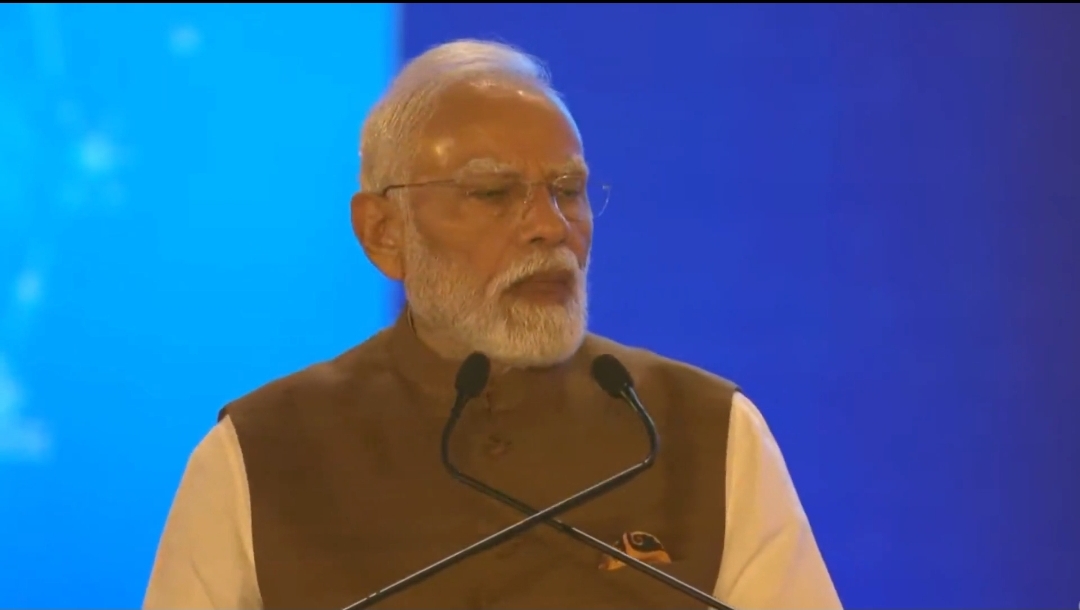
PM Modi Calls for India to Lead the World in Emerging Science and Technology.
Prime Minister inaugurates Emerging Science, Technology and Innovation Conclave 2026; highlights self-reliance in critical technologies, research funding and responsible use of AI.
New Delhi:
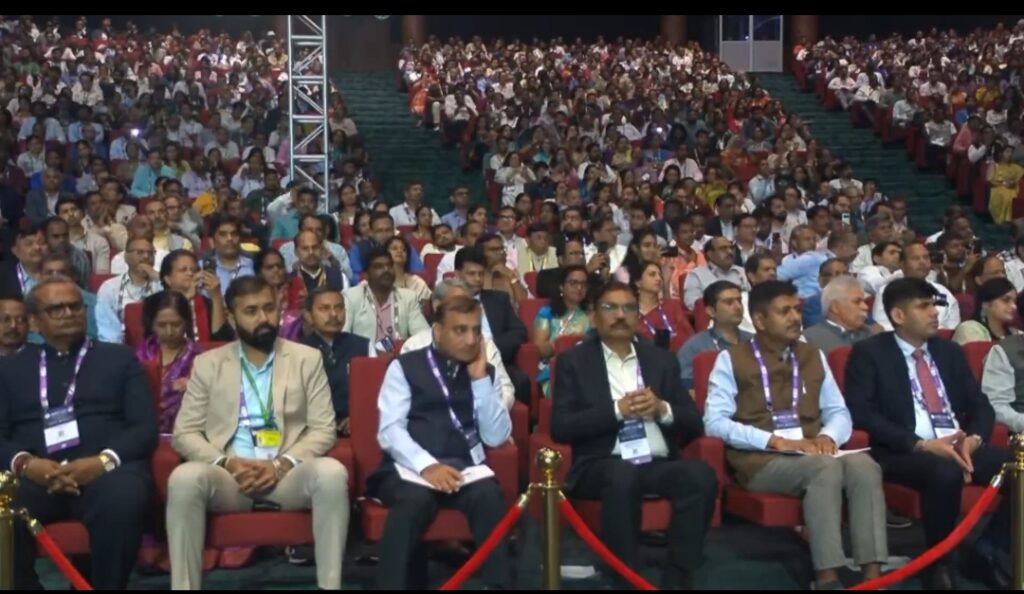
Prime Minister Narendra Modi today inaugurated the Emerging Science, Technology and Innovation Conclave 2026 at Bharat Mandapam in New Delhi, calling upon scientists, researchers, startups, industry leaders and students to make India a global leader in emerging technologies and scientific innovation.
Addressing the gathering, the Prime Minister said a developed India, or Viksit Bharat, would be built on strong foundations of scientific research, discoveries and a culture of innovation. He emphasised that India must move beyond adopting technologies developed elsewhere and focus on creating original solutions, setting global technological directions and addressing challenges facing humanity.
Modi expressed confidence in the country’s younger generation, praising the ambition, creativity and self-confidence of young Indians. Referring to his interaction with startup founders earlier in the day, he said their expanding vision and determination reflected the changing aspirations of the country.
Recalling his participation in the previous edition of the conclave, the Prime Minister said India had historically relied on adopting or modifying foreign technologies, often years after their development. He said the country was now moving towards developing indigenous technologies and creating solutions with global applications.
Citing India’s development of indigenous COVID-19 vaccines, its Mars mission and the successful landing near the Moon’s South Pole, Modi highlighted the country’s scientific achievements and called for greater ambition in future research.
“India must embrace the technologies of the future, innovate boldly, and lead the world in creating them,” he said.
Nuclear Energy and Space Technology in Focus
Highlighting India’s scientific heritage, including the invention of zero, the development of the number system and achievements in astronomy, the Prime Minister said the country was advancing its legacy through modern research and technological innovation.
With the birth anniversary of renowned nuclear scientist Dr Homi Jehangir Bhabha approaching on October 30, Modi began his review of recent technological developments with the nuclear energy sector.
He said expanding nuclear energy capacity was important for achieving the goal of Viksit Bharat and strengthening India’s energy security. Reducing dependence on imported nuclear fuel remains a significant consideration in this effort.
The Prime Minister highlighted progress in Fast Breeder Reactor technology, particularly the achievement of first criticality by India’s indigenous 500-megawatt Prototype Fast Breeder Reactor. He described the development as an important step towards strengthening the country’s long-term capabilities in nuclear energy.
Turning to the space sector, Modi cited achievements including an Indian space startup successfully placing a satellite into orbit on its maiden attempt using an indigenously developed rocket and India’s progress in satellite docking technology.
He also noted the growing participation of domestic startups, young scientists and entrepreneurs in developing innovative space-related solutions.
The Prime Minister said India’s ambitions extended beyond energy security and domestic technological capabilities to building strength across a broad range of critical technologies.
India Expanding Capabilities in AI and Semiconductors
Highlighting developments across multiple technology sectors, Modi referred to India’s hosting of the AI Impact Summit, the development of an indigenous artificial intelligence model and the commencement of shipments of Indian-made semiconductor chips to international markets.
He also pointed to efforts to expand battery storage capacity using raw materials available domestically.
The Prime Minister said achievements across nuclear energy, space technology, artificial intelligence, semiconductors and energy storage reflected India’s growing capabilities in emerging technologies.
He emphasised the importance of developing secure technological solutions that could be deployed at scale to address challenges affecting large populations.
Referring to India’s Digital Public Infrastructure and indigenous 5G technology, Modi said the country was working towards building secure digital platforms capable of serving millions of people.
He stressed that India’s ability to develop solutions at scale could help address challenges not only within the country but also across the world.
Science Must Improve People’s Lives
The Prime Minister said scientific and technological progress should ultimately be measured by its contribution to society rather than being confined to laboratories or technical achievements.
He called for greater application of research in healthcare, agriculture, education, employment and disaster management, emphasising that scientific discoveries must translate into practical benefits for ordinary citizens.
Modi noted that Indian startups and domestic companies were working on a range of innovative technologies, including wearable electroencephalography (EEG) devices for monitoring brain activity, indigenous wireless and satellite communication systems, specialised nutritional products, advanced semiconductor technologies and methods to utilise industrial waste such as steel slag.
“The real success of Science occurs when it steps out of the lab and makes the life of the common citizen better,” he said.
Referring to his recent visit to IIT Madras in Chennai, the Prime Minister also highlighted the inauguration of a modern Brain Centre that has developed a brain-imaging technology platform capable of producing high-resolution, digital three-dimensional images of the human brain.
He said the technology could support research into complex neurological diseases and demonstrate how scientific innovation could contribute to advances in healthcare.
Modi emphasised that the principles of “Science for Society” and “Technology for Transformation” should remain the ultimate benchmarks of scientific progress.
₹24,000 Crore Commitment to Research and Development
Underscoring the importance of sustained investment in research, the Prime Minister said India’s ability to develop technologies and achieve self-reliance in critical sectors depended on a strong research ecosystem.
Referring to his slogan “Jai Vigyan, Jai Anusandhan”, he highlighted the growing momentum of the Anusandhan National Research Foundation and recalled the commitment announced at the previous conclave to provide ₹1 lakh crore for research, development and innovation.
According to the Prime Minister, the government had committed ₹12,000 crore over the past year to support market-ready laboratory technologies, with private investors contributing an equal amount.
This brought the combined commitment to research and development to ₹24,000 crore, he said, describing the investment as an important step towards translating scientific discoveries into practical technologies and products.
The Prime Minister also highlighted the growth in India’s intellectual property ecosystem over the past decade.
He said annual patent filings had increased from fewer than 50,000 a decade ago to nearly 1.5 lakh in the previous year. According to him, the rise reflected a broader shift towards making research and innovation an integral part of India’s scientific and industrial culture.
PM Modi Calls for Responsible Use of Artificial Intelligence
Addressing the growing influence of artificial intelligence in scientific research, the Prime Minister urged scientists to use AI as a tool to improve productivity without compromising independent thinking and scientific judgement.
He observed that leading scientists and Nobel laureates had developed their expertise through years of experimentation, solving problems, learning from failures, questioning established ideas and identifying details that others might overlook.
While acknowledging AI’s ability to provide quick answers and perform routine tasks efficiently, Modi cautioned researchers against relying on its outputs without verification.
He said the time saved through AI should be used to investigate more complex questions, conduct new experiments and validate ideas.
“AI can give us answers quickly, but the responsibility of testing the veracity of the answer must lie with the scientist alone,” he said.
The Prime Minister stressed that scientific judgement, critical thinking and independent verification would remain essential even as AI became increasingly integrated into research and development.
National Missions to Drive Future Technologies
Calling for sustained preparation in areas likely to shape the future, Modi emphasised the need for dedicated national missions covering semiconductors, quantum technologies, biotechnology, advanced materials, robotics, space, clean energy and next-generation communications.
He said India should develop the capabilities needed to generate new scientific breakthroughs and reduce dependence on external sources for critical technologies.
The Prime Minister also underlined the importance of safety and security in emerging fields, particularly artificial intelligence, synthetic biology and autonomous systems.
Warning of cybersecurity threats in the AI era, including risks to financial networks and national security, he called for the development of AI-based and quantum security solutions to protect critical systems.
He said technological advancement should strengthen India’s capabilities while contributing to solutions for global challenges.
Researchers Asked to Set Three-Year Innovation Targets
In his concluding remarks, Modi called upon researchers, industry leaders, startup founders and students attending the conclave to establish concrete targets for the next three years.
He urged participants to identify the technologies, prototypes, pilot projects or products they intended to develop and work towards delivering measurable outcomes.
The Prime Minister said the conclave should go beyond discussions and the exchange of ideas to become a platform for tangible achievements in science, technology and innovation.
He called for coordinated efforts among research institutions, industry, startups and young innovators to strengthen India’s scientific ecosystem and establish the country as a global hub for technological solutions.
Concluding his address, Modi said India, as the world’s youngest nation, possessed significant talent and determination that needed to be channelled towards leadership in emerging science and technology.
He stressed that the country must prepare a generation capable of shaping the future of scientific discovery rather than merely participating in technological developments led by others.
The Prime Minister extended his best wishes for the success of the Emerging Science, Technology and Innovation Conclave 2026, expressing hope that it would help accelerate research, strengthen innovation and advance India’s ambition of becoming a developed nation.