WHO Announces US$1 Million Support for Critical Hospital Equipment in Haiti Amid Humanitarian Crisis.
Port-au-Haiti:
The World Health Organization (WHO) has announced US$1 million in support for critical medical equipment for Haiti’s healthcare system, which is facing severe pressure amid ongoing violence, insecurity and a worsening humanitarian crisis.
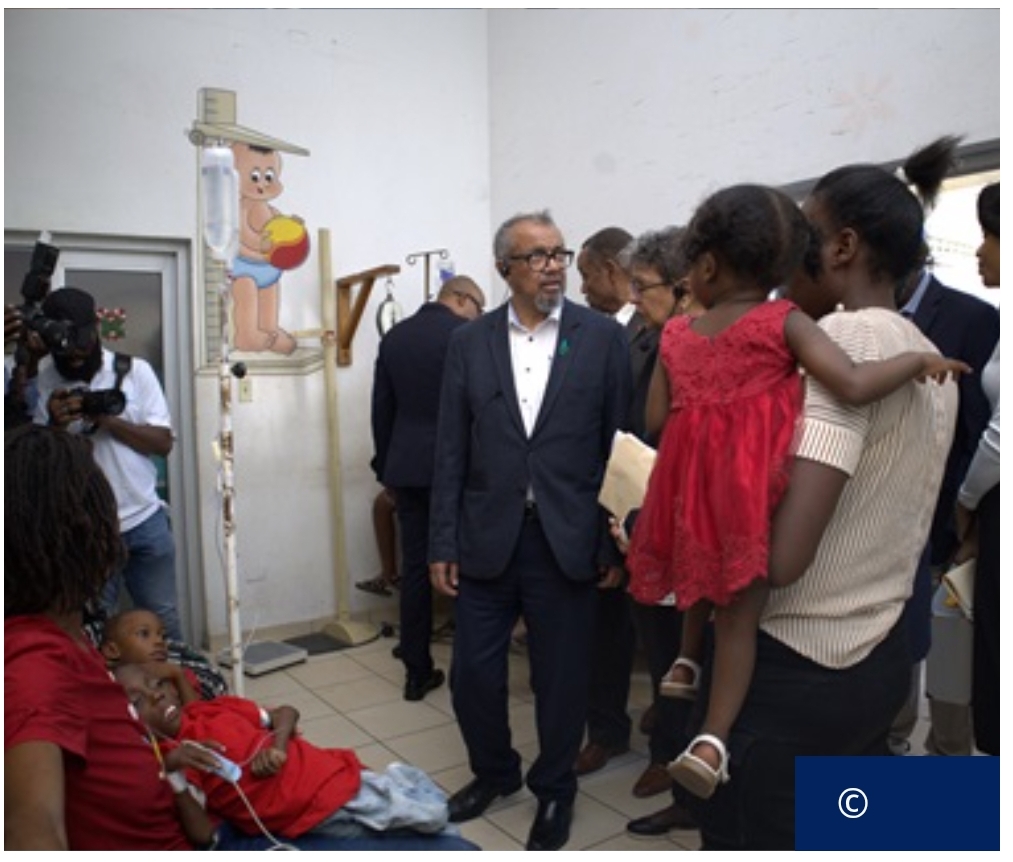
WHO Director-General Dr Tedros Adhanom Ghebreyesus announced the funding during his visit to Haiti on November 26, 2026, aimed at reinforcing international support for the country’s strained healthcare infrastructure and improving access to essential medical services.
The funding will be used to provide critical equipment to Hôpital Universitaire La Paix (HUP) in Port-au-Prince, including a computed tomography (CT) scanner and equipment for four operating rooms. The hospital is currently the last major public referral hospital still functioning in the Haitian capital, where widespread violence has disrupted healthcare services and forced many medical facilities to shut down.
According to WHO, nearly half of health facilities in Port-au-Prince are non-functional, while only 12% are partially operational. Across Haiti, which has a population of more than 11 million, approximately 24.5% of healthcare facilities are not functioning, while 48.5% are operating only partially.
The ongoing armed violence has severely affected access to healthcare, disrupted medical supply chains, displaced communities and forced several hospitals and health centres to close. The situation has further deteriorated with the growing number of internally displaced people, estimated at 1.5 million, putting additional pressure on the already overstretched healthcare system.
WHO estimates that around 4.9 million people in Haiti will require health assistance in 2026.
During his visit to Hôpital Universitaire La Paix, Dr Tedros said the healthcare system was under immense pressure due to the growing number of patients and trauma cases. He acknowledged the resilience, courage and dedication of healthcare workers who continue to provide services despite extremely challenging circumstances.
He reaffirmed WHO and the Pan American Health Organization’s (PAHO) commitment to supporting the Haitian government and people in sustaining and expanding essential health services, strengthening the healthcare system, improving disease surveillance and enhancing outbreak response capabilities.
The support for HUP is part of broader international efforts to maintain lifesaving healthcare services in the country, he said, while emphasising the need for sustained international solidarity and financial assistance.
Since January 2026, Hôpital Universitaire La Paix has treated more than 19,575 emergency patients with support from WHO and PAHO. The hospital has also treated 291 victims of gunshot wounds, performed 3,086 surgeries and handled 1,442 high-risk deliveries, making it a critical lifeline for residents of Port-au-Prince who have limited access to emergency medical services.
During his visit, Dr Tedros also met with Prime Minister Alix Didier Fils-Aimé and Minister of Public Health and Population Dr Bertrand Sinal to discuss priorities for strengthening the country’s healthcare system. He also held discussions with United Nations partners working in Haiti.
Over the past two years, WHO and PAHO have mobilised more than US$30 million to support Haiti’s health response. The funding has helped sustain lifesaving care at key healthcare facilities, reduce cholera transmission and maintain essential medical services for vulnerable populations.
WHO continues to seek additional funding to address the growing healthcare needs of Haiti amid the continuing humanitarian and security crisis.