
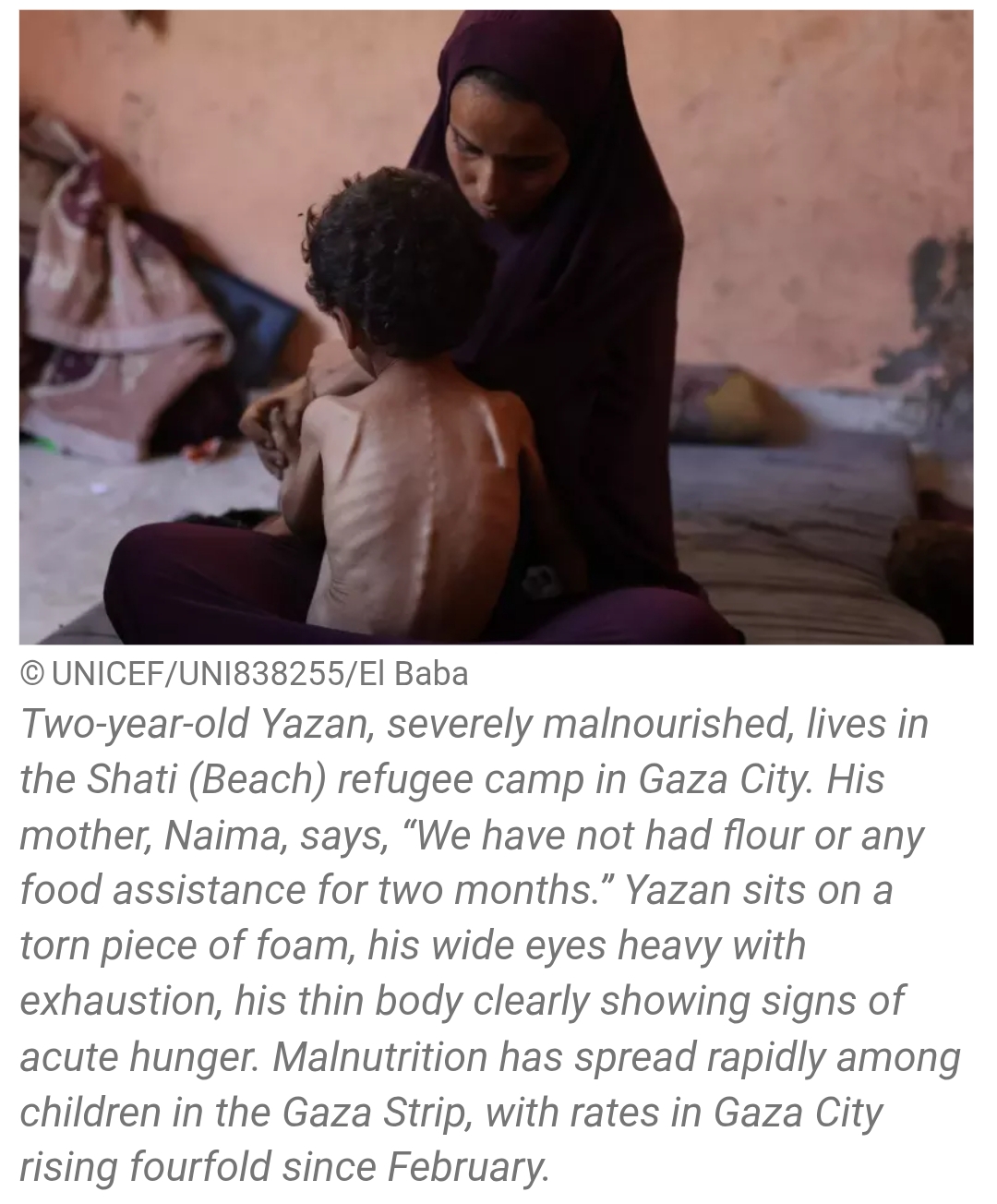
Gaza on the Brink: UN Agencies Warn Famine Thresholds Surpassed as Malnutrition Soars Among Children.
NEW YORK/ROME:
The Gaza Strip is teetering on the edge of a full-scale famine, with key food security and nutrition indicators surpassing critical thresholds, according to a stark warning issued today by three United Nations agencies — the World Food Programme (WFP), UNICEF, and the Food and Agriculture Organization (FAO).
Data from the Integrated Food Security Phase Classification (IPC) Alert, the internationally recognized system for measuring food crises, shows that two out of three core famine thresholds — extreme food consumption gaps and acute malnutrition — have now been breached in parts of Gaza. The third threshold — starvation-related deaths — is suspected to be rising but remains difficult to verify due to near-total collapse of Gaza’s health infrastructure.
“People Are Already Dying of Hunger”
“The unbearable suffering of the people of Gaza is already clear for the world to see,” said WFP Executive Director Cindy McCain. “We need to flood Gaza with large-scale food aid, immediately and without obstruction… People are already dying of malnutrition, and the longer we wait, the higher the death toll will rise.”
The agencies stressed that famine is not a distant threat — it is an unfolding reality. More than 500,000 people, or nearly a quarter of Gaza’s population, are experiencing famine-like conditions. An additional 75% of the population is classified at emergency levels of hunger, according to the IPC Alert.
Hunger and Malnutrition Skyrocket Among Children
The situation for Gaza’s youngest residents is especially grim. Rates of acute malnutrition among children under five in Gaza City have quadrupled since February, rising to 16.5%. As of July, more than 320,000 children — virtually every child under five in Gaza — is at risk of acute malnutrition.
“This is the deadliest form of hunger, and we are seeing it increase at an alarming rate,” said UNICEF Executive Director Catherine Russell. “We need immediate, safe and unhindered humanitarian access across Gaza… Without it, parents will remain powerless to save their children from a condition we know how to treat and prevent.”
In June alone, 6,500 children were admitted for treatment for malnutrition — the highest monthly number since the conflict began. In July, 5,000 more cases were reported in just the first two weeks. Fewer than 15% of essential nutrition treatment services remain functional in the Strip.
Food and Water Are Scarce — And Access is Blocked
The food crisis in Gaza is not caused by the absence of food but by the inability to access it, the UN warns. Conflict, collapsed local food systems, and severe restrictions on humanitarian access have left families unable to feed themselves or access even basic assistance.
More than 39% of Gaza’s population is now going entire days without food. Meanwhile, fuel shortages, water scarcity, and severed supply chains have crippled what remains of Gaza’s agricultural and food distribution infrastructure.
“People are starving not because food is unavailable, but because access is blocked,” said FAO Director-General QU Dongyu. “We urgently need safe and sustained humanitarian access and immediate support to restore local food production and livelihoods.”
What’s Needed to Prevent Famine Now
To meet basic humanitarian food and nutrition needs in Gaza, over 62,000 tons of life-saving aid are required every month. This must be complemented by the resumption of commercial imports, including fresh fruits, vegetables, dairy, and protein sources such as meat and fish — all essential to a diverse and healthy diet.
The UN agencies also call for:
- An immediate and sustained ceasefire, to halt violence and allow humanitarian operations.
- Safe and unimpeded humanitarian access, including the full use of all border crossings and secure humanitarian corridors.
- Revival of commercial supply chains, to restore local markets and bakeries.
- Protection of civilians and humanitarian workers, and urgent efforts to restore basic services, especially water, health, and sanitation infrastructure.
- Investment in long-term recovery, including agriculture, fisheries, and market rehabilitation, to rebuild Gaza’s shattered food system.
Despite limited humanitarian pauses and partial border openings, aid flows into Gaza remain a fraction of what is needed to prevent starvation. Thousands of lives — especially those of children — now depend on whether the global community acts swiftly and decisively.