
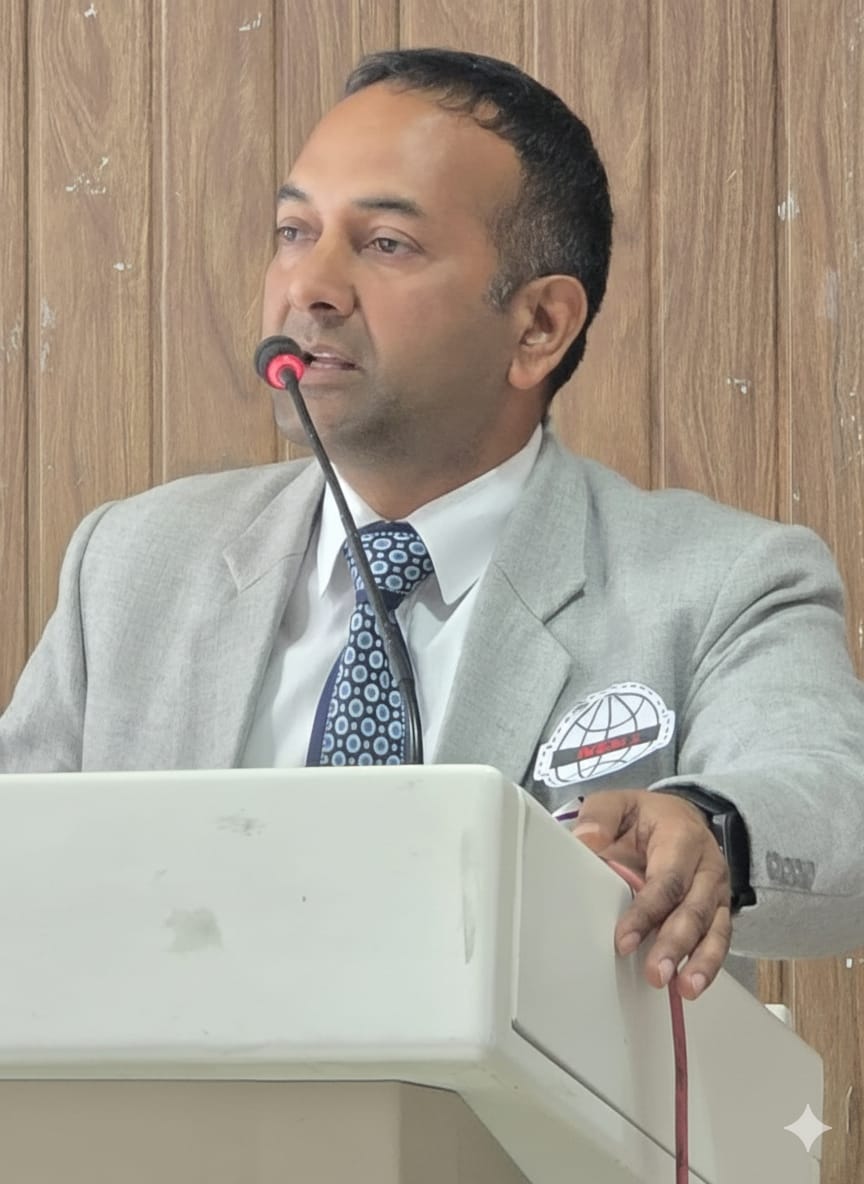
Dr. Chaman Lal Kranti Singh Highlights Dr. Ambedkar’s Vision of a Modern and United India at National Seminar.
Shimla:
Flying Officer Dr. Chaman Lal Kranti Singh, Head of the Department of Journalism and Mass Communication at Vallabh Government College, Mandi, delivered an online presentation of a highly thought-provoking and research-oriented paper at a National Seminar organized by Government College, Banjar. The paper, titled “Bharat Ratna Dr. B. R. Ambedkar’s Vision of a Modern and United India: Modernisation, Social Transformation, and Emerging Challenges in Media Discourse,” received wide appreciation from scholars, academicians, and research scholars.
Addressing the seminar, Flying Officer Dr. Chaman stated that Bharat Ratna Dr. B. R. Ambedkar was the foremost architect of a modern and united India. Dr. Ambedkar made historic contributions to the establishment of the Reserve Bank of India, the Damodar Valley Project and the concept of multipurpose river valley projects, the formulation of labour laws, the advancement of women’s rights, educational reforms, the drafting of the Indian Constitution, and the revival of Buddhism in India.
Dr. Chaman further emphasized that Dr. Ambedkar’s role in the formulation and implementation of the Instrument of Accession for the merger of more than 562 princely states into the Indian Union proved revolutionary in the creation of an integrated India.
He explained that Dr. Ambedkar’s thought continues to guide the nation toward inclusive development, democratic governance, and social justice. India’s emergence as a sovereign, democratic, and republican nation after colonial rule was not merely a transfer of power, but a profound and historic civilizational transformation. This transformation required the restructuring not only of political systems but also of social structures, economic institutions, cultural beliefs, and moral values.
Flying Officer Dr. Chaman noted that colonial rule had economically weakened Indian society while further complicating caste hierarchies and social inequalities. Establishing India as a modern, egalitarian, and unified nation was therefore a formidable challenge, and Dr. Ambedkar’s visionary thinking played a decisive role in addressing these challenges.
Dr. Chaman highlighted that Dr. Ambedkar was not only the chief architect of the Indian Constitution, but also a visionary jurist, eminent economist, great social philosopher, and humanist thinker. His vision of modern India was not confined to political freedom alone; it was firmly rooted in social justice, constitutional morality, economic democracy, gender equality, and human dignity.
He further explained that Dr. Ambedkar firmly believed that political democracy could not survive unless inequality, discrimination, and exploitation embedded in society were eliminated. Therefore, he considered social democracy an essential foundation of political democracy, and upheld liberty, equality, and fraternity as the core principles of democratic life.
In his research paper, Dr. Chaman clarified that for Dr. Ambedkar, modernisation did not merely signify industrial growth or technological advancement, but represented a profound process of social transformation aimed at eliminating structural inequalities and building a social order based on justice, equal opportunity, and human dignity.
Elaborating on Dr. Ambedkar’s constitutional contributions, he stated that Fundamental Rights, the Directive Principles of State Policy, and constitutional safeguards for minorities and marginalized sections were outcomes of his commitment to social justice. Dr. Ambedkar regarded the Constitution not merely as a legal document, but as a powerful instrument of social revolution.
On national integration, Dr. Chaman noted that Dr. Ambedkar strongly supported a robust and integrated federal structure, and that providing a permanent legal foundation for India’s unity through constitutional provisions reflected his deep nationalist vision.
Describing economic democracy as a vital dimension of Dr. Ambedkar’s concept of modernity, Dr. Chaman stated that the establishment of the Reserve Bank of India, his insights on monetary policy, and multipurpose river valley projects exemplified his farsightedness. For Dr. Ambedkar, economic institutions were not merely instruments of development, but effective tools for realizing social justice.
While discussing women’s rights, Dr. Chaman observed that through the Hindu Code Bill, Dr. Ambedkar made a historic attempt to secure equal rights for women in marriage, inheritance, and property. His assertion that “the progress of a society should be measured by the condition of its women” remains equally relevant today.
Dr. Chaman described the annihilation of caste and the Buddhist renaissance as the most revolutionary dimensions of Dr. Ambedkar’s thought. Viewing the caste system as incompatible with democracy, Dr. Ambedkar embraced Buddhism to promote social reconstruction based on equality, compassion, and rationality.
In the context of media, Dr. Chaman stated that mass communication today serves as a crucial bridge between constitutional values and social realities. However, market forces, political pressures, identity politics, the digital divide, and misinformation are increasingly challenging the role of the media. In such circumstances, the need for responsible journalism grounded in constitutional morality has become more urgent than ever.