Darfur’s Children Caught Between Desperation and Hope as Aid Struggles to Reach Them.
Geneva/Port Sudan:
Children in Sudan’s Darfur region are living on a fragile edge between abandonment and survival, as violence, mass displacement, and the collapse of basic services continue to devastate their lives, UNICEF warned a few days ago.
Speaking at a press briefing at the Palais des Nations in Geneva, UNICEF Sudan Chief of Communication Eva Hinds described an unfolding humanitarian catastrophe, following a 10-day mission to Darfur earlier this month. She said reaching even a single child now requires days of negotiation, security clearances, and perilous travel across shifting frontlines and sand roads.
“In Darfur today, every movement is hard-won and every delivery fragile,” Hinds said. “But this work is critical. For children here, humanitarian support is the thin line between being abandoned and being reached.”
A city built from fear and necessity
Hinds recently visited Tawila, in North Darfur, where an estimated 500,000 to 600,000 displaced people have sought refuge after fleeing violence in areas such as Al Fasher. What she found, she said, was an entire city built from hay, sticks, and plastic sheeting — a vast settlement born of desperation.
“Standing inside that immense expanse of makeshift shelters was overwhelming,” she said. “It felt like a whole city uprooted and rebuilt out of fear. It is larger than my hometown Helsinki, and every family there had no choice but to flee.”
Despite years of experience in emergency settings, Hinds said nothing had prepared her for the scale of displacement, the fragmentation of the conflict, and the near-total collapse of essential services across Darfur. Roads are largely unpaved, access is severely restricted, and humanitarian teams must navigate constant security risks to reach children who have gone months with little or no support.
Aid getting through — one convoy at a time
Even under these conditions, UNICEF and its partners have managed to deliver life-saving assistance. Over the past two weeks alone, more than 140,000 children were vaccinated, thousands received treatment for illness and malnutrition, and safe water was restored to tens of thousands of people. Temporary classrooms have been opened, and food, protection services, and psychosocial care have been provided.
“It is painstaking, precarious work,” Hinds said. “One convoy, one clinic, one classroom at a time.”
Stories behind the statistics
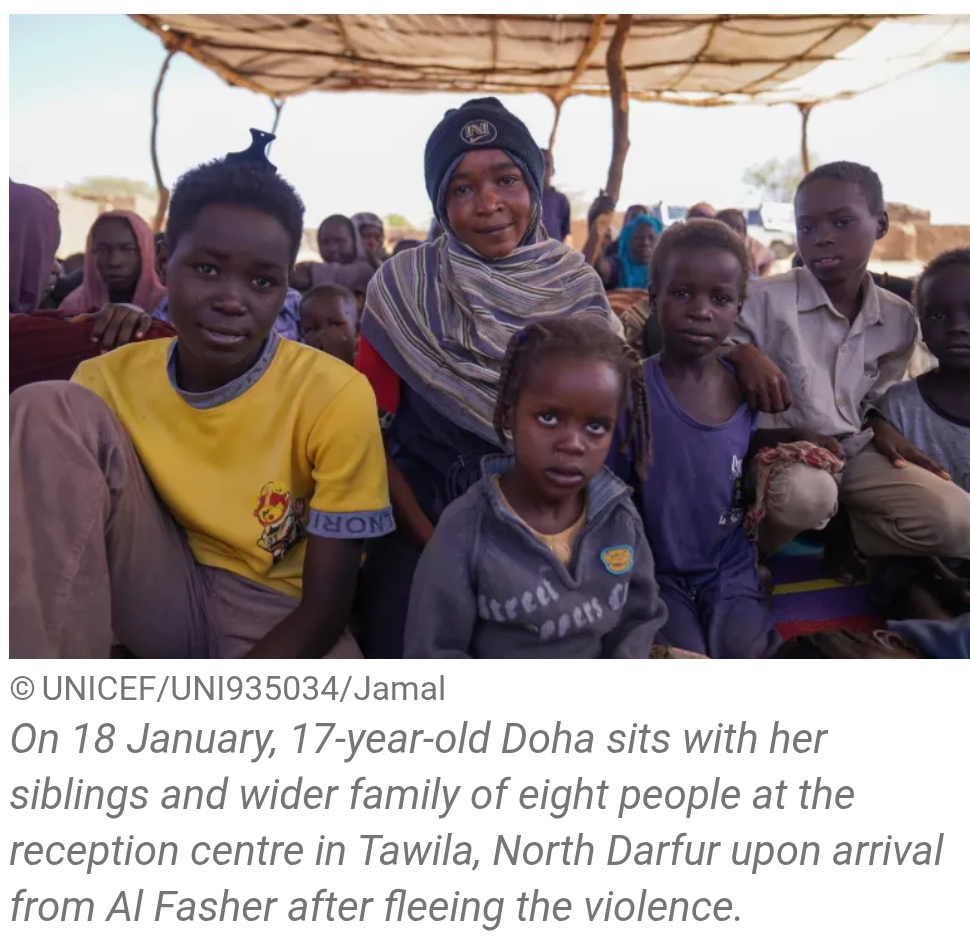
Among the many children Hinds met was Doha, a 17-year-old girl who had just arrived in Tawila with her siblings and extended family after fleeing Al Fasher. Before the war, Doha had been studying English and now dreams of returning to school and becoming a teacher.
“Her name refers to the soft light just after sunrise,” Hinds said. “She embodies that hope — determined, even after everything she has lost.”
At a nutrition centre, Hinds met the aunt of Fatima, a young girl being treated for malnutrition. Fatima’s mother had been killed in the conflict, leaving her aunt to care for her and protect her as best she could.
At a centre for women and girls, mothers spoke of having no food, no blankets, and no warm clothing for their children. “The children are freezing,” one mother told her. “We have nothing to cover them with.”
A crisis the world is not seeing
“These stories are only a fraction of what is happening across North Darfur,” Hinds said. Sudan is now the world’s largest humanitarian emergency, yet one of the least visible, she warned, as limited access, a complex conflict, and competing global crises push the suffering of millions of children out of the international spotlight.
“What I witnessed is a humanitarian catastrophe unfolding on a massive scale,” she said. “Sudan’s children urgently need international attention and decisive action. Without it, the horrors facing the country’s youngest and most vulnerable will only deepen.”