More Than 2.6 Million Afghan Girls Denied Secondary Education Since 2021: UNICEF.
New York:
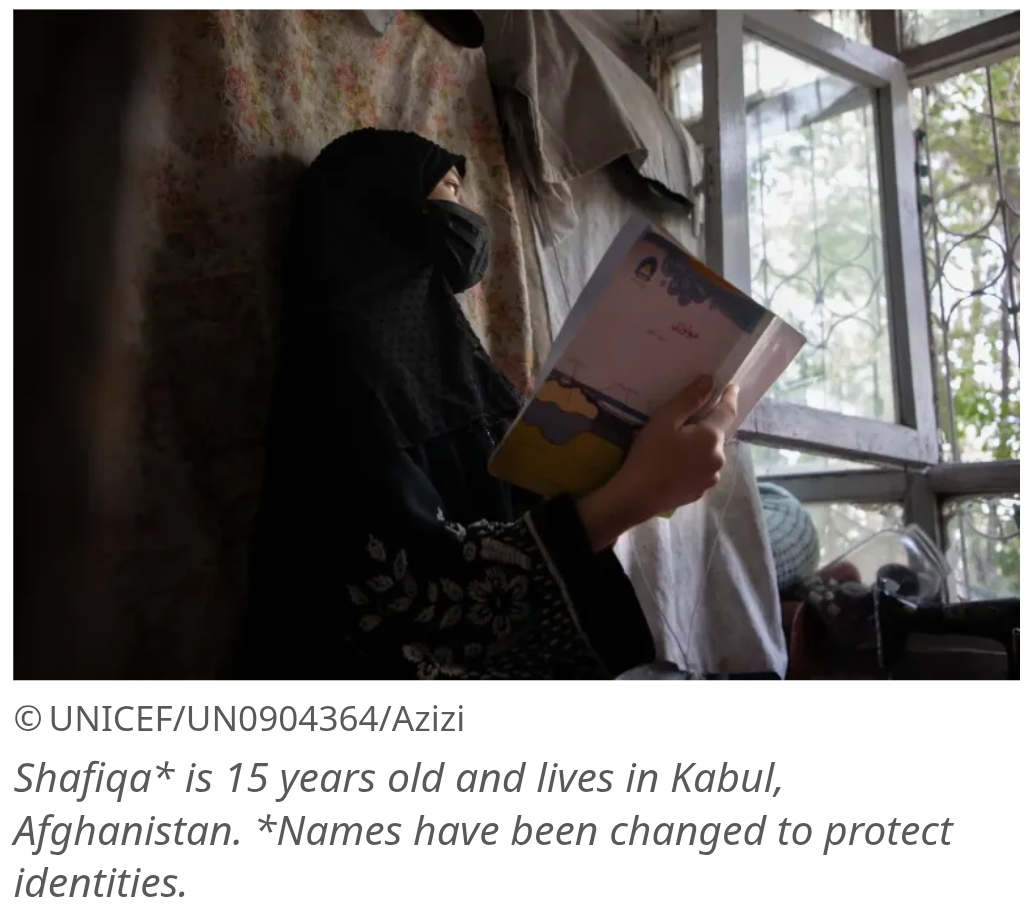
More than 2.6 million girls in Afghanistan have been denied access to secondary education since the de facto authorities took power in 2021, UNICEF said, warning that the continuing restrictions are creating serious consequences for girls, families and the country’s future.
Afghanistan remains the only country in the world where secondary and higher education is effectively closed to girls and women, according to UNICEF.
Girls have been barred from formal education beyond Grade 6 since September 2021, while women have been excluded from universities since December 2022.
UNICEF Executive Director Catherine Russell said that while five years may represent a relatively short period in a country’s history, it constitutes a defining stage in the life of a young girl.
She stressed that education provides more than academic knowledge, giving girls opportunities to develop their voices, reach their potential and gain protection from risks including child labour, early marriage, violence and abuse.
Rising protection risks for girls
UNICEF warned that girls who remain out of school face heightened protection risks, including child labour, abuse, early marriage and gender-based violence.
These risks are further aggravated by poverty and displacement, both of which remain widespread in Afghanistan.
More than 2.7 million people have returned to Afghanistan from Iran and Pakistan since 2023, with children and young people accounting for around 60 per cent of those returnees, according to UNICEF.
The organisation said the prolonged exclusion of girls from education is also affecting Afghanistan’s workforce and essential public services.
Shortage of female teachers and health workers
A UNICEF analysis published in April 2026, titled The Cost of Inaction on Girls’ Education and Women’s Labour Force Participation in Afghanistan, warned that Afghanistan could lose up to 20,000 women teachers and 5,400 female health workers by 2030 if current restrictions continue.
The number of female teachers in basic education has already declined by more than 9 per cent, falling from nearly 73,000 in 2022 to around 66,000 in 2024.
Female representation in Afghanistan’s civil service has also declined, from 21 per cent in 2023 to 17.7 per cent in 2025, according to the UNICEF analysis.
The decline in women’s participation in education, healthcare and public services could further limit the availability of female professionals in a country where women and girls face significant barriers to accessing essential services.
Restrictions carry major economic cost
UNICEF estimates that restrictions on girls’ education and women’s employment are costing Afghanistan approximately US$84 million every year in lost economic output.
The organisation warned that these economic losses accumulate for every year that restrictions remain in place, reducing the country’s long-term development potential.
The consequences also extend to future generations. UNICEF said that as the proportion of mothers without education increases, their children face higher risks of low birthweight, inadequate vaccination and stunting.
These challenges could place additional pressure on Afghanistan’s already strained healthcare system.
UNICEF continues education support
Despite the restrictions, UNICEF said it continues to support alternative and emergency learning opportunities for children across Afghanistan.
In 2025, more than 3.7 million children in public schools received emergency education support. A further 442,000 children participated in community-based learning programmes, with girls accounting for 66 per cent of participants.
UNICEF also reported that 232 schools were built or rehabilitated during the year.
The organisation said it remains prepared to support the safe reopening of schools and the return of girls to formal education.
Call for immediate reopening of schools and universities
UNICEF called on Afghanistan’s de facto authorities to immediately lift restrictions on education and allow all girls and women to return to schools and universities.
Russell also echoed the UN Secretary-General’s call for the suspension of girls’ education to be lifted.
UNICEF said it and its partners are ready to support the reopening of educational institutions and help ensure that girls can return safely.
The organisation warned that Afghanistan’s ability to build a stable and prosperous future is closely linked to whether girls and women are allowed to participate fully in education and society.
“A country cannot thrive when half of its young people are held back,” Russell said, stressing that Afghanistan’s future depends on ensuring that girls are given the opportunity to learn and fulfil their potential.