PM Modi Inaugurates 10th India Mobile Congress, Highlights Digital Transformation, Cybersecurity and Telecom Self-Reliance.
New Delhi:
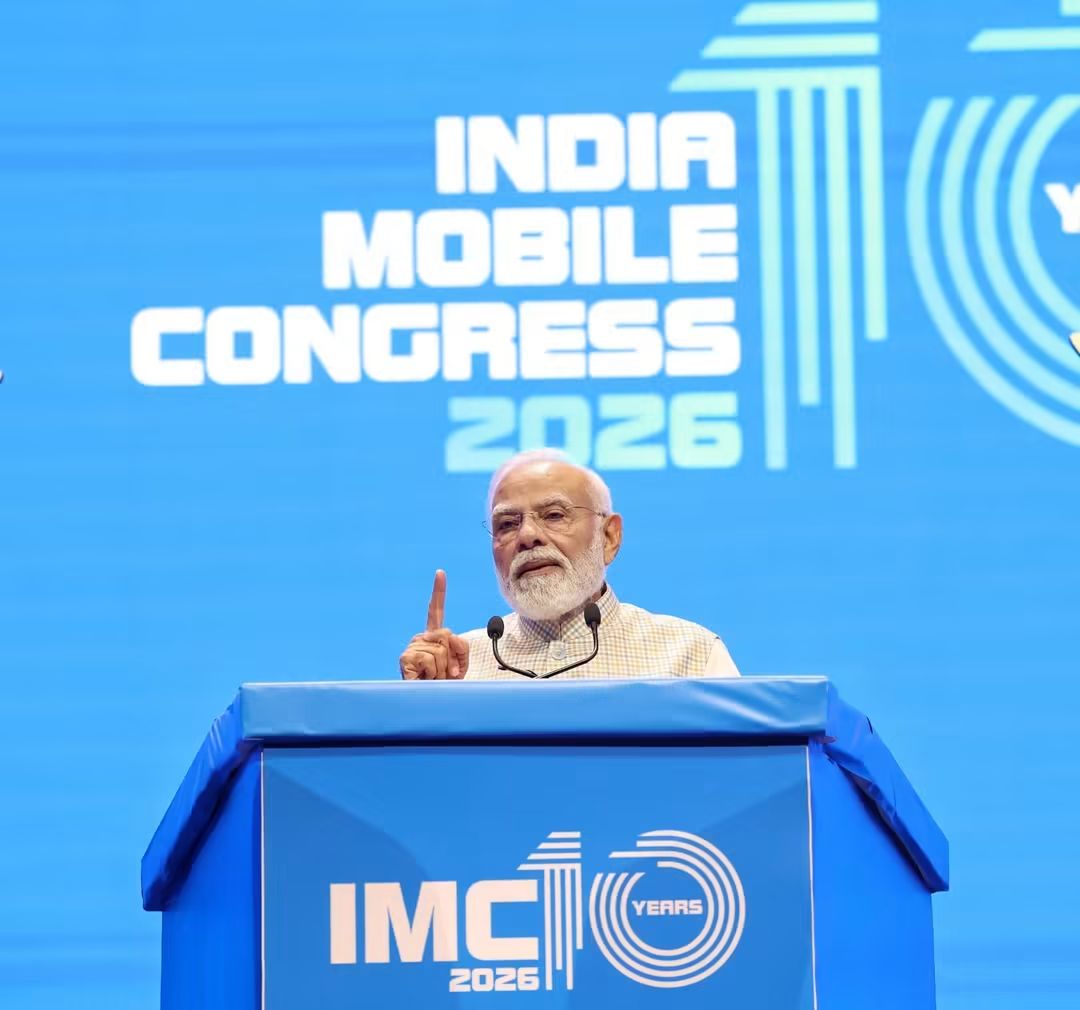
Prime Minister Narendra Modi inaugurated the 10th edition of the India Mobile Congress (IMC) at Yashobhoomi, New Delhi, on Thursday, outlining India’s transformation from a major technology consumer into an increasingly self-reliant creator and innovator in the telecom and digital technology sectors.
Addressing telecom operators, industry leaders, academics, startups and other stakeholders, Modi said India’s telecom sector was steadily moving towards greater self-reliance. He highlighted the country’s progress in mobile connectivity, digital governance, 5G deployment, semiconductor manufacturing, cybersecurity and the creator economy.
The Prime Minister also paid tribute to India’s armed forces on Air Force Day and expressed his gratitude to citizens and India’s friends across the world for their support during his 25 years of continuous service as a Head of Government.
Mobile phones at the heart of Digital India
Modi said that over the past 10-12 years, the mobile phone had evolved from being merely a means of communication into an important instrument of good governance and a central element of the Digital India vision.
He recalled that a decade ago, the digital divide was a major challenge, with modern technology increasingly becoming accessible mainly to those who could afford it. The Digital India campaign, he said, sought to change this reality by placing the mobile phone at the centre of a massive effort to democratise technology.
“Over the past 10-12 years, the mobile phone, along with being a medium of modern communication, has also emerged as a crucial tool for good governance, and this has been at the core of our Digital India vision,” Modi said.
He noted that hundreds of government services can now be accessed through mobile phones, while government assistance is increasingly transferred directly into beneficiaries’ bank accounts.
According to Modi, mobile connectivity has also significantly improved citizens’ ease of living by reducing travel, waiting time and costs. “Mobile phones are no longer just a medium to chat, rather, they have ensured less travel, less waiting, less cost, and more convenience. This is technology’s biggest Citizen dividend,” he said.
5G reaches every district
Highlighting India’s rapid expansion of 5G infrastructure, Modi recalled launching 5G from the India Mobile Congress platform in 2022 and said the technology had since expanded across the country.
He said 5G networks are now operational through more than 5.5 lakh base stations and have reached every district of India, contributing to a significant improvement in internet speeds.
The Prime Minister also underlined the growing international relevance of the India Mobile Congress, recalling that the 2024 edition hosted the International Telecommunication Union for discussions on global standards.
Technology expands education and financial inclusion
Modi highlighted the role of digital infrastructure during the COVID-19 pandemic, when mobile connectivity and online platforms helped keep government services, banking and education functioning despite restrictions on physical movement.
He cited the example of the national DIKSHA platform, saying that by July 2022 it had facilitated more than five billion learning sessions and 60 billion learning minutes during the peak of the pandemic.
He said the government’s next objective was to connect around 25 crore students with digital and online education platforms.
The Prime Minister also highlighted the impact of digital governance on financial inclusion. He said more than ₹50 lakh crore had been transferred directly to beneficiaries through digital platforms, helping prevent approximately ₹5 lakh crore from leakages.
He specifically referred to the PM-KISAN scheme, saying more than ₹4 lakh crore had been transferred directly to small and marginal farmers.
Mobile phone becomes gaming console and creation studio
Modi said the expansion of affordable connectivity and data had created entirely new sectors of the economy and transformed users into both consumers and creators.
He pointed to the growth of India’s gaming ecosystem, noting that more than 50 crore people are now engaged with gaming, particularly among young people in Tier-2 and Tier-3 cities.
According to the Prime Minister, mobile phones have evolved into gaming consoles as well as studios for content creation.
“India’s mobile phone today acts as both a gaming console and a creation studio,” he said.
He added that affordable data and widespread connectivity had helped video-sharing platforms and regional OTT services reach smaller towns and rural areas, contributing to the growth of India’s creator economy.
Cybersecurity and deepfakes a major concern
With digital technology becoming increasingly central to everyday life, Modi stressed the need to strengthen India’s telecom and digital security framework.
He said phone and network security must remain a priority and emphasised that citizens need confidence that callers, messages, digital payments and the handling of personal data are secure.
The Prime Minister also raised concerns over the growing threat posed by cyber fraud and deepfakes. He called for a global framework to address these challenges, involving governments, technology companies, telecom operators and financial institutions.
“We are all witnessing the major challenge that deepfakes have become. That is why it is crucial to work on a Global Framework to tackle this,” Modi said.
He urged the GSMA and the global telecom industry to work towards mechanisms that can identify and prevent fraudulent activities before they reach consumers.
India moves from consumer to creator
Emphasising India’s changing position in the global technology ecosystem, Modi said the country had moved from being primarily a consumer of technology to becoming a creator.
He said India’s next objective was to ensure that products and designs are developed domestically and that the underlying technologies and intellectual property are also owned by India.
The Prime Minister pointed to reforms in the telecom sector, including the Telecommunications Act and the GatiShakti portal, as part of the government’s efforts to modernise the regulatory and technological ecosystem.
He also highlighted progress under the India Semiconductor Mission, saying commercial semiconductor production had begun at five locations and that the next phase would focus on localising the wider semiconductor supply chain.
India seeks greater self-reliance in telecom
Modi said India’s telecom sector was entering a new phase of technological self-reliance, supported by domestic manufacturing, infrastructure expansion, regulatory reforms and investment in research and development.
“Over the past few years, India has traversed the journey from a Consumer to a Creator. Now, India is marching towards the goal, where the product and design will be made in India, and its technology and IP will also belong to India,” he said.
He stressed that India’s experience demonstrated that technological growth could be achieved at scale and urged the global industry to explore new models of cooperation and innovation.
IMC urged to become a global platform for innovation
Concluding his address, Modi called on the India Mobile Congress to evolve beyond being a showcase for technology and become a global platform for research, innovation, partnerships and solutions aimed at improving people’s lives.
He said the decisions and discussions taking place during the event would help shape the roadmap for the global mobile industry in the coming years.
The Prime Minister expressed confidence that industry leaders, researchers, startups and policymakers would work together to make India Mobile Congress a leading global meeting point for technology, industry and ideas.
The 10th edition of the India Mobile Congress thus focused on India’s rapidly expanding digital ecosystem, while reinforcing the country’s broader ambition of achieving technological self-reliance and building products, technologies and intellectual property in India.