
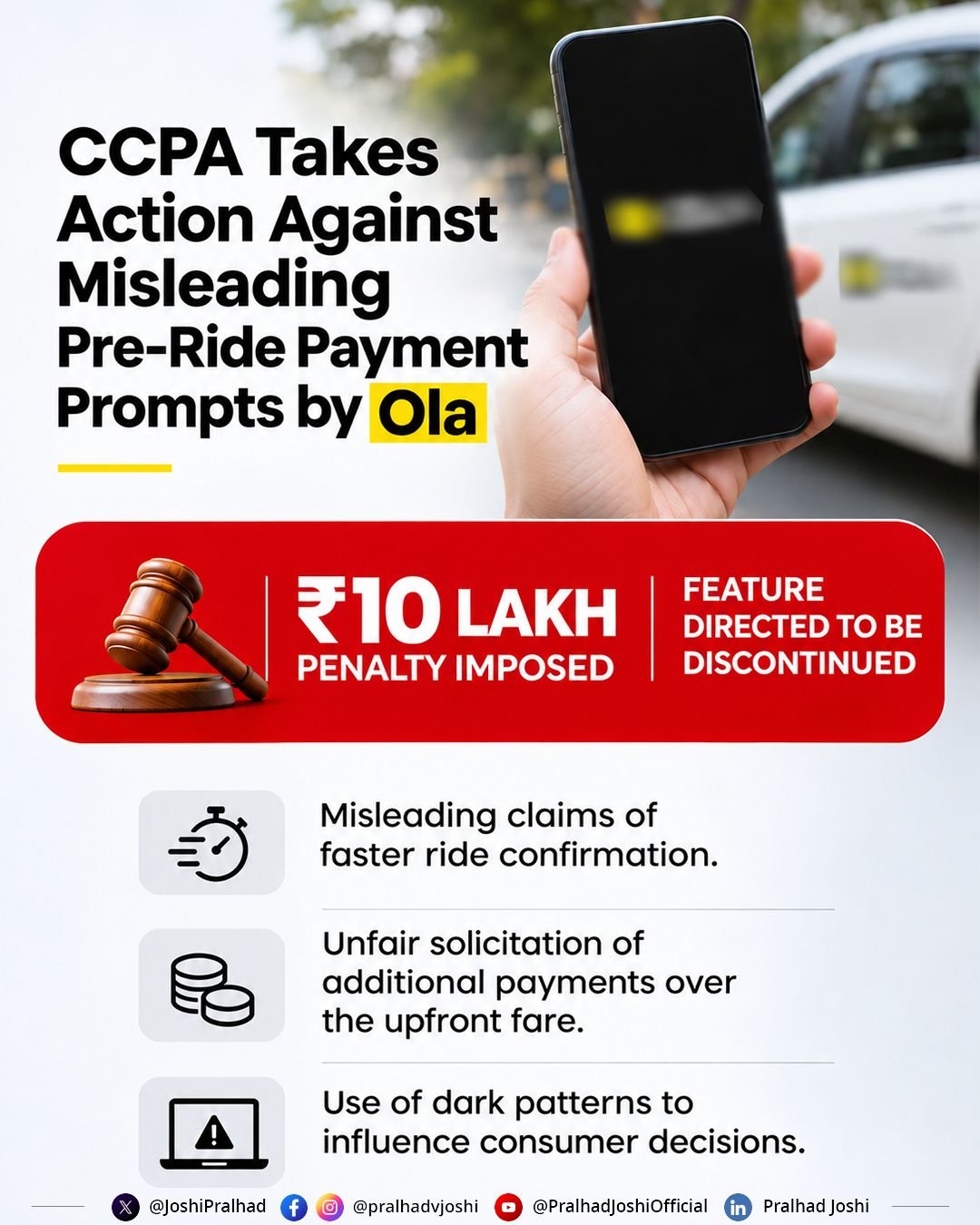
CCPA Imposes ₹10 Lakh Penalty on Ola Over Pre-Ride ‘Tip’ Feature, Orders Immediate Discontinuation.
Authority finds advance payment prompts misleading, classifies the practice as an unfair trade practice and dark pattern.
New Delhi:
The Central Consumer Protection Authority (CCPA) has imposed a penalty of ₹10 lakh on ANI Technologies Private Limited, which operates the ride-hailing platform Ola, for seeking additional payments from customers before their journeys were completed. The Authority has also directed the company to immediately discontinue its pre-ride ‘tip’ or ‘add-on’ feature, holding that the practice misled consumers, amounted to an unfair trade practice and involved the use of a dark pattern.
The order was issued by the CCPA following an examination of Ola’s app interface, which prompted customers to make additional payments while the platform was searching for a driver. The messages suggested that paying extra could improve their chances of securing a ride more quickly. Although Ola subsequently renamed the ‘tip’ feature as an ‘add-on’, the Authority found that the underlying practice remained unchanged.
The CCPA observed that messages displayed on the app, including “Adding a tip might help increase the chances of getting a ride faster” and “Tip now to boost the chances of getting a ride sooner”, created the impression that additional payment could speed up ride confirmation. These prompts appeared alongside pre-set payment amounts while customers were waiting for a driver.
According to the Authority, the use of words such as ‘might’ and ‘chance’ did not change the overall misleading impression conveyed by the interface.
Booking data did not support Ola’s claim
The CCPA examined Ola’s booking data for June 1–15, 2026, and found that ride requests carrying an add-on were accepted less frequently than those without an additional payment.
In Delhi, the acceptance rate was 38 per cent for requests with an add-on, compared with 62 per cent without one. In Bengaluru, the corresponding figures were 40 per cent and 68 per cent, while in Mumbai they stood at 39 per cent and 68 per cent, respectively.
The Authority also pointed out a contradiction in the company’s position. While Ola maintained that the additional payment did not influence driver allocation, its app interface suggested that paying extra could improve the chances of getting a ride sooner.
Consumers were not informed that the company’s own data showed lower acceptance rates for requests carrying an add-on. Nor were they provided with information about how the suggested payment amounts were determined. The CCPA held that withholding such material information amounted to concealment under Section 2(28)(iv) of the Consumer Protection Act, 2019.
Advance tipping termed an unfair trade practice.
The Authority observed that a tip is generally a voluntary payment made after a service has been delivered. Seeking such a payment before completion of a journey effectively converts a voluntary gratuity into a pre-service payment.
It further noted that customers had already booked rides at an upfront fare that accounted for factors such as peak pricing and the driver’s distance from the pickup point. Seeking another payment on account of the same supply constraints amounted to charging an additional premium.
The CCPA also raised concerns over the suggested payment amounts, which were generated on an undisclosed basis. These amounts had increased from ₹10–₹40 in May 2025 to as much as ₹140, while the app allowed payments of up to ₹499.
According to the Authority, customers could not independently assess whether an additional payment was necessary because information about driver availability was controlled by the platform. Making an extra payment appear necessary for timely acceptance of an already-booked ride also raised concerns about unfair contractual practices.
The Authority further found that the feature was inconsistent with Clause 14.15 of the Motor Vehicles Aggregators Guidelines, 2025, which provides for a tipping facility only after completion of a journey. Ola continued displaying the payment prompts even after the Ministry of Road Transport and Highways clarified on August 11, 2026, that such prompts could not be displayed before the ride was completed.
Interface design found to involve ‘Confirm Shaming’
Examining the feature under the Guidelines for Prevention and Regulation of Dark Patterns, 2023, the CCPA held that the app interface used a technique known as ‘Confirm Shaming’.
The Authority observed that the prompts appeared when customers were waiting for a driver to accept their booking. By suggesting that an additional payment could improve their chances of securing a ride, the interface created an impression that customers who chose not to pay might face delays or fail to get a ride.
The Authority also noted that pre-set payment amounts could influence customers to select higher figures, while messages such as “Generous Add On!” encouraged them to make additional payments. The interface did not provide an option to close the prompt.
The timing of these messages was also considered significant, as customers had already booked their rides and were waiting for confirmation, with limited information about driver availability or the actual impact of paying extra.
The CCPA highlighted that such requests were recorded for bookings originating from hospitals, railway stations, inter-state bus terminals and airports. It observed that patients, elderly people, travellers carrying luggage, and individuals travelling alone or at night could be particularly vulnerable to such prompts.
Ola directed to discontinue the practice
The CCPA has directed Ola to immediately stop displaying all prompts, messages, pre-set payment amounts and interface designs that seek payments over and above the upfront fare before completion of a journey. The direction covers payments described as tips, add-ons, additional fares or by any other name.
The company has also been directed to ensure strict compliance with the Consumer Protection Act, 2019, the Guidelines for Prevention and Regulation of Dark Patterns, 2023, and the Guidelines for Prevention of Misleading Advertisements and Endorsements for Misleading Advertisements, 2022. In addition, it has been ordered to pay a penalty of ₹10 lakh.
The CCPA has also initiated action against other cab aggregator platforms over similar practices. It has already imposed a penalty of ₹10 lakh on Rapido, operated by Roppen Transportation Services Pvt. Ltd. Proceedings against Uber and Namma Yatri are currently under investigation.
Consumers who encounter such practices or face difficulties in accessing services can register complaints through the National Consumer Helpline by calling 1915 or by emailing com-ccpa[at]gov[dot]in.
