

General Upendra Dwivedi Inaugurates ‘Agnishodh’ at IIT Madras, Marking a Major Leap Toward Self-Reliance in Defence Technology.
Chennai:
In a significant stride toward achieving technological self-reliance in defence, General Upendra Dwivedi, Chief of the Army Staff (COAS), today inaugurated the ‘Agnishodh’ Indian Army Research Cell (IARC) at the Indian Institute of Technology (IIT) Madras. The inauguration marks a key milestone in the Indian Army’s pursuit of advanced defence capabilities through academic collaboration, aligning with the nation’s vision of Atmanirbhar Bharat.
The newly established Agnishodh cell will serve as a high-impact research hub, fostering innovation in critical military technologies and facilitating seamless translation of academic research into operational deployment. This initiative is a vital component of the Army’s ongoing transformation agenda, specifically targeting the pillar of Modernisation and Technology Infusion—one of the Five Pillars of Transformation identified by the COAS.
A New Era of Military-Academic Synergy
During his two-day visit to Chennai, General Dwivedi addressed students, faculty, and military personnel at IIT Madras, delivering a compelling talk on “Operation Sindoor – A New Chapter in India’s Fight Against Terrorism.” He described Operation Sindoor as a game-changing counter-terrorism campaign that redefined India’s security posture through swift, intelligence-driven, and strategically calibrated military action.
“The 88-hour tri-services operation was unprecedented in its scale, range, and strategic tempo. It not only compelled a ceasefire from adversaries but also demonstrated India’s evolved counter-terrorism doctrine,” said General Dwivedi. He underlined the growing relevance of fifth-generation warfare characterized by non-contact engagements, information dominance, and hybrid threats.
‘Swadeshikaran Se Sashaktikaran’: Building Indigenous Defence Strength
Reinforcing the Army’s commitment to Swadeshikaran Se Sashaktikaran (Empowerment Through Indigenisation), General Dwivedi highlighted ongoing national collaborations under key technology initiatives like INDIAai, Chip-to-Startup, and Project QuILA. He lauded strategic partnerships with MCTE Mhow and academic institutions such as IIT Delhi, IIT Kanpur, and IISc Bengaluru, which are already making strides in defence innovation.
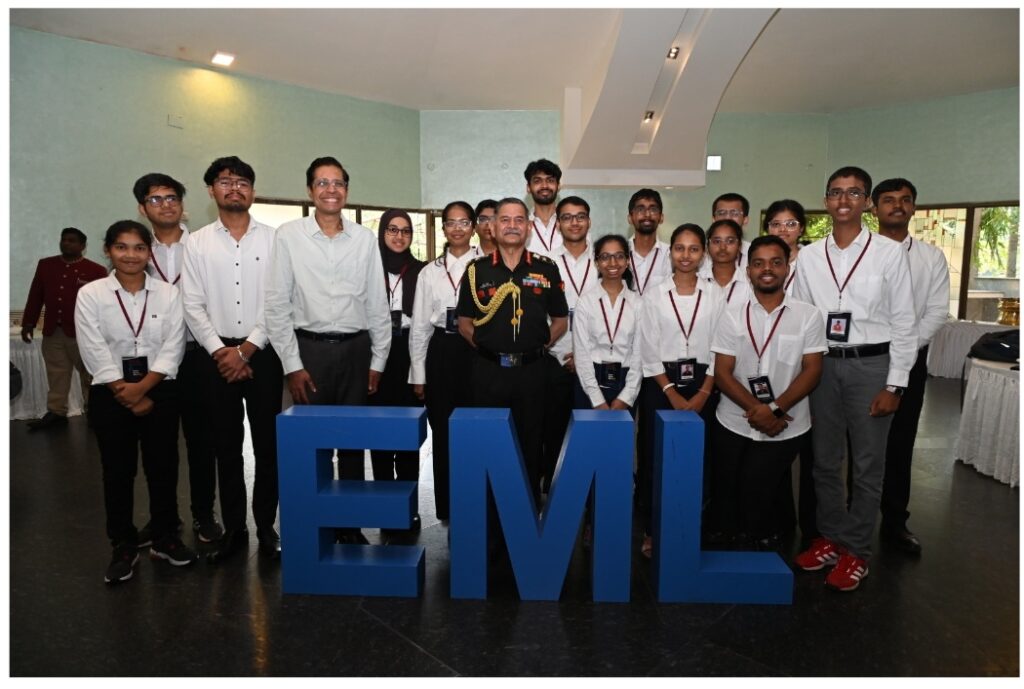
Commending IIT Madras for its leadership in defence-focused research, the COAS spotlighted cutting-edge initiatives like Project SAMBHAV and its collaboration with Army Base Workshops in the field of additive manufacturing. “Agnishodh will be a catalyst that transforms academic brilliance into battlefield capabilities,” he stated, envisioning the new research cell as a cornerstone of India’s journey towards Viksit Bharat 2047.
Expanding Innovation Horizons
Agnishodh will also engage with the IIT Madras Research Park and affiliated centres such as the Advanced Manufacturing Technology Development Centre (AMTDC) and Pravartak Technologies Foundation. These partnerships aim to accelerate the conversion of lab-scale research into deployable field solutions.
In addition, the initiative will focus on upskilling Indian Army personnel in advanced domains like additive manufacturing, cybersecurity, quantum computing, unmanned aerial systems, and wireless communication—thereby building a technologically empowered human resource pool within the Armed Forces.
Engagements Beyond Agnishodh
As part of his Chennai visit, General Dwivedi also toured the Officers Training Academy (OTA), where he reviewed infrastructure, training systems, and future-readiness programs designed to shape the next generation of military leaders. Addressing officer cadets, he underscored the evolving nature of warfare, citing grey zone conflicts and the growing interplay of conventional and modern technologies. “The future battlefield will demand that boots share space with bots,” he remarked.
He further reflected on Operation Sindoor’s success, asserting it as a testament to India’s ability to execute precise and punitive military action in a coordinated tri-services framework.
In a special ceremony, the COAS interacted with Armed Forces veterans and honoured four distinguished ex-servicemen with the Veteran Achievers Awards, recognizing their lasting contributions to national service and community development.
With the launch of Agnishodh, the Indian Army and IIT Madras have established a powerful blueprint for defence innovation rooted in academic excellence, indigenous capabilities, and strategic foresight. As India advances toward its 2047 vision of national development, such collaborations will be instrumental in safeguarding sovereignty through science and self-reliance.