India–UK Deepen Strategic Partnership Across Trade, Defence, Innovation & Education During PM Starmer’s First Official Visit.
New Delhi:
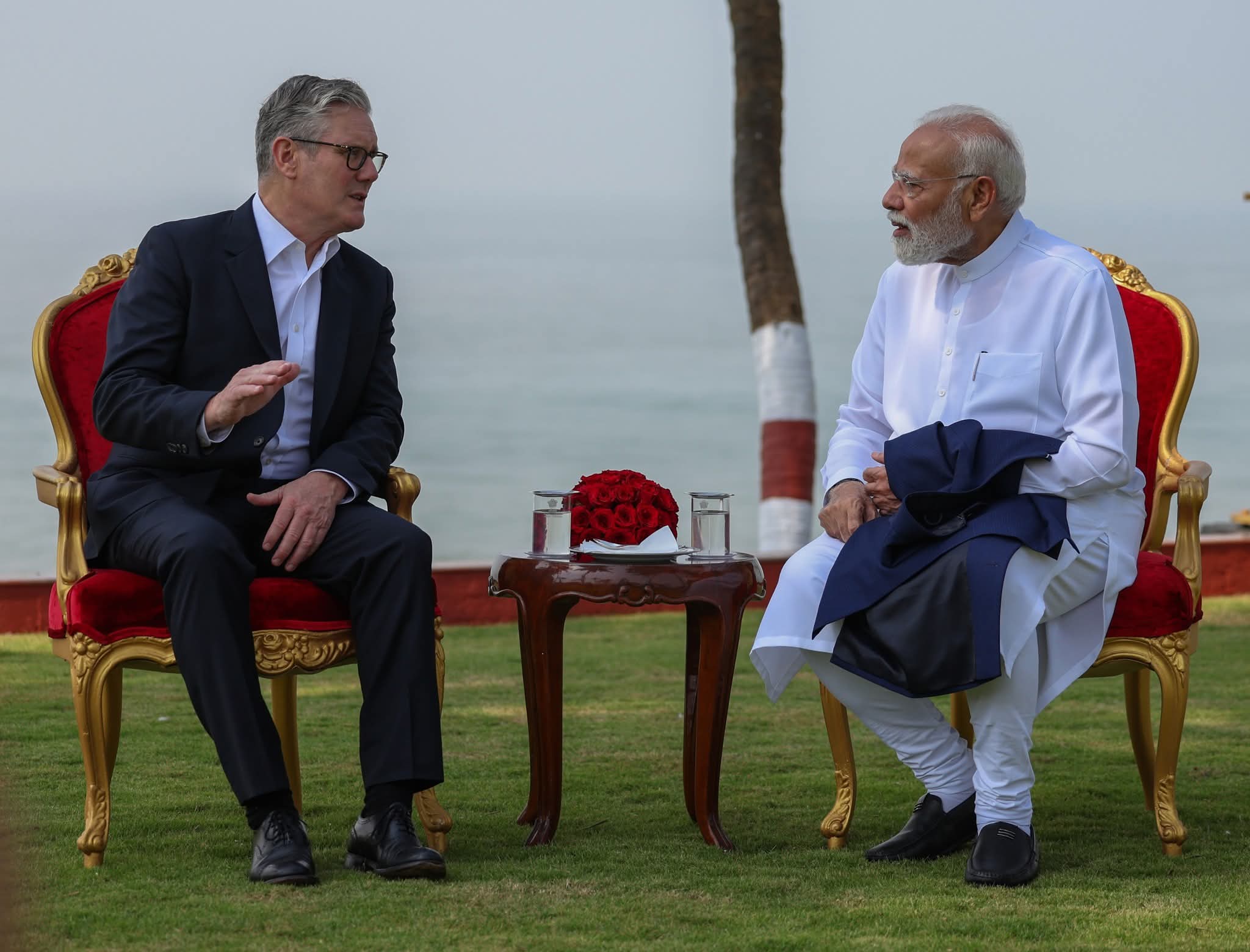
In a significant boost to the India–UK Comprehensive Strategic Partnership, British Prime Minister Keir Starmer concluded his maiden official visit to India from October 8–9, 2025, at the invitation of Indian Prime Minister Narendra Modi. The visit underscored deepening collaboration between the two democracies across critical sectors including trade, technology, defence, climate action, education, and people-to-people ties.
The visit, which follows PM Modi’s July 2025 visit to the UK, included the participation of senior UK ministers and a high-powered delegation of 125 CEOs, entrepreneurs, university leaders, and cultural figures. The leaders met in Mumbai, delivering keynote addresses at the Global Fintech Fest, and holding both restricted and delegation-level talks.
Economic Growth & Trade Ties: Accelerating CETA
The two leaders welcomed the upcoming ratification of the India–UK Comprehensive Economic and Trade Agreement (CETA) and the resetting of the Joint Economic and Trade Committee (JETCO). These developments aim to fast-track trade, investment, and economic cooperation.
The robust UK business delegation signalled strong bilateral interest across priority sectors including clean energy, infrastructure, defence manufacturing, advanced technologies, food and consumer goods, and professional services. The UK–India Infrastructure Financing Bridge (UKIIFB) was highlighted as a model initiative to promote sustainable investment.
Technology, AI, and Critical Minerals: A New Frontier
Building on the Technology Security Initiative (TSI), both leaders celebrated several landmark achievements:
- India–UK Connectivity and Innovation Centre: A £24 million AI and 6G telecom-focused hub.
- India–UK Joint Centre for AI: To promote responsible AI applications in health, climate, fintech, and biology.
- Critical Minerals Collaboration Guild: A key step towards securing supply chains in rare earths and launching Phase 2 of the Critical Minerals Supply Chain Observatory, with a new satellite campus at IIT-ISM Dhanbad.
Bilateral biotechnology collaborations were also announced, with new partnerships in biomanufacturing, 3D bioprinting, and genomics, including joint efforts by institutions like CPI UK, BRIC, IISc, and Oxford Nanopore.
Defence & Security: Strengthening Maritime and Air Power
PMs Modi and Starmer agreed to expand military engagement through joint exercises, capacity building, and defence technology co-development. India welcomed the UK’s Carrier Strike Group and Exercise KONKAN with the Indian Navy as a demonstration of growing maritime ties in the Indo-Pacific.
Key outcomes included:
- Progress on integrating Indian Air Force instructors into UK RAF training.
- Intent to sign an Inter-Governmental Agreement (IGA) on maritime electric propulsion systems.
- Government-to-government agreement for the initial supply of Lightweight Multirole Missile (LMM) systems to support India’s air defence.
Both sides strongly condemned terrorism and extremism, committing to a zero-tolerance approach. They condemned the April 2025 terrorist attack in Pahalgam, Jammu and Kashmir, and agreed to intensify cooperation on counter-terrorism at bilateral and multilateral levels including the UN and FATF.
Climate, Energy and Innovation: Green Growth Agenda
The leaders announced a new joint investment in a Climate Tech Start-up Fund and welcomed the India–UK Climate Finance Initiative to unlock green investments.
They committed to exploring collaboration via the Global Clean Power Alliance (GCPA) and welcomed the formation of an Offshore Wind Taskforce to support renewable energy goals and net-zero ambitions.
Education, Culture & People: Building the Living Bridge
Education was a highlight of the visit, with the announcement that nine UK universities are establishing campuses in India. The University of Southampton has already welcomed its first cohort in Gurugram, while other institutions, including University of Liverpool, University of York, University of Aberdeen, and University of Bristol, received Letters of Intent to open branches.
Two universities — Queen’s University Belfast and Coventry University — are set to open campuses in GIFT City, with Lancaster University and University of Surrey also receiving approvals.
The leaders reaffirmed commitment to implementing the Migration and Mobility Partnership (MMP) and recognised the contribution of the Indian diaspora in the UK as a “living bridge” that strengthens societal, economic and cultural bonds.
Global Outlook: Unity on Peace and Multilateralism
Reaffirming their commitment to reformed multilateralism, the UK reiterated support for India’s permanent membership in a reformed UN Security Council. Both sides agreed to work together in the Commonwealth, particularly on climate change and youth engagement.
On Ukraine, the leaders supported diplomatic efforts for a peaceful resolution under the UN Charter and international law. On the Middle East crisis, they called for restraint, humanitarian access, and endorsed the US peace plan for Gaza, reaffirming support for a Two-State solution.
Looking Ahead: A Shared Vision
Prime Minister Starmer thanked Prime Minister Modi for the warm hospitality and reaffirmed the UK’s commitment to a partnership rooted in shared democratic values and mutual respect. The visit marked a pivotal moment in the evolving India–UK Comprehensive Strategic Partnership, aligning their cooperation across a wide spectrum — from economic resilience and security to education and innovation.