India and Russia Reaffirm ‘Time-Tested Partnership’ at 23rd Annual Summit.
Leaders Pledge Deeper Strategic, Economic, Defence and Energy Cooperation.
New Delhi:
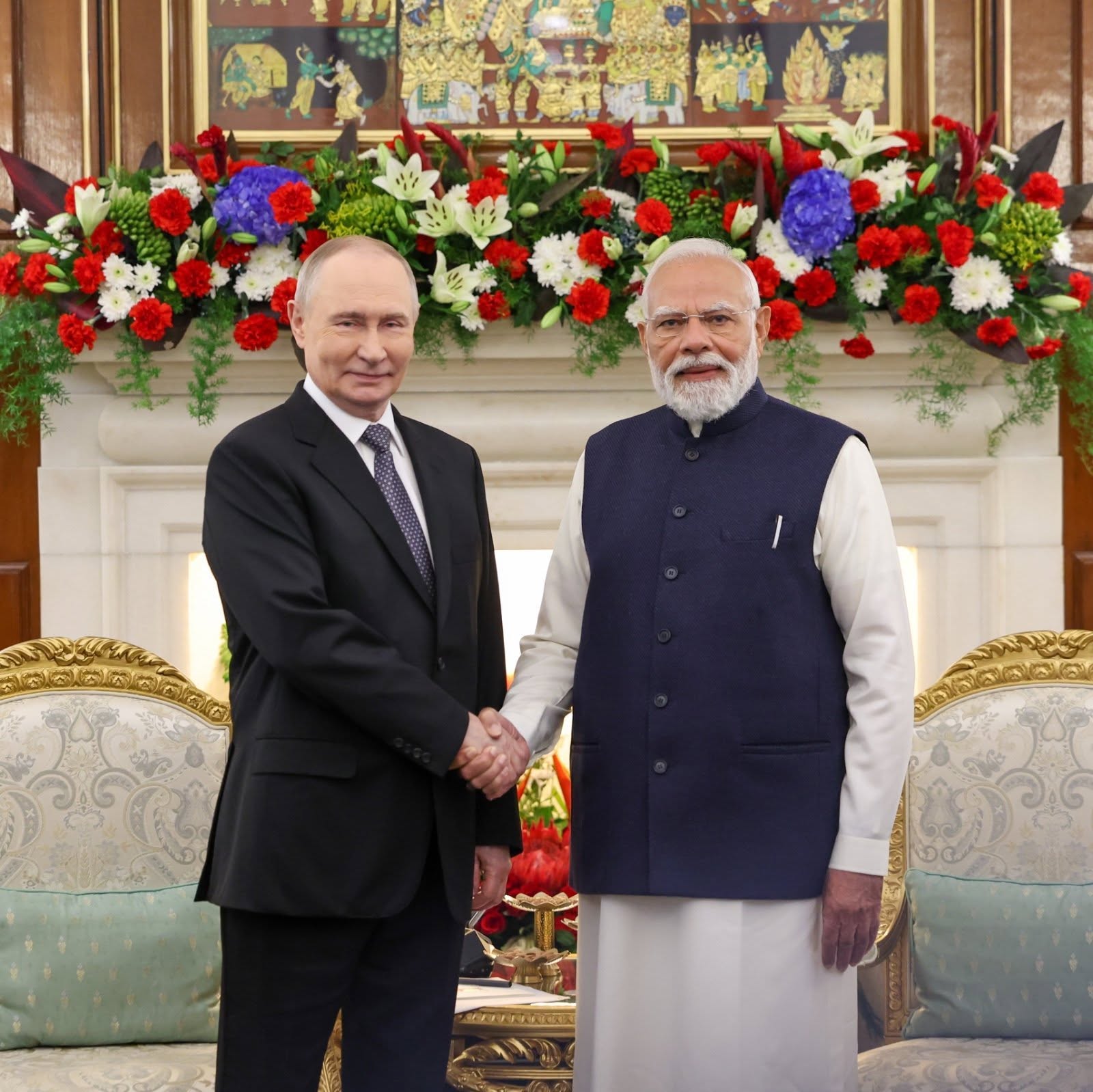
India and Russia reaffirmed their “Special and Privileged Strategic Partnership” during the 23rd India–Russia Annual Summit held in New Delhi on December 4–5, 2025. Russian President Vladimir Putin arrived in India on a state visit at the invitation of Prime Minister Narendra Modi, marking 25 years since the establishment of the Strategic Partnership in 2000.
In a comprehensive joint statement, both leaders underlined the “time-tested, resilient and trust-based” nature of bilateral ties, emphasising shared values, respect for core national interests, and a mutual commitment to global peace and stability.
Strengthening a 25-Year Strategic Partnership
PM Modi and President Putin reiterated the unique depth of India–Russia relations, calling the partnership an anchor of stability in a world marked by geopolitical uncertainty. They highlighted consistent high-level exchanges across political, economic, defence, and cultural domains, noting that the relationship has withstood global challenges and continues to evolve towards a balanced and sustainable future.
The opening of two new Indian Consulates General in Yekaterinburg and Kazan was welcomed as a major step toward stronger regional and economic connectivity.
Trade and Economic Cooperation: Push Toward USD 100 Billion by 2030
The leaders reaffirmed their ambition to expand bilateral trade and endorsed Programme 2030, a roadmap for deepening strategic economic ties.
Key initiatives include:
- Progress on a proposed Free Trade Agreement between India and the Eurasian Economic Union.
- Strengthening payment mechanisms, including national currencies and digital currency interoperability.
- Removing logistics bottlenecks and enhancing trade in fertilizers, energy resources, precious minerals and critical raw materials.
- Promoting joint ventures in sectors such as high-technology manufacturing, mining and pharmaceuticals.
Both sides reiterated their commitment to achieving the revised trade target of USD 100 billion by 2030.
Energy: A Cornerstone of the Partnership
Energy cooperation featured prominently, with both countries expanding collaboration in:
- Oil, petrochemicals, oilfield technologies
- LNG and LPG infrastructure
- Underground coal gasification
- Nuclear energy, including progress on the Kudankulam Nuclear Power Plant (KKNPP)
India also confirmed its intention to move forward on allocating a second site for another Russian-designed nuclear project.
Connectivity and the Far East
The two sides agreed to deepen logistical cooperation, focusing on key corridors:
- International North–South Transport Corridor (INSTC)
- Chennai–Vladivostok Maritime Corridor
- Northern Sea Route
Russia welcomed India’s growing engagement in the Arctic, including participation as an Observer in the Arctic Council.
Defence: Focus on Co-Production and Technology Transfer
Reaffirming defence as a major pillar of the relationship, both sides committed to:
- Co-development and co-production of advanced defence systems
- Joint manufacturing of spare parts and components for Russian-origin equipment under Make in India
- Expanding joint military exercises and high-level defence exchanges
The leaders welcomed outcomes of the 22nd India–Russia Intergovernmental Commission on Military and Military-Technical Cooperation held in New Delhi.
Science, Technology, Space and Education
India and Russia pledged to boost joint research and technological innovation, especially in:
- Critical minerals and rare earths
- Emerging technologies and cybersecurity
- Space cooperation, including human spaceflight and satellite navigation
- Rocket engine development and joint manufacturing
Both sides also committed to expanding academic mobility, collaborative research projects, and start-up partnerships.
Culture, Tourism and People-to-People Exchanges
The two countries agreed to strengthen cultural exchanges, support joint film productions, and further liberalise visa regimes to encourage tourism. Both sides acknowledged the rising number of Indian and Russian students and pledged to enhance educational cooperation.
Multilateral Cooperation: UN, BRICS, SCO, G20
India and Russia reaffirmed their shared approach to global governance, highlighting cooperation on:
- UN reforms, with Russia reiterating strong support for India’s bid for a permanent UNSC seat
- Strengthening the G20 as a platform for global economic cooperation
- Deepening BRICS collaboration under India’s 2026 Chairship
- Enhancing SCO mechanisms, especially counter-terrorism and narcotics control
Both sides called for upholding international law, supporting multilateralism, and addressing global challenges including climate change, sustainable development, and supply chain resilience.
Counter-Terrorism: Zero-Tolerance Stance Reaffirmed
India and Russia issued a strong condemnation of terrorism in all forms, referencing attacks in Pahalgam (April 2025) and Moscow’s Crocus City Hall (March 2024). Both countries pledged joint efforts to counter financing networks, extremist ideologies, and cross-border terrorism, calling for early adoption of the Comprehensive Convention on International Terrorism.
Regional Issues: Afghanistan, Middle East and Climate Action
The statement highlighted:
- Continued coordination on Afghanistan, urging humanitarian support and strong counter-terrorism measures
- Concern over the situation in Gaza, calling for civilian protection and diplomatic solutions
- Enhanced cooperation under the Paris Agreement, with ongoing bilateral climate dialogues and commitments under BRICS and G20 frameworks
Looking Ahead
The summit concluded with President Putin thanking PM Modi for the warm hospitality and inviting him to Russia in 2026 for the 24th Annual Summit.
Both leaders reaffirmed that India and Russia—“two major powers with a shared responsibility”—will continue to work together for global peace, a fair multipolar world, and deeper bilateral cooperation across all sectors.