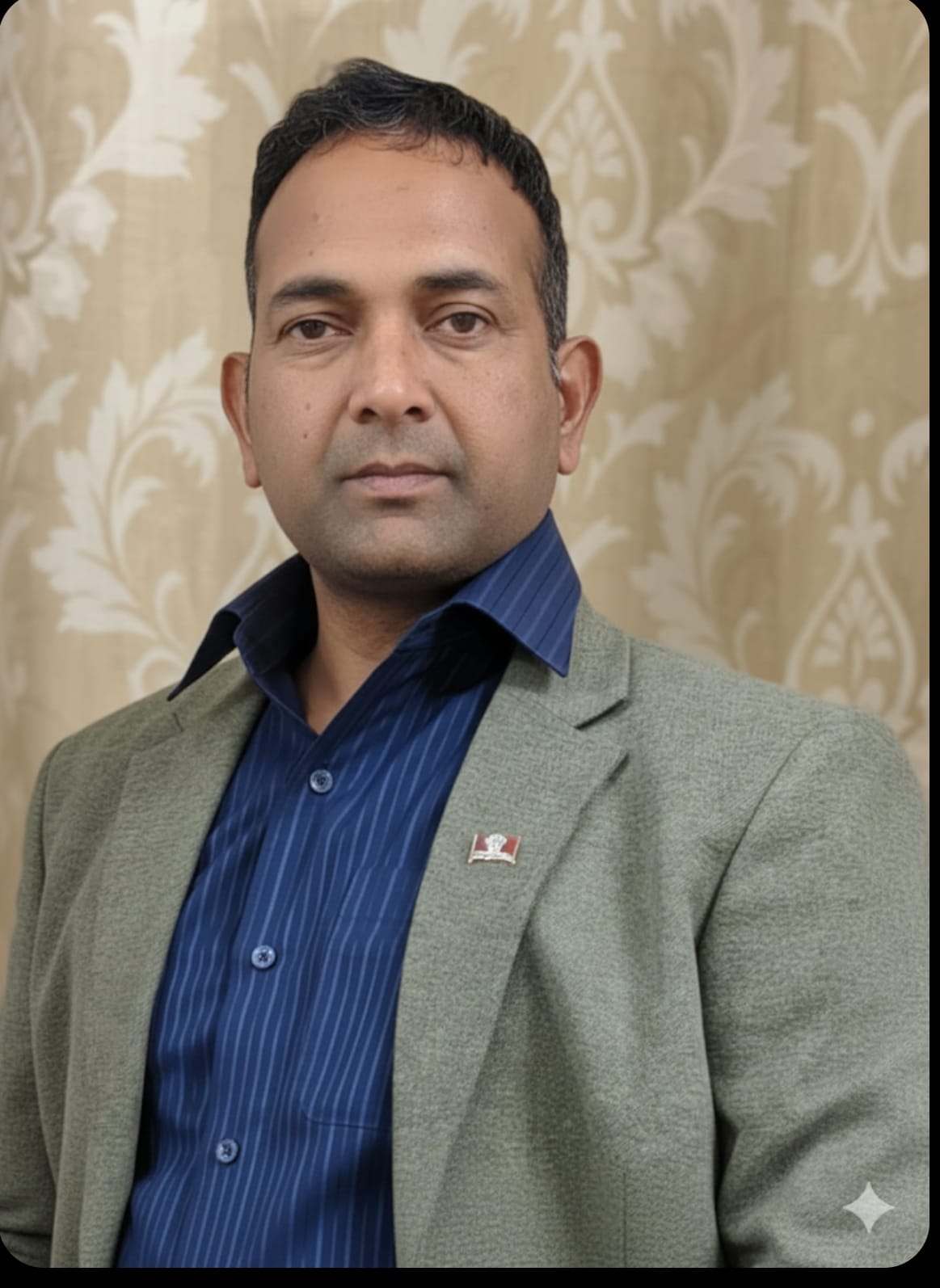
Flying Officer Dr. Chaman Lal Kranti Singh Delivers Insightful Talk on “Nalanda to Tibet: Journey of Buddhist Knowledge” on Voice of Kinnaur.
Shimla:
Flying Officer Dr. Chaman Lal Kranti Singh, Head of the Department of Journalism and Mass Communication, Vallabh Government College, Mandi, shared his scholarly insights on the theme “Nalanda to Tibet: Journey of Buddhist Knowledge” in a special programme broadcast on Radio Station Pooh (Voice of Kinnaur) recently. The community radio station in Kinnaur has been established under Operation Sadbhavana by the Indian Army’s Surya Command.
During the programme, Flying Officer Dr. Chaman presented his profound, research-based, and thought-provoking views on India–Tibet Buddhist relations, the Mahayana tradition, and the rich Himalayan Buddhist heritage in a highly engaging and impressive manner.
Highlighting the historical, philosophical, and contemporary relevance of Buddhist philosophy, Dr. Chaman stated that Tathagata Gautama Buddha remains the eternal guide of truth, non-violence, compassion, and ethical conduct. He remarked, “Where Buddha exists, war cannot exist; and where war exists, Buddha cannot.” According to him, the teachings of the Buddha are rational, intellectually sound, and wholly dedicated to the welfare of humanity. Describing the Buddha as the “Revolutionary Lion of Humanity,” Dr. Chaman observed that his voluntary renunciation and lifelong commitment to world peace and human welfare have placed him among the greatest revolutionary thinkers in human history. It was the intense quest to discover the root causes of human suffering that transformed Prince Siddhartha of the Shakya clan into Tathagata Buddha.
Dr. Chaman further stated that Bharat Ratna Dr. B. R. Ambedkar described Tathagata Buddha as the world’s greatest rationalist and social reformer. In his timeless work “The Buddha and His Dhamma,” Dr. Ambedkar characterized the Buddhist Dhamma as a philosophy of liberty, equality, and fraternity, and as the moral foundation of democracy. He emphasized that Buddhist philosophy challenges casteism and blind superstition.
Referring to Nalanda, Takshashila, Vikramashila, and Vallabhi as the educational arteries of Asia, Dr. Chaman noted that these were not merely universities but great centres of humanistic and scientific knowledge traditions. This eternal knowledge heritage of India, he said, has earned it recognition as a “Vishwaguru” and continues to inspire humanity even today.
Elaborating on the historical background of India–Tibet Buddhist relations, Dr. Chaman explained that these ties began in the early centuries of the Common Era with the trans-Himalayan journeys of Indian monks. In the seventh and eighth centuries, eminent Indian acharyas such as Shantarakshita, Kamalashila, Rinpoche Padmasambhava, and Atisha laid a strong foundation of Buddhism in Tibet, thereby deepening cultural and spiritual dialogue. He clarified that these relations were not limited to religion alone, but represented a broad exchange of language, philosophy, education, and culture.
Describing Nalanda University as the intellectual backbone of the India–Tibet Buddhist tradition, Dr. Chaman stated that many renowned Tibetan scholars were educated in the Nalanda tradition. The rich tradition of debate in Tibetan education, the Vinaya discipline, and the philosophical framework of Mahayana and Vajrayana are invaluable contributions of Nalanda. The extensive translation of Buddhist texts into the Tibetan language, compiled as the Kangyur and Tengyur, stands as a continuation of this great scholarly heritage.
Highlighting the global contribution of Buddhism from India, Dr. Chaman observed that Buddhism has gifted humanity the invaluable ideals of non-violence, compassion, and inner transformation. The Buddha’s message that peace does not lie in external circumstances but in the state of the mind has today become a cornerstone of global ethics, psychology, and social values. He further added that Indian acharyas in Tibet not only propagated sacred texts but also established disciplined monastic life, systematic spiritual practices, and a strong tradition of rational discourse.
Emphasizing the significance of Rinpoche Padmasambhava, Dr. Chaman said that he is revered in Tibet as the “Second Buddha.” His contribution to the establishment of the Vajrayana tradition, the spiritual transformation of local beliefs, and the consolidation of Tibetan cultural identity is unparalleled.
Dr. Chaman also noted that in regions of Himachal Pradesh such as Mandi, Rewalsar, Kinnaur, Lahaul–Spiti, and Chamba, folk legends, devotional songs, dances, and murals associated with Padmasambhava continue to thrive as living traditions. He recalled that Princess Mandarava, a disciple of Padmasambhava, made the supreme sacrifice for women’s education. Her temple in Mandi district is still known as the Kua Rani (Khuarani) Temple. According to local belief, due to a misunderstanding, attempts were made to execute Princess Mandarava and Guru Padmasambhava, and Princess Mandarava was thrown into a well in Mandi town. The temple stands today at that very site.
Highlighting the importance of Rewalsar (Tso-Padma), Dr. Chaman explained that it is believed to be the place where an attempt was made to burn Padmasambhava alive, and that Rewalsar Lake originated at the same site. According to popular belief, Acharya Padmasambhava and Princess Mandarava continue to live on as ideas and consciousness. The towering statue of Guru Padmasambhava at Rewalsar remains a major attraction for devotees and tourists from India and abroad. He added that sacred sites such as Rewalsar and Trilokinath convey a profound message of peace and compassion to the world—Rewalsar symbolizing spiritual confluence, while Trilokinath represents a rare place where followers of different faiths worship together.
Reflecting on the relevance of the Buddha’s compassion in modern life, Dr. Chaman stated that in today’s stressful and violent social environment, compassion acts as an effective psychological remedy. Metta (loving-kindness) meditation, he noted, is now being widely adopted across the world for mental health, emotional balance, and social harmony.
The programme was successfully conducted by Neeraj Solanki, Programme Presenter at the community radio station Voice of Kinnaur, established under Operation Sadbhavana by the Indian Army’s Surya Command.