Regional Focus, Farmer-Centric Vision: North Zone Agriculture Conference Outlines Bold Roadmap for 2026.
LUCKNOW:
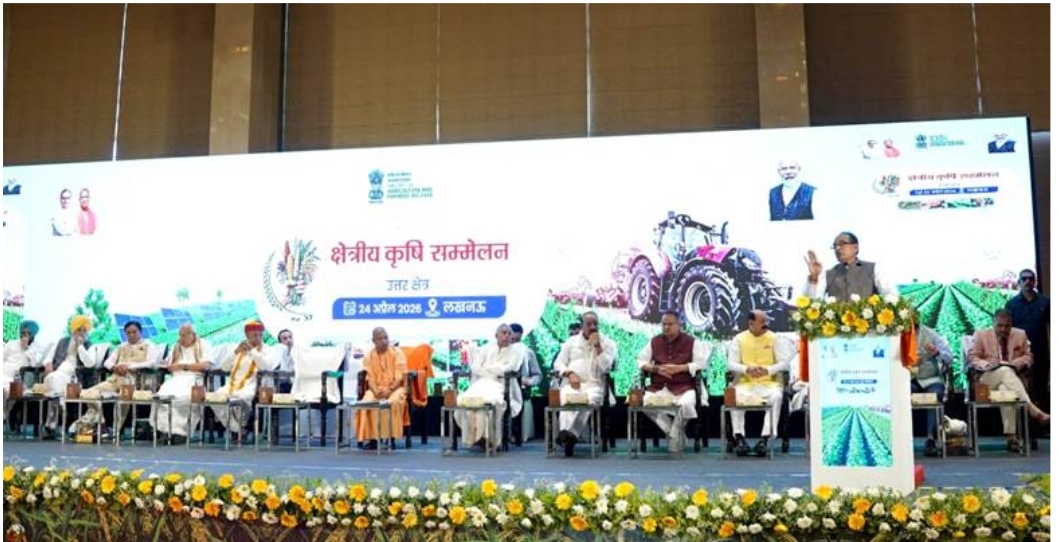
In a significant move to decentralize agricultural planning and bring laboratory research directly to the soil, the Union Ministry of Agriculture and Farmers Welfare hosted the North Zone Agriculture Conference in Lucknow on Friday.
The high-profile summit, chaired by Union Agriculture Minister Shivraj Singh Chouhan and Uttar Pradesh Chief Minister Yogi Adityanath, signaled a departure from “one-size-fits-all” national strategies. Instead, the conference focused on region-specific roadmaps tailored to the diverse climates of northern India, ranging from the grain belts of Punjab to the horticultural landscapes of Jammu & Kashmir.
A Shift to Zonal Strategy
Addressing a gathering of ministers from six states and three Union Territories, Union Minister Shivraj Singh Chouhan explained that national-level meetings often struggle to address the hyper-local challenges of a country as vast as India.
“Introduction of zonal conferences allows for deeper discussions based on soil type, climate, and regional cropping systems,” Chouhan stated.
The Minister outlined three pillars for the nation’s agricultural future:
1. Food Security
2. Increased Farmer Income
3. Nutritional Security
Crackdown on Counterfeit Inputs and Over-Fertilization
In a stern message to unscrupulous trade practices, the Union Minister issued a “strong warning” against counterfeit fertilizers and seeds. He called for a total ban on substandard inputs and urged state governments to launch special campaigns to protect farmers from fraud.
Furthermore, expressing concern over the rising chemical footprint, Chouhan questioned whether the current high consumption of fertilizers is based on scientific requirements or merely traditional habit.
He advocated for:
Balanced fertilizer use to protect soil health.
A transition toward Natural and Organic Farming. Widespread adoption of the Kisan ID and Kisan Credit Cards (KCC) to streamline institutional credit for small-scale farmers.
From Lab to Land: The Uttar Pradesh Model.
Chief Minister Yogi Adityanath emphasized that the true measure of success for any agricultural policy is its impact on the field. He lauded the Viksit Krishi Sankalp Abhiyan (Advanced Agricultural Resolution Campaign), which facilitates direct interaction between scientists and farmers.
“Real transformation occurs when scientists conduct field demonstrations and provide continuous guidance,” Adityanath noted. He highlighted that in Uttar Pradesh, the strengthening of Krishi Vigyan Kendras (KVKs) has already encouraged many farmers to shift from single-crop to triple-cropping systems, significantly boosting rural incomes.
The Path to Diversification
The conference collectively pushed for Integrated Farming. Leaders argued that relying solely on grain production is insufficient for long-term stability. The proposed diversification model includes:
Horticulture: Fruits, flowers, and vegetables.
Animal Husbandry: Poultry, goat rearing, and fisheries.
Agro-Entrepreneurship: Linking production directly to food processing and competitive markets.
A Unified Agenda for Kharif and Rabi
The summit served as a critical planning ground for the upcoming Kharif and Rabi seasons. With unpredictable weather patterns becoming the new normal, the conference urged states to prepare contingency plans regarding seed selection and technology adoption.
The event saw participation from Union Ministers of State Ramnath Thakur and Bhagirath Chaudhary, along with state agriculture ministers from Punjab, Haryana, Uttarakhand, Himachal Pradesh, and Jammu & Kashmir. Senior officials from the Indian Council of Agricultural Research (ICAR) were also present to provide scientific backing to the policy discussions.
As the conference concluded, the message was clear: the future of Indian agriculture lies in a “common agenda” that respects regional diversity while empowering the individual farmer through technology and transparency.