Eastern India Agriculture Gets New Roadmap as Centre Pushes Crop Diversification, Farmer Welfare and Modern Farming.
Bhubaneswar:
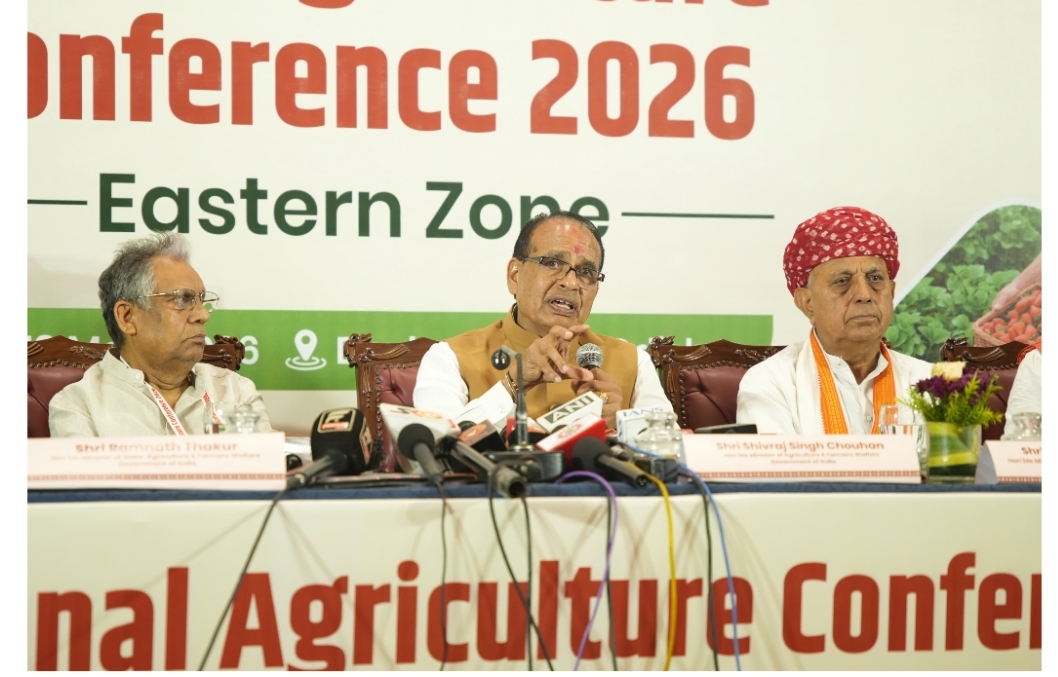
Union Agriculture and Farmers Welfare Minister Shivraj Singh Chouhan today announced a comprehensive roadmap for the development of agriculture in Eastern India, with a strong focus on crop diversification, pulses and oilseed production, integrated farming, balanced fertilizer use and modern agricultural technology.
Addressing a press conference during the Eastern Regional Kharif Agriculture Zonal Conference in Bhubaneswar, the Union Minister said the Centre and states have jointly finalized a region-specific and state-specific strategy aimed at transforming Eastern India into a major agricultural growth engine.
The conference brought together representatives from Odisha, Bihar, Chhattisgarh, Jharkhand and West Bengal to deliberate on issues related to food security, nutrition, farmer income, sustainable farming practices and agricultural infrastructure.
Chouhan said India’s diverse agro-climatic conditions require localized planning rather than a one-size-fits-all national strategy. He noted that zonal conferences have emerged as an effective mechanism to identify region-specific agricultural challenges and opportunities.
He stated that under the leadership of Prime Minister Narendra Modi, the government is working with three key objectives — ensuring food security, improving nutritional availability and strengthening farmers’ incomes and livelihoods.
According to the Minister, the government’s six-point agricultural strategy focuses on increasing production and productivity, reducing input costs, ensuring remunerative prices, providing compensation for losses and promoting diversification in farming.
Focus on Pulses, Oilseeds and Soil Health
Chouhan highlighted that while India has achieved strong production levels in wheat and paddy, self-reliance in pulses and oilseeds remains a priority area. He emphasized that crop diversification is essential not only for boosting income but also for maintaining soil fertility.
He explained that repeated cultivation of the same crop weakens soil health, whereas pulses improve fertility through natural nitrogen fixation.
The Minister also stressed the importance of integrated farming models for small and marginal farmers. These models combine traditional crops with horticulture, vegetable cultivation, fisheries, beekeeping, agro-forestry and animal husbandry to generate multiple income streams.
He said Eastern India has immense potential for integrated farming systems that can substantially raise farmers’ earnings.
‘Khet Bachao Abhiyan’ from June 1
Announcing a major nationwide awareness drive, Chouhan said the government will launch the ‘Khet Bachao Abhiyan’ from June 1 to June 15.
The campaign will focus on balanced fertilizer usage, soil health awareness and farmer education. The Minister warned that excessive and unscientific fertilizer application increases costs and negatively impacts soil, crop quality and human health.
Balanced fertilizer use, he said, is essential for sustainable agriculture and long-term productivity.
Farmer ID to Improve Transparency
Describing Farmer ID as a transformative reform, Chouhan said the initiative will create a unified digital identity containing information related to landholdings, crops and farmer families.
The digital system is expected to improve transparency and efficiency in agricultural credit, direct benefit transfer schemes, fertilizer distribution and other government services. It will also help prevent diversion of subsidized fertilizers.
The Minister said implementation of Farmer ID is progressing rapidly in several states and efforts are underway to expand the initiative nationwide.
Rice Fallow Lands to Boost Pulses Production
Chouhan said vast rice fallow lands in Eastern India offer a major opportunity to increase pulses and oilseed production after paddy harvest.
The government plans to identify suitable areas and support farmers with quality seeds, demonstrations, incentives and procurement support under the PM-AASHA scheme for crops such as urad, masoor and tur.
He also announced subsidy support for establishing dal mills and oil mills to promote local-level processing and value addition.
Strict Action Against Fake Inputs
The Union Minister announced that the government is preparing stricter laws to tackle fake pesticides, substandard seeds and poor-quality fertilizers.
He said new legislation, including a revised Pesticide Act and Seed Act, is being planned to ensure stronger punishment for offenders and protect farmers from fraudulent agricultural inputs.
Horticulture and Cold Storage Expansion
Highlighting the horticulture potential of Eastern India, Chouhan said crops such as mango and other fruits can significantly improve farmers’ incomes.
He informed that crop-wise and state-wise agricultural roadmaps will be prepared based on soil type, climatic suitability and local resources.
The Minister also acknowledged the urgent need to strengthen cold storage and cold chain infrastructure in the region. He said schemes such as the Agriculture Infrastructure Fund, MIDH and PM Kisan Sampada Yojana are being used to expand storage facilities and improve agricultural logistics.
Technology and Research to Reach Farmers
Chouhan said India possesses a strong network of agricultural scientists, universities and Krishi Vigyan Kendras (KVKs), and the government will continue efforts to ensure modern technologies, scientific research and best practices reach farmers effectively.
Reiterating the government’s commitment to farmer welfare, the Minister said agriculture remains the backbone of the Indian economy and improving farmers’ livelihoods, productivity and incomes will remain the Centre’s top priority.