India Wins 1 Gold and 3 Silver Medals at International Biology Olympiad 2026 in Lithuania.
Vilnius/Mumbai:
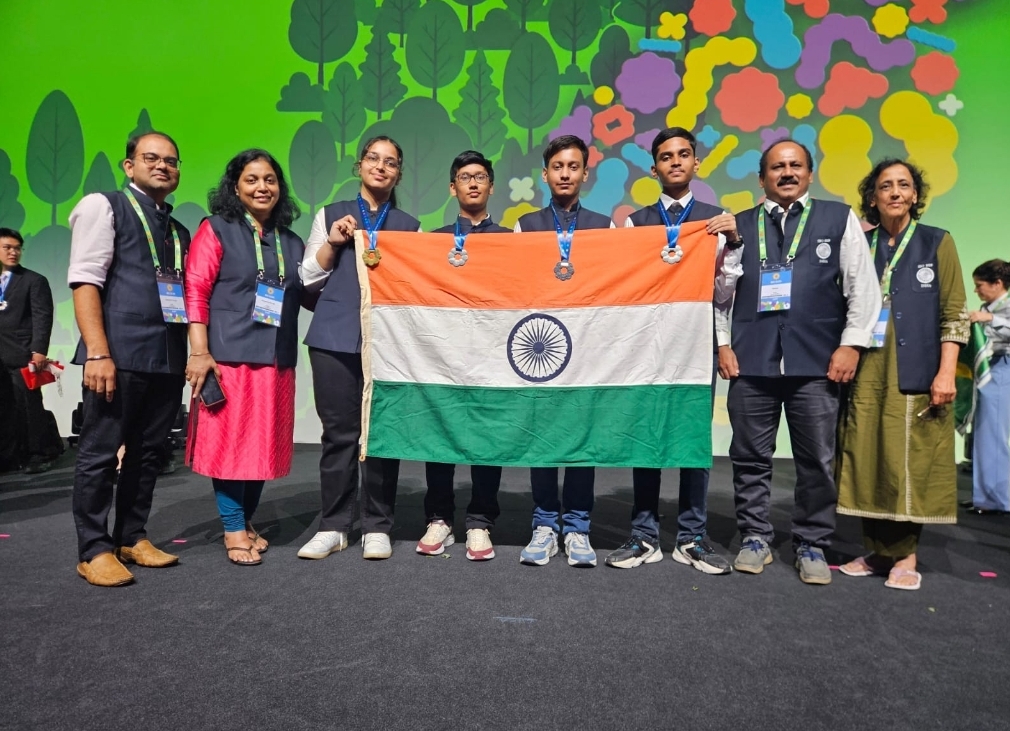
India delivered an outstanding performance at the 37th International Biology Olympiad (IBO) 2026, with all four members of the national team securing medals. The prestigious competition was held in Vilnius, Lithuania, from July 12 to July 19, 2026, bringing together the world’s brightest young biology students.
The Indian contingent returned with one Gold medal and three Silver medals, continuing the country’s remarkable record at the global biology competition.
The medal winners are:
Bhavyaa Gunwal from Mahendragarh, Haryana – Gold Medal
Soumil Maity from Howrah, West Bengal – Silver Medal
Nishit Kalani from Pali, Rajasthan – Silver Medal
Anmol Kumar from Mansa, Punjab – Silver Medal
The team was led by Prof. Rekha Vartak (Retired, HBCSE-TIFR, Mumbai) and Dr. Anupama Ronad (HBCSE-TIFR), while Dr. Ranjithsinh Devkar of M. S. University, Baroda, and Dr. Siddhesh Ghag of the UM-DAE Centre of Excellence in Basic Sciences, Mumbai, accompanied the delegation as Scientific Observers.
Global Participation
This year’s Olympiad witnessed participation from 307 students representing 78 countries, making it one of the largest editions of the International Biology Olympiad. A total of 31 Gold, 61 Silver, and 91 Bronze medals were awarded.
Challenging Practical and Theory Examinations
The IBO 2026 featured some of the most demanding examinations in the history of the competition. Designed by the Vilnius University Life Sciences Centre, the Olympiad tested students through six hours of practical examinations and six hours of theoretical assessments.
The practical examinations covered four advanced areas of biology:
Molecular Biology and Biochemistry: Students performed restriction digestion, agarose gel analysis of plasmids, and biochemical enzyme assays.
Animal Physiology: Participants studied aspirin pharmacokinetics and analyzed simulated blood samples using an in-house developed application and a light-box colorimeter.
Animal Morphology and Systematics: Competitors classified insect specimens through detailed morphological analysis, including intricate mouth-part dissections.
Plant Computational Biology: Students used ImageJ software to measure plant root lengths, analyze macrophenotypes of different plant ecotypes, and conduct transcriptome analysis.
The theoretical examination was equally rigorous, comprising 100 research-oriented questions spread across two three-hour sessions. Rather than testing rote memorization, the questions assessed analytical and problem-solving abilities in key biological disciplines, including Cell and Molecular Biology, Genetics, Evolution, Ecology, Ethology, Plant Sciences, Animal Sciences, and Biosystematics.
India’s Strong Legacy at IBO
The 2026 edition marked India’s 26th participation in the International Biology Olympiad. Since its debut, 104 Indian students have represented the country, earning an impressive tally of:
17 Gold Medals
69 Silver Medals
17 Bronze Medals
1 Honourable Mention
Over the past decade, India’s performance has remained consistently strong, with a 25% Gold medal rate and a 68% Silver medal rate, reflecting the country’s growing excellence in biology education and Olympiad training.
Appreciation for Students and Mentors
The Government of India congratulated the medal winners and the entire Indian delegation for their exceptional achievement. Appreciation was also extended to the teachers, mentors, and the Biology Olympiad Cell of Homi Bhabha Centre for Science Education (HBCSE-TIFR) for their rigorous training during the orientation and pre-departure camps.
The National Steering Committee, participating teacher organizations, and various government funding agencies were also acknowledged for their continued support in strengthening India’s Olympiad programme and nurturing future scientific talent.
India’s stellar performance at the International Biology Olympiad 2026 once again underscores the country’s growing presence in global science competitions and highlights the exceptional abilities of its young scholars on the international stage.