Defence Minister Rajnath Singh Launches Rs. 3,500-Crore Expansion Projects of GRSE and YIL to Boost India’s Defence Manufacturing.
Kolkata:
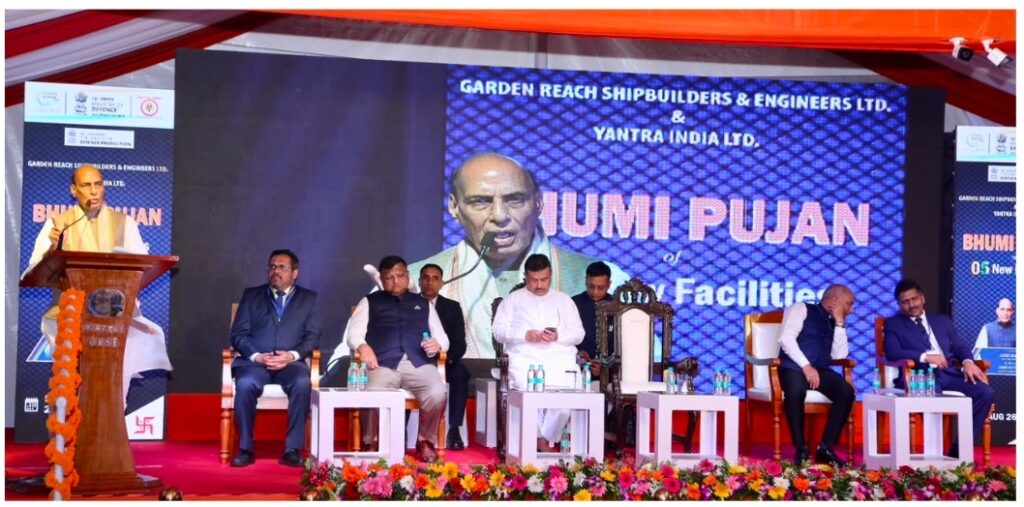
Defence Minister Rajnath Singh, along with West Bengal Chief Minister Suvendu Adhikari, on Sunday performed the Bhumi Pujan for five major expansion projects of Garden Reach Shipbuilders & Engineers (GRSE) and Yantra India Limited (YIL), involving a combined investment of around Rs. 500 crore.
The projects, launched virtually from GRSE Bhavan in Kolkata, are aimed at significantly strengthening India’s shipbuilding, ship repair, metallurgical and defence production capabilities. The expansion is expected to provide a major boost to the government’s Aatmanirbhar Bharat, Make in India and Make for the World initiatives while creating employment and opening new opportunities for ancillary industries and MSMEs.
Three of the projects belong to GRSE and will be developed at Kidderpore in Kolkata, Shalimar in Howrah and Raichak in South 24-Parganas. The remaining two projects are being established at YIL’s Metal and Steel Factory (MSF) in Ishapore.
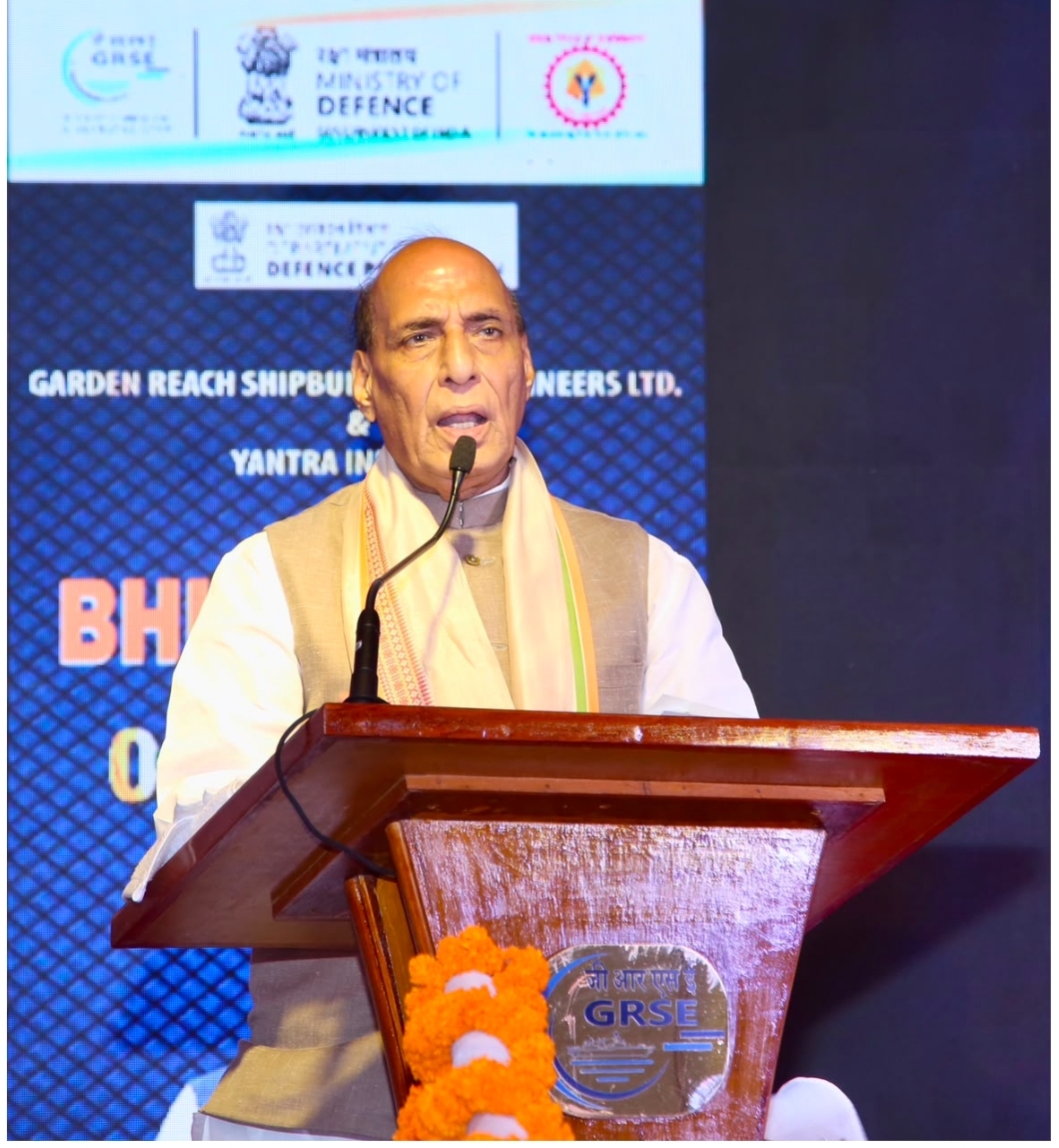
Addressing the gathering, Rajnath Singh said self-reliance in defence was not merely a policy objective but a force multiplier for battlefield capability. He said the experience of Operation Sindoor had highlighted the importance of indigenous weapons, platforms and defence systems.
“Self-reliance is not merely a policy; it is a force multiplier for battlefield capability,” Singh said, underlining the critical role of defence PSUs, private companies, research institutions and MSMEs in strengthening India’s strategic autonomy.
He praised GRSE for its contribution to indigenous shipbuilding and noted that the shipyard has constructed more than 800 vessels so far. He also highlighted that next-generation offshore patrol vessels currently under construction would have more than 80 per cent indigenous content.
The Defence Minister said the expansion projects come at a time when India has a major opportunity to emerge as a global shipbuilding hub. He referred to an emerging “capacity paradox” in the global shipbuilding industry, with demand for naval and commercial vessels rising while traditional shipbuilding nations face declining capacity.
According to Singh, India has significant advantages, including a large pool of engineers and IT professionals, a strong steel industry, skilled manpower and a growing MSME ecosystem. He called for greater investment in ship design, simulation, artificial intelligence and modern manufacturing technologies so that India could develop indigenous designs, secure patents and eventually export them globally.
GRSE to invest over Rs. 2,500 crore at Raichak
The largest of the GRSE projects is the development of a new shipbuilding hub at Raichak, where the company plans to invest more than Rs. 2,500 crore. The 32-acre riverside property has a 356-metre waterfront and an existing 96-metre jetty, with a draught of 8-10 metres.
The facility will be capable of constructing warships up to 200 metres long and commercial vessels of up to 60,000 deadweight tonnes. It will feature a 200-metre dry dock, a 200-metre slipway, a 200-metre ship launching pad and two jetties measuring 120 metres and 86 metres.
The Raichak facility is also expected to enable GRSE to compete for the construction of next-generation destroyers and strengthen the country’s warship-building capacity.
At Timber Pond in Shalimar, Howrah, GRSE plans to invest nearly Rs. 100 crore to revive an existing facility and develop it into a shipbuilding and repair centre for medium-sized vessels. The project includes restoration of a 130-metre dry dock, construction of a 120-metre slipway and installation of modern cranes and other infrastructure.
At the Damodar facility near Kidderpore Docks, GRSE will invest around Rs. 70 crore. The facility will be used for repairing medium-sized vessels and constructing electric ferries and other small craft.
YIL to modernise metallurgical production
The two YIL projects at MSF Ishapore involve an investment of more than Rs. 750 crore and are aimed at modernising the production of strategic defence and industrial components.
One project involves installation of a 3,000-tonne Heavy Duty Hydraulic Open Die Forging Press, replacing the existing 2,650-tonne press commissioned in 1976. The new press, equipped with two integrated rail-bound manipulators, will manufacture critical gun barrels, ammunition components and heavy defence forgings with greater precision and reliability.
The project is expected to be completed within 26 months and is projected to generate annual savings of around Rs. 25.58 crore while supporting an annual turnover of approximately Rs. 500 crore.
The second project is a Radial Forging Plant, being established at an investment of Rs. 473.84 crore. It will introduce advanced radial forging technology and enable production of super-alloy forgings, hollow tubes for aerial bombs, components for future ordnance systems, high-strength railway axles and nuclear reactor components.
The facility will incorporate Industry 4.0 technologies and energy-efficient systems. It is projected to generate an annual profit of around Rs. 69 crore and reduce India’s dependence on imported strategic forgings.
Rajnath Singh also emphasised the importance of developing India as a major ship repair and Maintenance, Repair and Overhaul (MRO) hub in the Indian Ocean Region. He said establishing India as an MRO centre could save foreign exchange and create thousands of jobs.
West Bengal Chief Minister Suvendu Adhikari described the Bhumi Pujan ceremony as a historic moment for the state. He said the projects would strengthen the capacities of GRSE and YIL while contributing to the revival of West Bengal’s industrial sector.
The expansion is expected to generate direct and indirect employment and create wider business opportunities for MSMEs and other ancillary industries, further integrating West Bengal into India’s expanding defence manufacturing and shipbuilding ecosystem.