Children Account for Half of Suspected Mpox Cases in Guinea-Bissau as UNICEF Scales Up Response.
BISSAU/DAKAR:
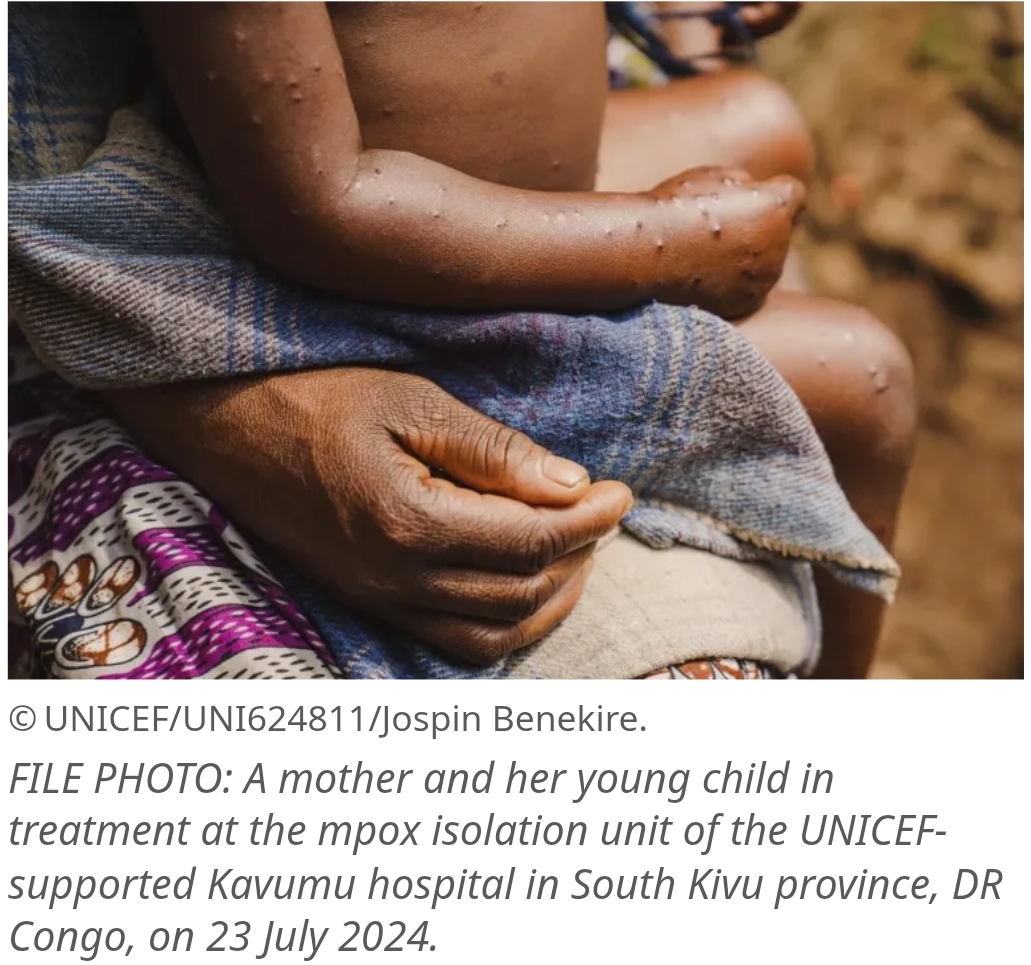
Children under the age of 15 account for half of the suspected mpox cases reported in Guinea-Bissau, prompting UNICEF to intensify surveillance, prevention and community outreach as the country confronts its first-ever outbreak of the disease.
According to UNICEF, Guinea-Bissau has recorded 46 suspected mpox cases, including 23 children under 15. Of these children, 16 are aged between zero and four years, a development that has raised particular concern because younger children may face a greater risk of severe complications from mpox.
The outbreak was officially declared on July 4, 2026. As of August 17, health authorities had confirmed seven cases, all among adults. Six confirmed cases were reported in the Autonomous Sector of Bissau, while one was identified in the Biombo Region. No deaths have been reported so far.
UNICEF warned, however, that the number of confirmed infections may not reflect the true extent of transmission because the country’s surveillance and contact-tracing systems remain fragile.
“This is the first time mpox cases have been reported in Guinea-Bissau, making even a small outbreak a major public health event,” said Sandra Martins, UNICEF Deputy Representative in Guinea-Bissau.
She said the country’s limited surveillance capacity creates a significant risk that infections could go undetected, particularly among children who may be more vulnerable to complications.
Concern Over Undetected Transmission
Health authorities have noted that the confirmed cases do not appear to be directly connected to one another. This raises concerns about possible undetected chains of transmission within communities.
Critical gaps remain in community-based surveillance, identification of contacts, laboratory testing and systematic tracing of transmission routes. UNICEF says strengthening these areas is essential to identify infections early and prevent the outbreak from expanding.
The reopening of schools in September is adding another layer of concern. With children returning to classrooms and other group settings, health authorities are particularly focused on improving awareness, early detection and infection-prevention measures among children, families and school communities.
UNICEF Strengthens Support
UNICEF is working with Guinea-Bissau’s Ministry of Public Health, the World Health Organization and other partners to reinforce the national response.
The agency’s support includes strengthening disease surveillance and contact tracing, improving infection-prevention and control measures in health facilities, and reinforcing water, sanitation and hygiene (WASH) measures.
UNICEF is also supporting efforts to provide children, parents and communities with timely and accurate information about mpox, including how it spreads, how to reduce the risk of infection and when to seek medical care.
“With early detection, care, and prevention, mpox can be managed and its spread reduced,” Martins said.
She urged families to seek medical attention immediately if a child or other family member develops symptoms such as a rash, fever or swollen lymph nodes, while following public-health advice on handwashing and avoiding close contact with people suspected of having mpox.
Families Urged to Reduce Transmission and Stigma
UNICEF is also emphasizing the importance of preventing stigma around mpox. Fear and misinformation can discourage people from reporting symptoms or seeking medical assistance, potentially allowing transmission to continue unnoticed.
Families are being encouraged to follow health guidance, maintain good hand hygiene and limit close contact with suspected cases. Early identification and appropriate care remain central to controlling the outbreak.
Urgent Funding Needed
As Guinea-Bissau expands its national response, UNICEF says additional resources are urgently required. The organization is seeking more than US$150,000 to support critical components of its mpox intervention.
The funding will help UNICEF deploy essential surveillance, prevention, infection-control, WASH and community-engagement resources, with a particular focus on protecting children and other vulnerable populations.
With almost half of suspected cases occurring among children under 15, the outbreak has placed child health at the centre of Guinea-Bissau’s public-health response. UNICEF says rapid detection, stronger community surveillance, accurate information and adequate emergency financing will be critical to preventing further spread as the country prepares for the reopening of schools in September.