Hundreds of Health and Nutrition Facilities Shut Down as Somalia’s Child Crisis Deepens.
MOGADISHU/NAIROBI:
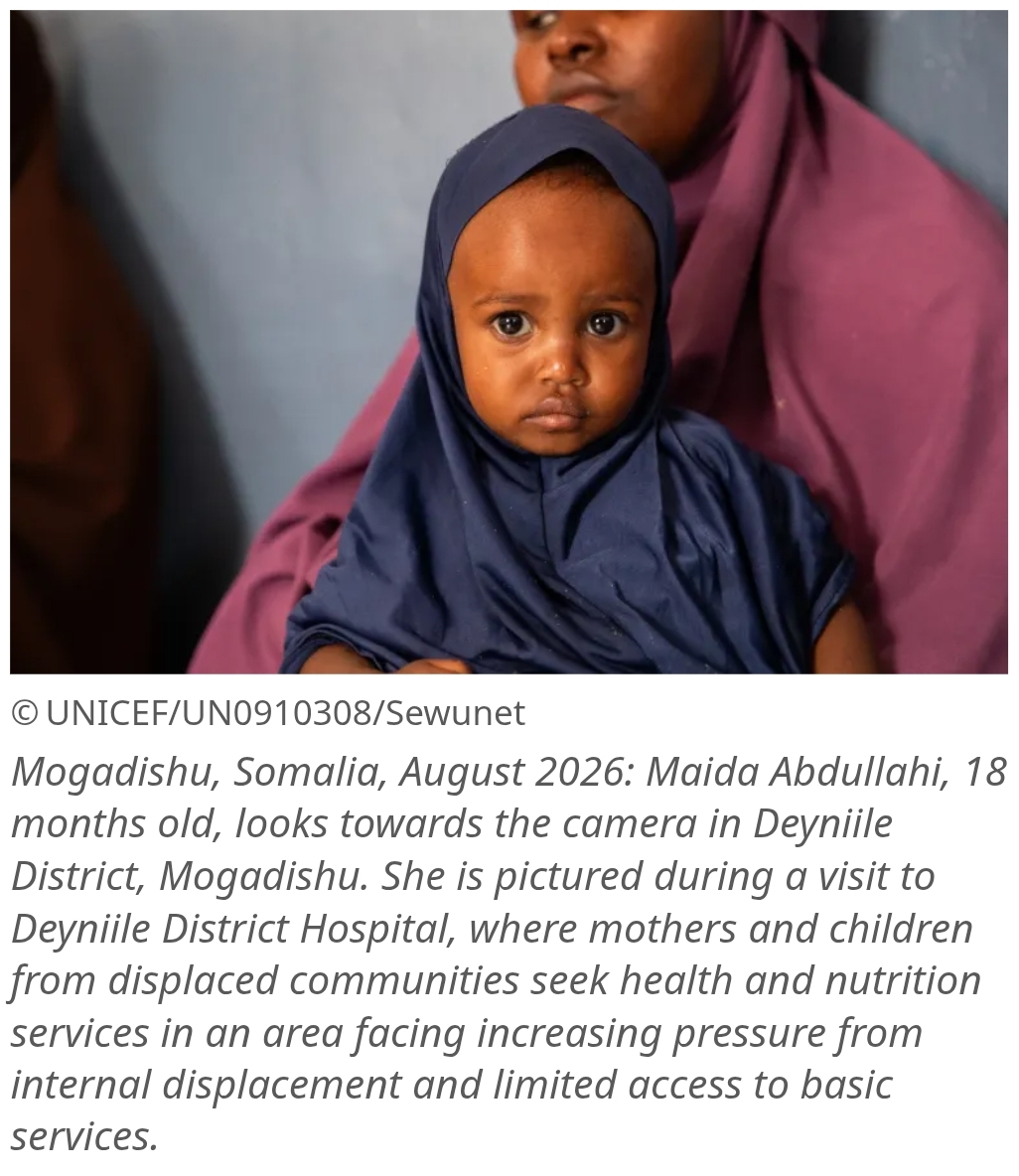
Somalia’s worsening humanitarian crisis is placing millions of children at greater risk as severe cuts to international humanitarian assistance force the closure of hundreds of health and nutrition facilities, according to UNICEF.
Speaking at a press briefing at the Palais des Nations in Geneva, UNICEF spokesperson James Elder said 205 health and nutrition facilities have already closed following unprecedented reductions in humanitarian funding. The closures are already having a measurable impact, with admissions of children suffering from severe acute malnutrition and related complications rising by 32 per cent during the first six months of 2026 compared with the same period last year.
“Fewer facilities mean longer journeys for mums and their babies; longer journeys mean later treatment,” Elder said, warning that delays in treatment can lead to more severe illness and a higher risk of preventable deaths.
Nearly 1.9 million children at risk of malnutrition
UNICEF estimates that nearly 1.9 million children in Somalia are projected to be affected by malnutrition this year, including almost 500,000 children suffering from severe acute malnutrition, the most dangerous form of the condition.
Elder stressed that the increase in children arriving at stabilization centres does not necessarily mean that more children are initially becoming sick. Rather, the disruption of preventive and community-based nutrition programmes means vulnerable children are increasingly missed at an earlier stage.
By the time they reach specialized facilities, many are already critically ill and more difficult and costly to treat.
Nearly one million children under five, adolescent girls and women are also at risk of losing access to essential nutrition services as funding shortages deepen.
The consequences are particularly serious in a country where UNICEF-supported programmes have previously achieved significant results. Between 2021 and 2025, UNICEF supported more than 2.25 million admissions of children with severe acute malnutrition, while the reported cure rate in 2025 reached 97.6 per cent.
Health services face further closures
The funding crisis has already contributed to an estimated 30 per cent reduction in health and nutrition service coverage.
UNICEF warned that under severe funding scenarios, as many as 618 health facilities could eventually close nationwide, leaving families in remote and vulnerable communities with even fewer options for treatment.
The humanitarian air service UNHAS, which provides critical air connectivity for UNICEF operations and the delivery of life-saving supplies, has also suffered from funding reductions. Its Somalia budget was cut by 40 per cent between 2025 and 2026, making it increasingly difficult to deliver assistance to hard-to-reach areas.
Drought, conflict and climate threats intensify
The funding crisis comes as Somalia faces multiple overlapping emergencies.
Severe drought is affecting parts of the north, while conflict and displacement continue to uproot families. Rising fuel and fertilizer costs are adding further pressure on households already struggling to survive.
UNICEF also warned that a record-strength El Niño could compound the humanitarian crisis, with severe flooding forecast to peak in the coming months.
Elder described the situation as a “brutal contradiction”: resources to protect vulnerable children are being reduced at precisely the moment when climate shocks, displacement and other pressures are intensifying.
During a recent visit to Somalia, Elder said he met malnourished children who had arrived at stabilization centres in critical condition after community-based services had closed.
He also described the case of Hajio, a mother whose family once had cattle, a home and children attending school. Prolonged drought killed her livestock and destroyed her livelihood, forcing her to leave her home in search of assistance.
She eventually reached Burhakaba in southwestern Somalia, where she now lives in a makeshift shelter made of plastic and sticks. According to Elder, the only assistance she received was clothing and tomatoes from a nearby community that is itself among the poorest in the country.
Water crisis pushes costs higher
The humanitarian funding cuts are also worsening Somalia’s water crisis.
More than 1.6 million people require access to safe water, while more than 800,000 people are at risk of losing essential hygiene supplies.
The cost of water in rural and pastoral areas has risen sharply. A 200-litre barrel that previously cost around US$2 now costs about US$8, a fourfold increase that puts basic water supplies beyond the reach of many vulnerable families.
UNICEF said it has nevertheless reached more than one million people through emergency and sustainable water services. Without continued funding, however, those gains could be lost.
Education disrupted as children leave school
The crisis is also threatening children’s education. UNICEF said the education sector lost approximately US$30 million in 2025, while major donors are expected to reduce their contributions by more than half in 2026.
More than 78,000 students have already dropped out of school, while another 660,000 girls and boys are considered at risk of dropping out.
Education is particularly important during humanitarian emergencies because it can protect children from exploitation, early marriage and child labour while providing a pathway out of poverty.
During Somalia’s 2022 drought, UNICEF support helped more than 130,000 children remain in education.
Child protection services under threat
Funding cuts are also threatening programmes designed to protect children from violence, exploitation and armed recruitment.
At least 65 child protection service points and facilities have already closed, while case management, psychological support, family tracing and reintegration services are under increasing financial pressure.
Somalia has one of the world’s highest reported rates of violations against children, making the loss of protection services particularly concerning.
Elder highlighted the story of Abdullah, a teenager who dreamed of becoming a mechanic. Non-state armed groups initially approached him with an offer of work and mechanical training. Desperate to support his widowed mother and lacking other opportunities, he accepted.
The promise, however, was reportedly a deception. Abdullah was instead taken to the battlefield. After attempting to escape, he was wounded and eventually captured by government forces.
UNICEF had previously supported vocational training for children formerly associated with armed groups. In late 2024 and early 2025, more than 160 children received training in areas including mechanics, electrical work and cooking, followed by starter kits designed to help them establish businesses or find employment.
Elder warned that funding cuts now threaten such opportunities, meaning children like Abdullah could lose the support needed to rebuild their lives and avoid re-recruitment.
Previous successes at risk
UNICEF emphasized that the current crisis is not occurring in a vacuum. Years of donor investment have helped establish programmes capable of delivering measurable results.
In 2024, a UNICEF-supported oral cholera vaccination campaign reached more than 885,000 people at risk, achieving more than 90 per cent of its target.
The organization said Somalia has the programmes and partners required to respond to the crisis, but the critical missing element is funding.
Elder argued that reducing humanitarian assistance now could ultimately cost the international community more, both financially and in terms of security, development and human lives.
UNICEF urges sustained international support
Despite the worsening situation, Somalia’s government and humanitarian organizations continue to work on strengthening national systems, improving regulation and finding more efficient, locally driven and sustainable ways to deliver assistance.
However, UNICEF said Somalia should not be forced to choose between drought response and long-term development, between treating severely ill children and preventing malnutrition, or between emergency water supplies and sustainable water systems.
Elder warned that Somalia’s crisis has consequences beyond its borders, pointing to the links between climate shocks, displacement, conflict, child recruitment and economic instability.
“Protecting children is not a discretionary expense,” he said. “Preventing suffering is not an inefficiency.”
He stressed that dismantling effective humanitarian programmes at a time of growing need should not be viewed as a saving, arguing that the eventual costs could be greater through increased suffering, insecurity, lost development opportunities and preventable deaths.
UNICEF is therefore calling for renewed and sustained donor support to prevent further closures of essential services and to ensure that Somalia’s most vulnerable children continue to receive life-saving health, nutrition, water, education and protection assistance.