NAAS Showcases Indian Agricultural Excellence at Global Food Prize Dialogue; Indian Student Wins Youth Institute Award.
NAAS-CAST MoU to strengthen international cooperation in agricultural research, education and knowledge exchange.
New Delhi:
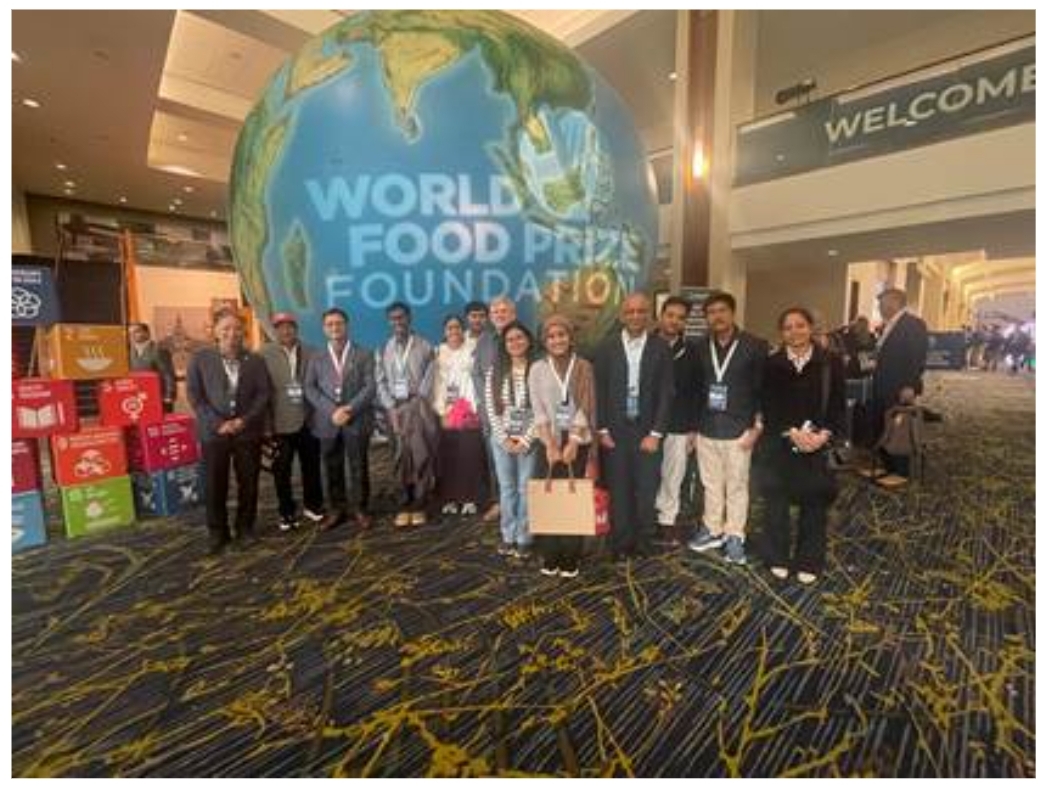
The National Academy of Agricultural Sciences (NAAS), New Delhi, showcased India’s agricultural research capabilities at the 2026 Norman E. Borlaug International Dialogue, organised by the World Food Prize Foundation (WFPF) in Des Moines, Iowa, USA, from October 20 to 22. The event, held under the theme “Before Hunger Wins”, brought together stakeholders to discuss global food security and sustainable agricultural development.
India’s participation featured an exhibition showcasing publications of NAAS and the Indian Council of Agricultural Research (ICAR), the participation of seven Indian high school students in the Global Youth Institute (GYI), discussions on agricultural higher education and the signing of a Memorandum of Understanding (MoU) between NAAS and the Council for Agricultural Science and Technology (CAST), USA.
A major highlight was the recognition of young Indian talent, with Ameena Nazreen A S winning a GYI Award carrying a cash prize of US$500. She was among seven high school students selected through the NAAS-YUVA selection drive to participate in the international programme.
The students presented research papers addressing critical food-security challenges, gaining an opportunity to interact with international peers and exchange ideas on sustainable agri-food systems. Their participation highlighted the potential of India’s young researchers to contribute to solutions for global agricultural and nutritional challenges.
The NAAS exhibition booth attracted attention from researchers, academicians, policymakers and other stakeholders by displaying prominent publications of the Academy and ICAR. It provided an international platform to share India’s scientific contributions, agricultural research findings and policy perspectives.
NAAS President Calls for Global Partnerships in Agricultural Education
A special roundtable on agricultural higher education was organised alongside the international dialogue to explore ways to transform agricultural education through global partnerships and stronger academic collaboration.
Addressing the meeting virtually, Dr. M. L. Jat, President of NAAS, Secretary of the Department of Agricultural Research and Education (DARE), and Director General of ICAR, called for a broader approach to agricultural education to prepare future professionals to address emerging global challenges.
He highlighted climate change, natural resource degradation, biodiversity loss and the growing demand for nutritious and healthy food as key issues requiring scientific innovation and skilled human resources.
Dr. Jat emphasised the need to move beyond a production-centric approach towards an integrated agri-food systems and value-chain perspective. He stressed that agricultural education must equip students with the knowledge and skills required to respond to changing industry needs and evolving global food systems.
He also underlined the importance of stronger academia-industry collaboration, international knowledge exchange and greater engagement with the Indian agricultural diaspora. Such partnerships, he said, could help develop industry-ready professionals and strengthen agricultural research, education and extension services.
The role of NAAS in facilitating policy dialogue and bringing together researchers, policymakers, academic institutions and industry representatives to address emerging challenges in agricultural research and development was also highlighted.
NAAS-CAST MoU to Expand Scientific Cooperation
Another significant development was the signing of an MoU between NAAS and CAST, USA. The agreement is aimed at opening new avenues for cooperation in agricultural research, capacity development and knowledge exchange.
The partnership is expected to strengthen institutional linkages and create opportunities for international scientific collaboration, enabling researchers and institutions to exchange expertise and explore solutions to shared agricultural challenges.
Congratulating the young participants and highlighting the importance of international engagement, Dr. Jat said nurturing young talent and strengthening global partnerships were essential for developing innovative solutions for sustainable agriculture and food security.
He expressed confidence that such collaborative initiatives would contribute to advancing agricultural research, education and extension, particularly across countries of the Global South.
Through scientific outreach, youth engagement, academic dialogue and institutional partnerships, NAAS reaffirmed its commitment to promoting Indian agricultural excellence and contributing to a resilient, sustainable and food-secure future.