
PM Modi Meets Chinese President Xi Jinping on SCO Sidelines, Reaffirms Commitment to Peaceful, Cooperative Bilateral Ties.
Tianjin:
On the sidelines of the Shanghai Cooperation Organization (SCO) Summit, Prime Minister Narendra Modi met with President Xi Jinping of the People’s Republic of China in Tianjin, marking a significant step in the ongoing efforts to stabilize and advance India-China bilateral relations.
This was the first face-to-face meeting between the two leaders since their last interaction in Kazan in October 2024. Both sides welcomed the positive momentum in bilateral ties and noted the importance of continuing dialogue and engagement. They reaffirmed that India and China are development partners, not rivals, and that differences between the two nations must not escalate into disputes.
Focus on Border Peace and Stability
Prime Minister Modi underlined the crucial importance of peace and tranquility along the border areas for sustained progress in bilateral relations. The two leaders expressed satisfaction over the successful disengagement in 2024, noting the maintenance of calm and stability along the Line of Actual Control (LAC) since then.
They reiterated their commitment to a fair, reasonable, and mutually acceptable resolution of the boundary issue, keeping in view the broader bilateral relationship and long-term interests of both peoples. The leaders acknowledged the constructive outcomes of the Special Representatives’ Talks held earlier this month, and agreed to continue supporting this dialogue mechanism.
Strengthening Bilateral and People-to-People Ties
The discussion also touched on enhancing people-to-people exchanges. Both leaders agreed on expanding direct flight connectivity, improving visa facilitation, and welcomed the resumption of the Kailash Mansarovar Yatra as a significant cultural and spiritual bridge between the two nations.
On the economic front, the leaders recognized the stabilizing role of India and China’s economies in global trade. They emphasized the need to expand bilateral trade and investment, while addressing the existing trade imbalance through strategic and political alignment.
Shared Vision for Multilateralism and Global Cooperation
Prime Minister Modi stressed that India-China relations should not be viewed through the lens of any third country, reaffirming both nations’ commitment to strategic autonomy. The leaders discussed the need to broaden cooperation on regional and global challenges, such as terrorism, fair trade practices, and reform of multilateral platforms.
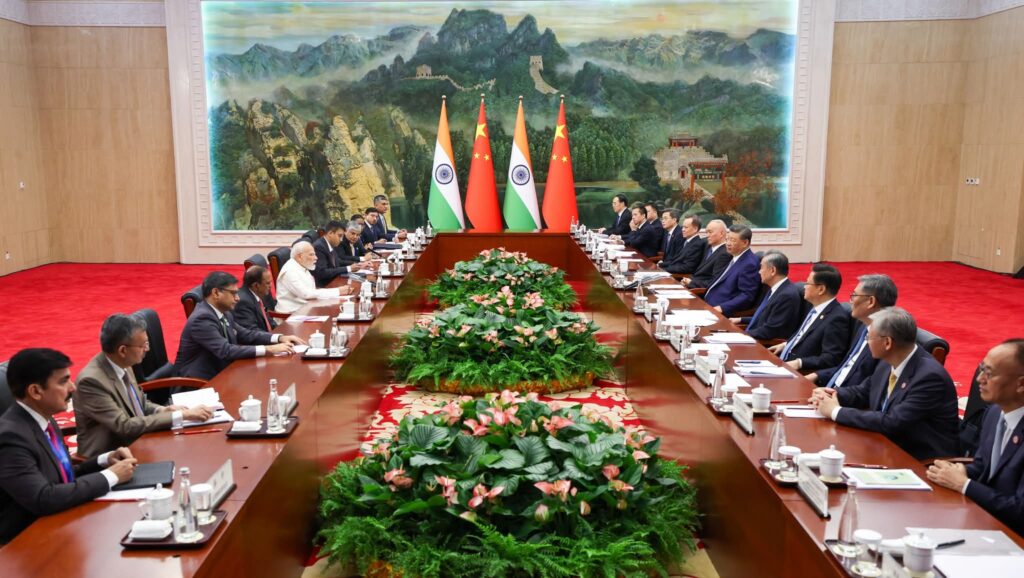
Prime Minister also extended his support for China’s current SCO Presidency and commended its successful hosting of the summit. He invited President Xi to attend the BRICS Summit in 2026, which will be hosted by India. President Xi thanked the Prime Minister and assured China’s support for India’s upcoming BRICS presidency.
Meeting with Politburo Standing Committee Member
Separately, Prime Minister Modi also held a meeting with Cai Qi, Member of the Standing Committee of the Politburo of the Communist Party of China. PM Modi shared his strategic vision for India-China relations and sought support in furthering the consensus reached between the two top leaders. Mr. Cai reiterated China’s commitment to expanding bilateral exchanges and improving mutual understanding in line with the directions set by Prime Minister Modi and President Xi.
A Cautious but Forward-Looking Engagement
The Modi-Xi meeting comes at a critical time, as both countries look to stabilize relations post-border tensions, while navigating complex global dynamics. The emphasis on mutual respect, regional stability, and strategic cooperation reflects a measured but forward-looking approach to managing the India-China relationship in the 21st-century multipolar order.
Further engagements and follow-ups at diplomatic and ministerial levels are expected in the coming months as both sides work to rebuild trust and expand collaboration across strategic, economic, and cultural domains.