

Hostage Families Accuse Netanyahu of Sabotaging Deal as Qatar Strike Escalates Tensions.
Jerusalem, Israel:
Families of Israeli hostages still held by Hamas have launched scathing criticism against Prime Minister Benjamin Netanyahu, calling him the “one obstacle” preventing their loved ones’ return and a comprehensive ceasefire deal with Hamas.
The Hostages and Missing Families Forum — a group representing the relatives of the 48 Israelis still believed to be held in Gaza — made the accusation following Israel’s controversial airstrike in the Qatari capital of Doha last week. The strike reportedly killed five senior Hamas leaders and a Qatari security official, triggering international condemnation and fears of diplomatic fallout.
Netanyahu Accused of Undermining Peace
In a statement posted on social media, the Hostages and Missing Families Forum said, “Every time a deal approaches, Netanyahu sabotages it.” They cited the recent strike as proof that Netanyahu is intentionally stalling hostage negotiations in a bid to prolong the war and preserve his grip on power.
“The targeted operation in Qatar proved beyond any doubt that there is one obstacle to returning the 48 hostages and ending the war: Prime Minister Netanyahu,” the group said.
They added that Netanyahu’s approach has already cost the lives of 42 hostages and now threatens the survival of those still in captivity, who are reportedly in deteriorating health conditions.
“The time has come to end the excuses designed to buy time so he can cling to power,” the group’s statement concluded.
Netanyahu Defends Qatar Strike
On Saturday, Prime Minister Netanyahu defended the strike, saying that eliminating Hamas leadership in Qatar would “rid the main obstacle” to releasing the hostages and ending the war.
He also blamed Hamas for blocking previous ceasefire efforts, arguing that the group deliberately prolongs the conflict to gain political leverage.
International Fallout and U.S. Response
The operation in Doha has sparked widespread diplomatic backlash, especially given Qatar’s strategic role as a mediator between Israel, Hamas, and the international community.
Qatar condemned the airstrike as a “cowardly” act and a “flagrant violation of international law.” The Gulf nation also hosts the largest U.S. air base in the Middle East and has played a key role in past hostage negotiations.
U.S. Secretary of State Marco Rubio, who arrived in Israel over the weekend, is expected to meet with Netanyahu amid growing pressure on Israel to rein in its military operations and resume diplomatic efforts.
Before departing Washington, Rubio said President Donald Trump was “not happy” about the Israeli strike in Qatar.
“Obviously we’re not happy about it — the president was not happy about it. Now we need to move forward and figure out what comes next,” Rubio told reporters.
Despite his criticism, Rubio reaffirmed the strength of the U.S.-Israel alliance, stating that the top U.S. priority remains the safe return of hostages and an end to the war in Gaza.
Escalation in Gaza City
Meanwhile, Israeli military operations in Gaza have intensified. Over the weekend, the Israel Defense Forces (IDF) launched a heavy bombardment campaign on Gaza City, reducing apartment blocks and key infrastructure to rubble.
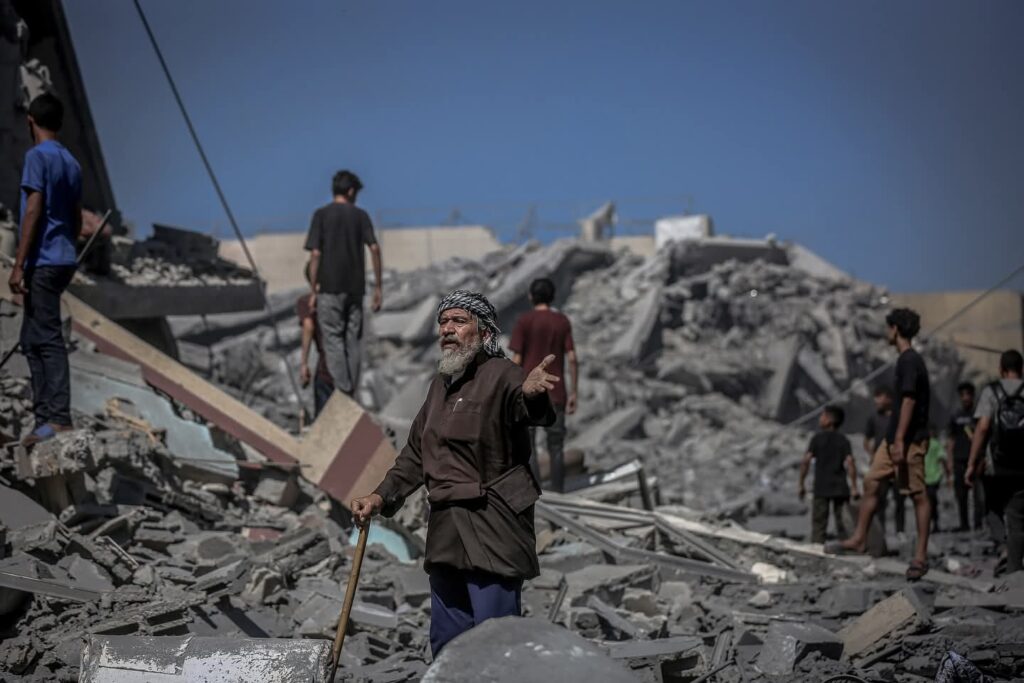
The IDF said approximately 250,000 civilians have evacuated the city amid warnings of a major ground offensive. However, residents and aid groups have reported attacks on schools and makeshift shelters, often after last-minute warnings that leave little time to escape.
The United Nations has warned that further military escalation in the region — already suffering from widespread famine — would plunge civilians into an “even deeper catastrophe.”
Humanitarian Toll
The war in Gaza erupted following the Hamas-led assault on southern Israel on October 7, 2023, which left 1,200 Israelis dead and 251 taken hostage.
Since then, at least 64,605 Palestinians have been killed in Israeli strikes across Gaza, according to the territory’s Hamas-run health ministry. The figures include a large number of women and children, with entire families reportedly wiped out in airstrikes.
Growing Domestic Pressure
As the war drags on, Netanyahu faces mounting pressure at home. The families of hostages, once largely supportive of government efforts, are increasingly vocal in their criticism, accusing the prime minister of political maneuvering at the expense of human lives.
With negotiations at a standstill and international condemnation mounting, the path to a ceasefire — and the return of hostages — appears more uncertain than ever.