
New Study Uncovers Key Genetic Drivers of Oral Cancer in Indian Women.
Bengaluru:
In a major scientific breakthrough, Indian researchers have identified critical genetic mutations responsible for the unusually aggressive forms of oral cancer seen among women in southern India. The discovery offers fresh hope for developing gender-specific diagnostics and personalized treatments for one of the country’s most pervasive and lethal cancers.
India bears one of the highest global burdens of oral cancer, with particularly high incidence among women in southern and northeastern regions. The trend is closely linked to the longstanding cultural practice of chewing tobacco-infused betel quid, gutka, and other related products. Yet, while male oral cancer has been extensively studied, the disease in women has received significantly less scientific attention.
A team of scientists from the Jawaharlal Nehru Centre for Advanced Scientific Research (JNCASR), Bengaluru, and the BRIC-National Institute of Biomedical Genomics (NIBMG), Kalyani, working with clinicians from the Sri Devraj Urs Academy of Higher Education and Research (SDUAHER), Kolar, conducted one of the first comprehensive female-focused genetic studies on oral cancer in India.
Led by Prof. Tapas K. Kundu of JNCASR, the study sought to understand why oral cancer manifests differently in women, what drives its progression, and how treatments can be better tailored to female patients. The findings, published in the journal Clinical and Translational Medicine, shed light on the biological mechanisms behind the highly recurrent and life-threatening forms of the disease seen in Indian women.
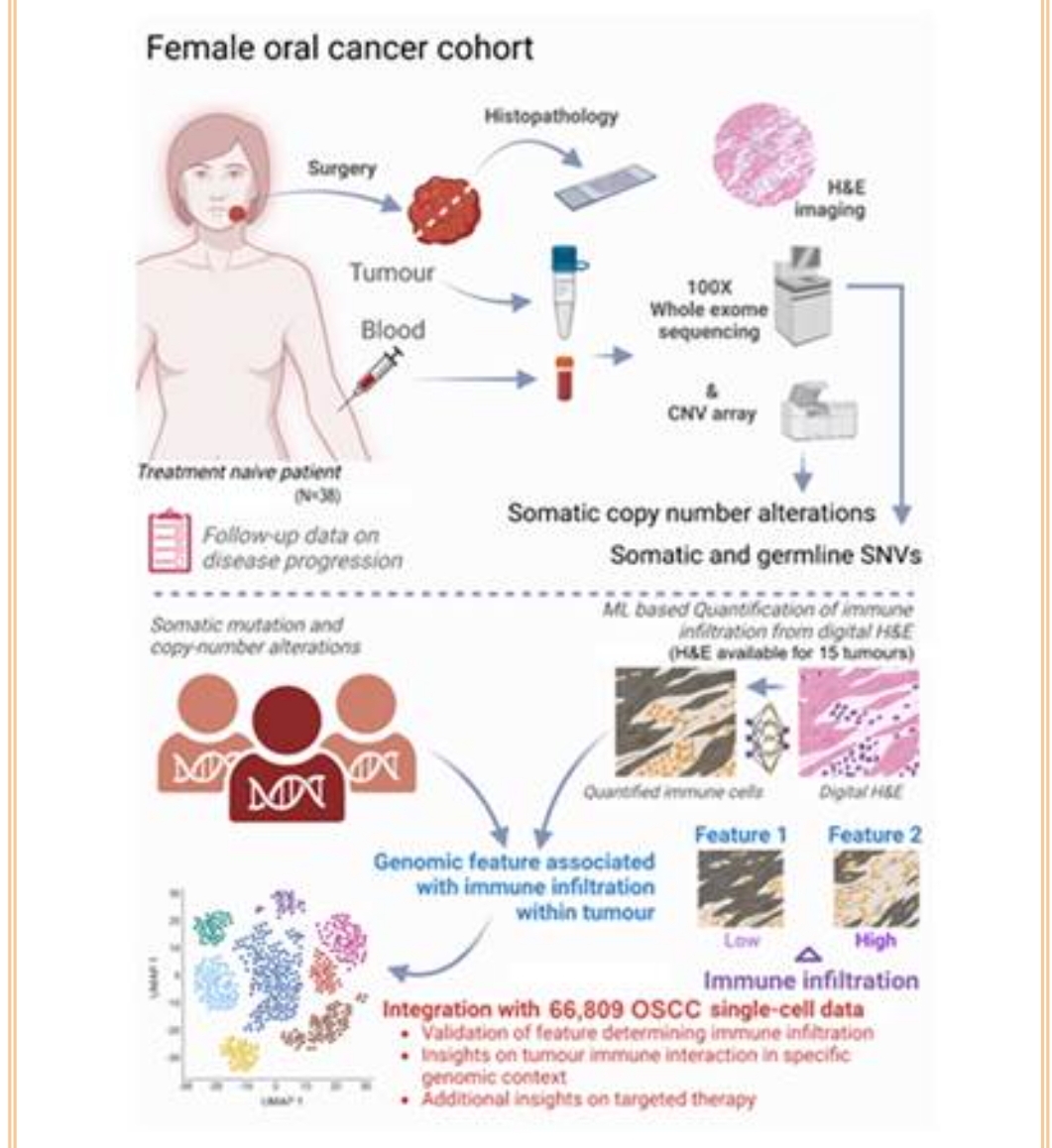
Using advanced whole-exome sequencing, the researchers identified ten genes that showed significant mutations in a cohort of 38 women from Kolar, Karnataka. Among these, two well-known cancer-related genes—CASP8 and TP53—stood out for their high mutation rates. Strikingly, the team found that CASP8 may act as a key driver mutation in these women, a discovery that differs from previous studies, which predominantly involved male patients.
The combination of TP53 and CASP8 mutations appears to create an especially aggressive cancer phenotype, potentially explaining the high mortality associated with oral cancer in women from this region. Although the sample size was limited, the findings mark a crucial step forward in understanding sex-specific cancer biology.
The team also incorporated artificial intelligence into their analysis. Using deep-learning techniques to examine tumor tissue samples, they detected two distinct groups of patients—each exhibiting different immune response patterns. This differentiation could be vital in predicting which patients might respond better to particular therapies, opening the door to more precise and personalized treatment strategies.
The researchers emphasize the need for larger studies to validate their findings but believe the current results set an important foundation. Beyond scientific insights, the study underscores the urgent need to include more women in cancer research, as well as the importance of region-specific studies given unique lifestyle and environmental factors.
This pioneering work not only deepens the understanding of oral cancer among Indian women but also provides a roadmap for future innovations in cancer diagnosis and treatment—bringing new hope to thousands at risk across the country.