India–EU Relations Enter a New Strategic Phase with Landmark Agreements During High-Level Visit.
New Delhi:
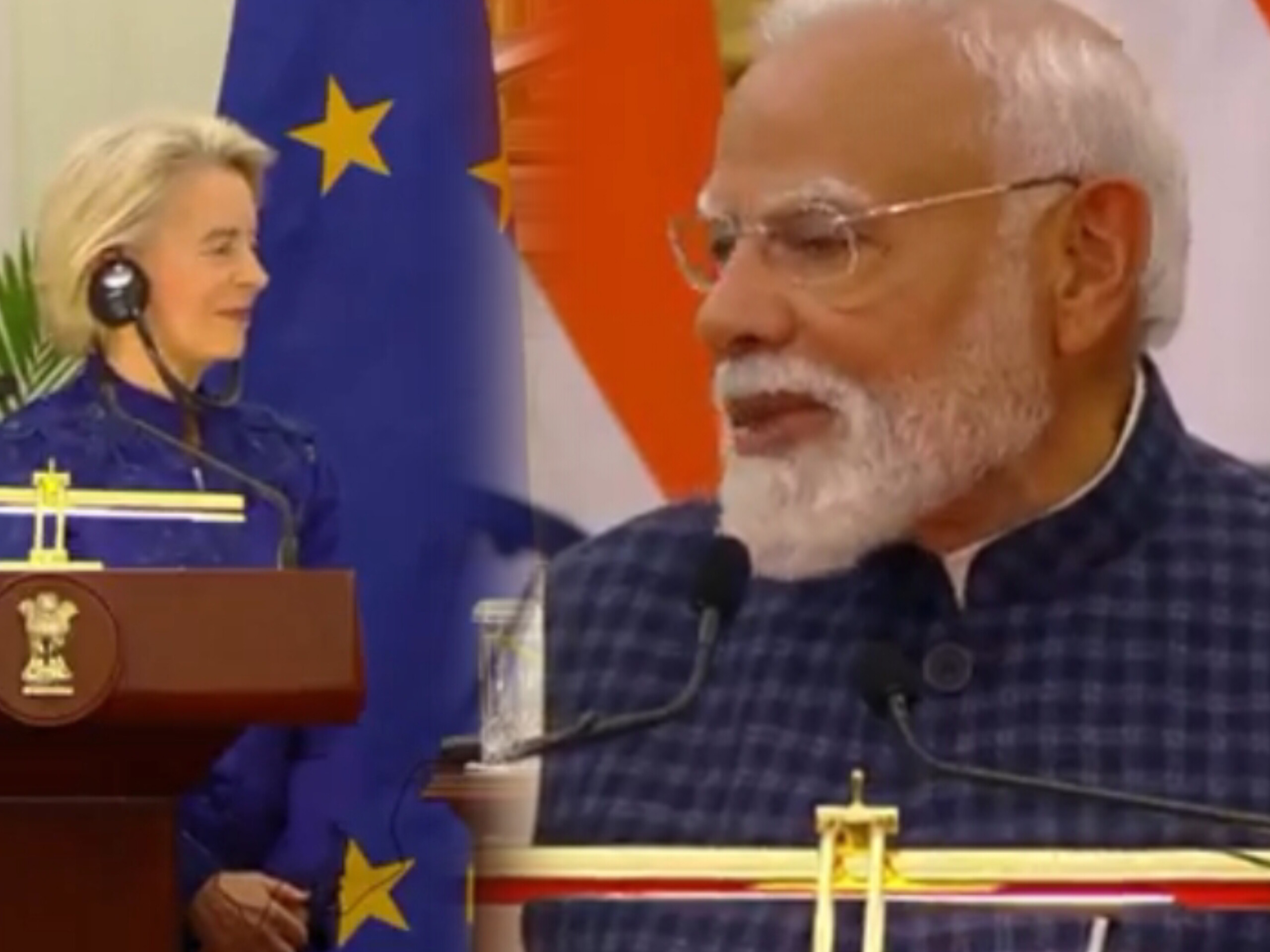
India and the European Union (EU) took a decisive step toward deepening their long-standing partnership with the successful visit of the President of the European Council and the President of the European Commission to India. The visit culminated in a comprehensive set of outcomes spanning trade, security, clean energy, technology, mobility, and global connectivity, reinforcing the growing strategic convergence between the two sides.
At the heart of the visit was the adoption of “Towards 2030: A Joint India–European Union Comprehensive Strategic Agenda”, an overarching roadmap that outlines shared priorities and cooperation across political, economic, security, technological, and people-to-people domains. The agenda reaffirms the commitment of both partners to a rules-based international order, sustainable development, and inclusive growth.
Major Boost to Trade and Economic Ties
A key highlight of the visit was the Joint Announcement on the conclusion of negotiations for the India–EU Free Trade Agreement (FTA). The agreement is expected to significantly enhance bilateral trade, investment flows, and economic integration, providing new opportunities for businesses on both sides. It marks a major milestone in strengthening India–EU trade and financial cooperation.
Further strengthening financial sector cooperation, the Reserve Bank of India (RBI) and the European Securities and Markets Authority (ESMA) signed a Memorandum of Understanding, facilitating closer regulatory coordination and information exchange.
Expanding Security and Defence Cooperation
Reflecting shared security interests, India and the EU unveiled a Security and Defence Partnership, underscoring enhanced cooperation in defence, maritime security, cyber security, and counter-terrorism. In addition, both sides launched negotiations for an India–EU Security of Information Agreement, aimed at enabling secure exchange of classified information and deeper institutional collaboration.
Advancing Digital Trust and Mobility
To strengthen digital and administrative cooperation, an Administrative Arrangement on Advanced Electronic Signatures and Seals was concluded, promoting interoperability and trust in digital transactions.
In the area of skilling and people-to-people ties, the two sides signed a MoU on a Comprehensive Framework for Cooperation on Mobility, focusing on skills development and talent exchange. Complementing this, the EU announced the setting up of a pilot Legal Gateway Office in India, designed to facilitate legal pathways and enhance skill mobility between India and Europe.
Cooperation in Disaster Management and Humanitarian Assistance
India and the EU also deepened collaboration in disaster preparedness and response through an Administrative Arrangement between India’s National Disaster Management Authority (NDMA) and the EU Directorate-General for European Civil Protection and Humanitarian Aid Operations (DG-ECHO). The arrangement focuses on disaster risk management, early warning systems, and coordinated emergency response.
Clean Energy, Science, and Innovation at the Core
Reinforcing their shared climate ambitions, India and the EU agreed to the constitution of a Green Hydrogen Task Force, aimed at accelerating cooperation in clean hydrogen technologies and supporting the global energy transition.
In the field of science and innovation, the two sides renewed the India–EU Agreement on Scientific and Technological Cooperation for the period 2025–2030, ensuring continuity in joint research and innovation initiatives. They also launched exploratory talks for India’s association with the Horizon Europe Programme, opening new avenues for Indian researchers and institutions to participate in Europe’s flagship research framework.
Global Connectivity and Development Cooperation
Demonstrating their commitment to inclusive global development, India and the EU agreed to jointly implement four projects under the India–EU Trilateral Cooperation framework. These projects focus on digital innovation and skills hubs for women and youth, solar-based solutions for empowering women farmers, early warning systems, and sustainable solar energy transitions in Africa, Small Island Developing States in the Indo-Pacific, and the Caribbean.
A Forward-Looking Partnership
The outcomes of the visit underline the growing breadth and depth of the India–EU Strategic Partnership. By aligning priorities across trade, security, clean energy, technology, and global development, India and the European Union have set a clear and ambitious course toward a resilient, future-oriented partnership leading up to 2030 and beyond.