Melania Trump and Queen Camilla Lead Groundbreaking AI and VR Education Initiative at the White House.
Washington DC:
In a significant demonstration of how emerging technologies are reshaping education, US First Lady Melania Trump joined UK Queen Camilla to host a cross-cultural educational program at the White House Tennis Pavilion. The initiative highlighted the growing role of artificial intelligence and virtual reality in enhancing historical learning and fostering global understanding among students.
The program was conducted under Mrs. Trump’s “Fostering the Future Together” initiative, which is part of her broader Be Best campaign. The event brought together a group of American students, including several recognized as state champions in the Presidential AI Challenge, to participate in a unique, technology-driven exploration of British and American history.
Speaking during the event, Melania Trump emphasized the transformative potential of digital tools in education. She stated that students around the world can now visit historically important sites, learn about the past, and draw inspiration without the need for physical travel. She added that virtual reality and artificial intelligence are enabling educational experiences that are richer, more engaging, and more memorable than traditional methods.
Students began the program by using Meta Quest headsets, each customized with the “Fostering the Future Together” logo along with the flags of the United States and the United Kingdom. Through a fully immersive 360-degree virtual reality experience, participants explored several iconic landmarks across the United Kingdom. These included Snowdonia, Giant’s Causeway, Stonehenge, and the exterior of Buckingham Palace. The immersive journey enabled students to deepen their understanding of geography, history, and cultural diversity through advanced visualization technologies.
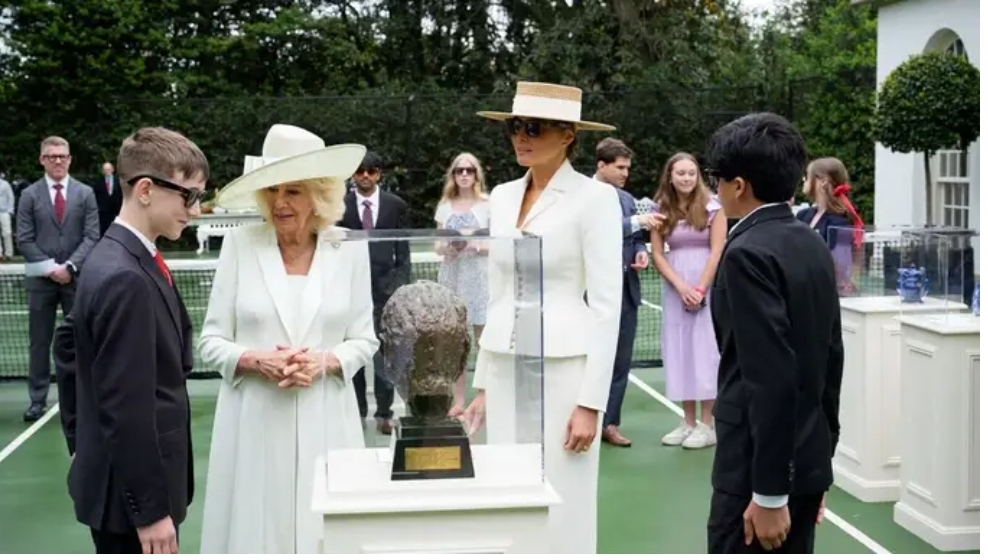
Following the virtual tour, the program transitioned to an interactive session using artificial intelligence-powered glasses developed by Meta. During this segment, Melania Trump presented a curated selection of historically significant artifacts to Queen Camilla and the students. Many of these items were sourced from the White House Collection and the National Archives and Records Administration.
Among the artifacts displayed was a portrait of John Adams, who served as the first United States Ambassador to the United Kingdom. Students also examined a World War II situation map prepared for Franklin D. Roosevelt, offering insight into wartime strategy and leadership. Additional items included a bronze bust of Winston Churchill, symbolizing the strong wartime alliance between the United States and the United Kingdom, as well as Staffordshire ceramics that reflect early transatlantic cultural exchange.
The collection further featured diplomatic gifts exchanged during previous state visits, illustrating the longstanding relationship and shared history between the two nations. These artifacts provided students with a tangible connection to historical events and figures, enhanced by the interpretive capabilities of artificial intelligence.
Throughout the program, Melania Trump and Queen Camilla actively engaged with the students. They encouraged thoughtful discussions about the intersection of history, culture, and technology, and they invited students to reflect on how innovation can expand access to knowledge. Their interactions underscored the importance of nurturing curiosity, critical thinking, and global awareness in the next generation.
The event represents a broader commitment by Melania Trump to integrate modern technology into educational initiatives while strengthening international partnerships. By combining artificial intelligence, virtual reality, and historical scholarship, the program demonstrated how digital tools can create meaningful and immersive learning experiences.
The initiative concluded with a shared message from both leaders emphasizing the importance of education, innovation, and collaboration in preparing young people for the future. The program stands as a model for how technology can bridge geographical distances, connect cultures, and inspire students to explore history in new and impactful ways.