16th National Meet of State Biodiversity Boards Begins in Chandigarh to Strengthen Biodiversity Governance.
States and UTs urged to align biodiversity rules and institutional mechanisms with amended national framework; focus on community participation, traditional knowledge and grassroots conservation.
Chandigarh/New Delhi:
The 16th National Meet of State Biodiversity Boards (SBBs) and Union Territory Biodiversity Councils (UTBCs) was inaugurated in Chandigarh on Sunday, bringing together biodiversity authorities, senior government officials, experts and scientists from across the country to deliberate on strengthening biodiversity governance at the State and local levels.
Organised by the National Biodiversity Authority (NBA), the two-day National Meet is being held from September 6–7, 2026. Chairpersons and Member Secretaries of SBBs and UTBCs from across India are participating in the event, along with senior officials, experts and scientists.
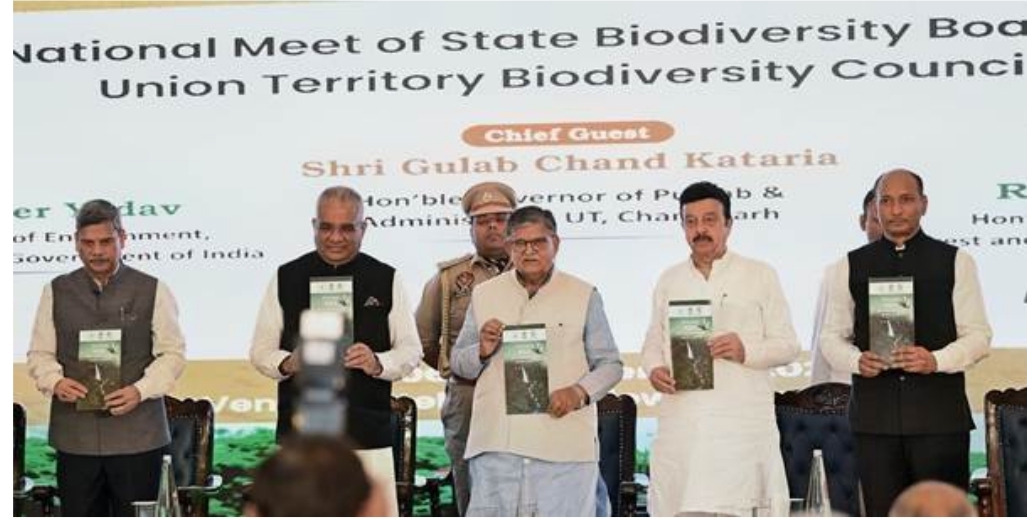
The inaugural session was presided over by Governor of Punjab and Administrator of UT Chandigarh Gulab Chand Kataria, Union Minister for Environment, Forest and Climate Change Bhupender Yadav, and Haryana Minister for Environment, Forest and Wildlife Rao Narbir Singh.
Secretary, Ministry of Environment, Forest and Climate Change Tanmay Kumar; Director General of Forests and Special Secretary Sushil Kumar Awasthi; Additional Secretary Ashutosh Agnihotri; Chairperson, National Biodiversity Authority Virendra Tiwari; and other senior officials of the Union Ministry, State Biodiversity Boards and Union Territory Biodiversity Councils were also present.
Traditional knowledge and community participation vital for conservation
Addressing the gathering, Gulab Chand Kataria highlighted India’s rich biological heritage and long-standing traditional environmental ethos. He said ecological security is closely connected with food and water security, livelihoods and sustainable development.
Kataria emphasised the need to combine traditional knowledge and community participation with contemporary approaches to biodiversity conservation. He also drew attention to the ecological significance of wetlands, riverine ecosystems and agricultural biodiversity.
He stressed the importance of strengthening Biodiversity Management Committees (BMCs) and People’s Biodiversity Registers (PBRs), while calling for stronger coordination between biodiversity institutions and local communities.
States and UTs asked to align biodiversity governance with amended framework
Union Environment Minister Bhupender Yadav highlighted India’s long-standing environmental ethos and referred to initiatives including Mission LiFE, Ek Ped Maa Ke Naam, Amrit Sarovar and the Green Credit Programme.
Yadav said India is combining its scientific capabilities with traditional community wisdom in its conservation efforts.
Referring to the Biological Diversity Act, 2002, the Minister said the Biological Diversity (Amendment) Act, 2023 and the Biological Diversity Rules, 2024 have further strengthened and streamlined the country’s biodiversity governance framework.
He urged States and Union Territories to align their rules, institutional mechanisms and implementation processes with the amended national framework to ensure effective implementation at the grassroots level.
More than 2.76 lakh Biodiversity Management Committees to be made effective
Yadav highlighted India’s progress in fulfilling its international biodiversity commitments, including the submission of the 7th National Report to the Convention on Biological Diversity and the 1st National Report on the Nagoya Protocol on Access and Benefit Sharing.
Emphasising grassroots implementation, he called for making more than 2.76 lakh Biodiversity Management Committees functional and effective.
The Minister also stressed that People’s Biodiversity Registers should evolve beyond being documentation exercises and become dynamic planning instruments for local bodies.
According to Yadav, PBRs should enable information on local biodiversity and associated traditional knowledge to feed into local planning and sustainable development.
Over Rs. 200 crore in Access and Benefit Sharing funds distributed
On Access and Benefit Sharing (ABS), Yadav said the National Biodiversity Authority has shared more than Rs. 200 crore in ABS funds with farmers, local communities, Biodiversity Management Committees, State Biodiversity Boards, Union Territory Biodiversity Councils and research institutions.
He emphasised that ABS mechanisms should provide tangible benefits to communities while simultaneously supporting biodiversity conservation and sustainable livelihoods.
During the event, several knowledge products were also released, including a document detailing the achievements of the National Biodiversity Authority over the last year. The publication provides an overview of the ABS scheme and the distribution of funds among different stakeholders.
Biodiversity conservation linked with climate action
Highlighting the strong links between biodiversity and climate action, Yadav said India has consistently taken decisive steps in accordance with international protocols on biodiversity conservation.
He emphasised the importance of adopting both a ‘Whole of Government’ and ‘Whole of Society’ approach to conservation.
The Minister referred to India’s Updated National Biodiversity Strategy and Action Plan (NBSAP) 2024–2030, which is aligned with the Kunming-Montreal Global Biodiversity Framework (KMGBF).
He called for measurable outcomes in areas including ecosystem restoration, species and habitat conservation, agro-biodiversity and the development of climate-resilient landscapes.
Yadav also encouraged States and Union Territories to become active partners in contributing to the global 30-by-30 conservation target, which seeks to conserve 30 per cent of the world’s land and ocean areas by 2030.
Haryana highlights role of Biodiversity Management Committees
Speaking at the event, Haryana Minister for Environment, Forest and Wildlife Rao Narbir Singh highlighted the State’s initiatives for biodiversity conservation and ecological restoration.
He emphasised the need to further strengthen biodiversity governance at both State and local levels. He highlighted the role played by Biodiversity Management Committees in Haryana in conserving local biodiversity and called for enhanced training and capacity building of BMCs and local communities.
National Meet to focus on stronger grassroots implementation
The two-day National Meet is providing a platform for States and Union Territories to exchange experiences, innovations and implementation challenges related to biodiversity conservation.
The deliberations are expected to focus on practical measures to strengthen biodiversity governance, improve the functioning of Biodiversity Management Committees, enhance the quality and use of People’s Biodiversity Registers, and expand capacity-building initiatives.
The meeting will also seek to strengthen institutional mechanisms and ensure more effective implementation of the national biodiversity governance framework at the State and local levels.
The emphasis on dynamic local-level planning, community participation and the integration of traditional knowledge with scientific approaches is expected to play an important role in ensuring that biodiversity conservation contributes directly to sustainable development and resilient communities.