
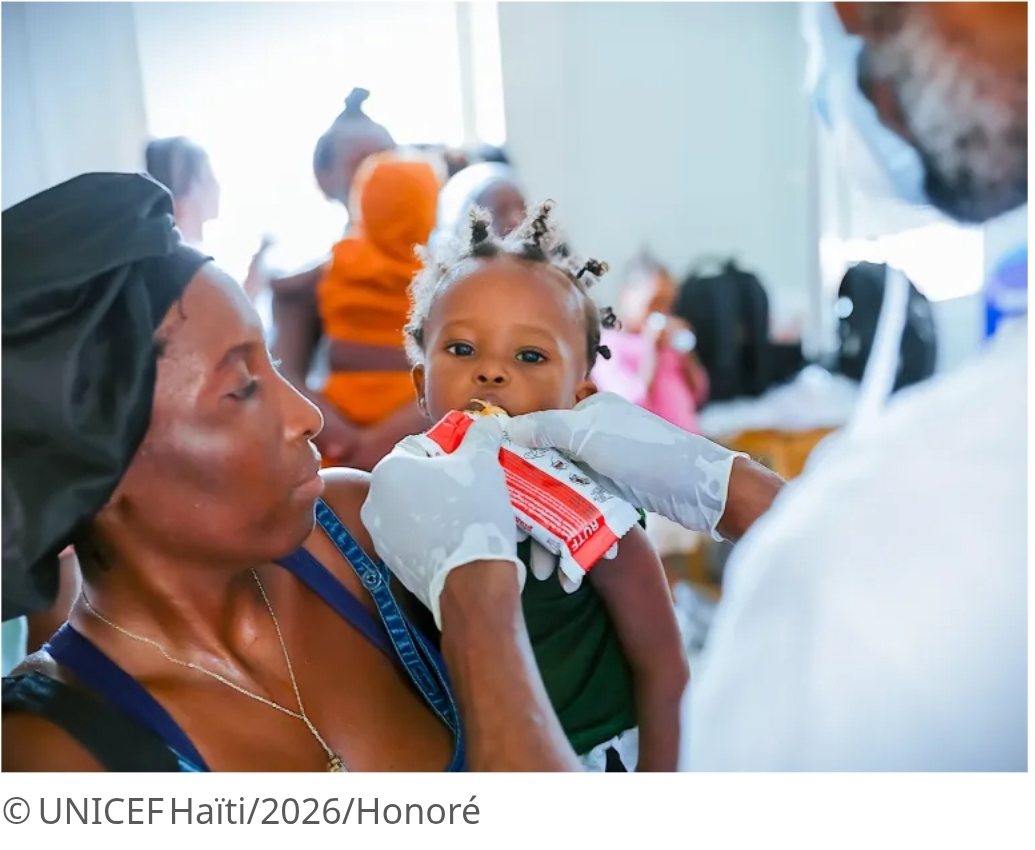
Haiti Faces Deepening Child Malnutrition Crisis as Violence Displaces Families.
PORT-AU-PRINCE:
More than a quarter of a million young children in Haiti are expected to face acute malnutrition over the next year as escalating violence, displacement and limited access to essential services threaten to worsen an already severe humanitarian crisis.
An estimated 253,725 children aged 6 to 59 months are projected to suffer from acute malnutrition between June 2026 and May 2027, according to an analysis led by Haiti’s Ministry of Public Health and Population, with support from UNICEF, FAO, WFP, WHO and other nutrition partners.
Of those children, nearly 94,000 are expected to experience severe acute malnutrition, a potentially life-threatening condition requiring timely treatment. Another 159,852 children are projected to experience moderate acute malnutrition.
The assessment also estimates that around 25,750 pregnant and breastfeeding women will require nutritional support during the same period.
Violence and displacement worsening the crisis
The worsening nutrition situation comes amid continuing violence by armed groups across Haiti. The violence has forced families to flee their homes, disrupted access to food and healthcare, and made it more difficult for humanitarian organizations to reach vulnerable communities.
Approximately 1.47 million people were internally displaced in Haiti as of mid-May 2026, according to the assessment.
Humanitarian agencies warn that displacement can leave families without reliable access to nutritious food, clean water, healthcare and other basic services, increasing the risk of malnutrition among children.
Cité Soleil and Cabaret face critical conditions
The analysis indicates that the situation could deteriorate further in the coming months.
Between December 2026 and May 2027, 29 of Haiti’s 140 municipalities are projected to reach IPC Acute Malnutrition Phase 3, classified as serious levels of acute malnutrition.
Two municipalities — Cité Soleil and Cabaret — are projected to reach Phase 4, classified as critical.
The IPC Acute Malnutrition classification is used to identify the severity of acute malnutrition and help humanitarian agencies prioritize resources. Phase 4 represents very high levels of acute malnutrition and an increased risk of illness and death among affected children.
Agencies call for urgent intervention
UNICEF, FAO and WFP are urging the Haitian government, donors, civil society organizations, international agencies and other partners to expand both prevention and treatment programmes before conditions deteriorate further.
The agencies are calling for community-based screening to identify malnourished children earlier, timely access to treatment, adequate supplies of therapeutic food and nutritional assistance for pregnant and breastfeeding women.
UNICEF Representative to Haiti Geeta Narayan said the figures highlight the need to reach vulnerable children before their condition becomes life-threatening.
FAO Representative in Haiti Pierre Vauthier emphasized that addressing malnutrition requires action beyond emergency treatment. He called for greater access to diverse and nutritious food, protection of agricultural livelihoods and stronger local food production so vulnerable households can better withstand future shocks.
WFP Representative to Haiti and Country Director Lauren Landis said greater investment in nutrition, healthcare, school meals and assistance to vulnerable families could help prevent more severe humanitarian and economic consequences in the future.
Food, water and healthcare support needed
The UN agencies are also calling for nutrition programmes to be combined with access to safe water, sanitation and healthcare, while protecting household food production and livelihoods.
They stressed the importance of maintaining safe humanitarian access and securing immediate, flexible funding so families can reach essential services and aid organizations can pre-position supplies and prepare for rising needs.
With the projected deterioration expected from December 2026 through May 2027, humanitarian agencies say early action will be crucial to prevent moderate malnutrition from progressing to severe cases.
The agencies are urging partners to act before the crisis deepens, arguing that timely prevention and treatment can reduce the number of children becoming severely malnourished and help save lives.