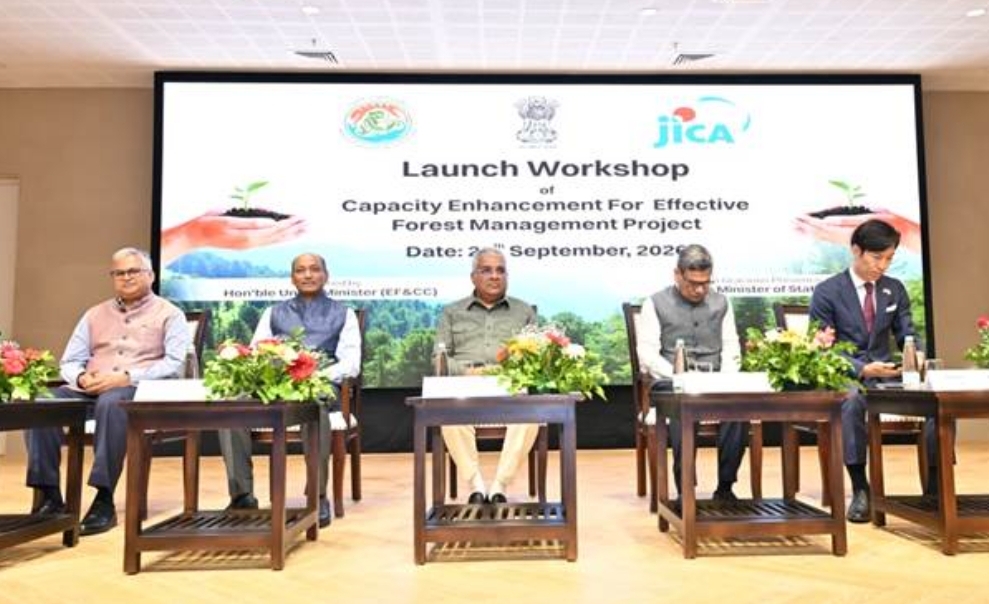
Environment Minister Launches Workshop on Capacity Enhancement for Effective Forest Management Project with JICA.
Project to strengthen frontline forest personnel through region-specific training, scientific approaches and emerging technologies.
New Delhi:
Union Minister for Environment, Forest and Climate Change Bhupender Yadav on Thursday launched a workshop on the ‘Capacity Enhancement for Effective Forest Management Project’, organised by the Ministry of Environment, Forest and Climate Change (MoEFCC) in collaboration with the Japan International Cooperation Agency (JICA), in New Delhi.
The workshop brought together senior officials of the Ministry, a senior representative of JICA India, representatives from Forest Departments of various States and Union Territories, Indian research institutions and Central Training Institutes working in the field of forestry.
The Capacity Enhancement Project, being implemented from 2025-26 to 2031-32, aims to strengthen the capabilities of frontline forest personnel in response to changing forest and wildlife management requirements, emerging climate and environmental challenges and the increasingly diverse responsibilities of field-level officials.
The project also seeks to strengthen research and development and facilitate the translation of research findings and technical knowledge into improved training programmes and sustainable forest management practices.
Focus on region-specific capacity building
Addressing the inaugural session, Bhupender Yadav said the project represents an important milestone in the long-standing cooperation between India and Japan in the forestry sector. He emphasised that forests play a critical role in addressing climate change, conserving biodiversity and supporting the livelihoods of communities dependent on forest resources.
The Minister underlined the need to strengthen the capacity of frontline forest personnel from both operational and administrative perspectives. He said capacity-building initiatives should respond to the realities faced by forest officials on the ground and should integrate local knowledge with modern scientific and technological approaches.
Highlighting forest fires as a global challenge, Yadav said the project has significant potential to enhance technical and field-level capabilities in forest fire management, biodiversity conservation and climate action.
He stressed that capacity building should extend beyond conventional classroom-based training and focus on the practical application of modern technologies and field-level best practices. He also emphasised the importance of incorporating the knowledge and experience of local communities into forest management approaches.
Yadav called for the development of region-specific capacity-building modules that take into account local knowledge, ecological conditions and challenges faced by different regions. He also urged stakeholders to ensure that the deliberations of the workshop are translated into tangible action on the ground by bringing together traditional knowledge, the latest scientific approaches and emerging technologies.
Research, technology and field-level solutions
The project includes several key components aimed at improving the effectiveness of forest management. These include research and development for practical technological solutions, pilot projects for field-level application, strengthening of training institutions and promotion of practice-oriented training.
Another component involves sharing best practices with SAARC countries and other developing nations, with the objective of contributing to wider cooperation in sustainable forest management and capacity enhancement.
JICA highlights nearly three decades of partnership
Speaking at the workshop, Eiji Wakamatsu, Senior Representative, JICA India Office, said the project seeks to establish a platform connecting Indian and Japanese research institutions to develop solutions to global challenges.
He said the initiative would also contribute to strengthening India’s leadership in the Global South in areas including forest management, climate change and capacity building.
Wakamatsu noted that JICA’s partnership with India in the forestry sector has continued for nearly three decades and has benefited more than seven lakh people.
He highlighted that the second phase of the project, covering 2025-26 to 2031-32, will focus on areas such as wood transformation and livelihood generation, digital transformation for improved forest management and collaborative academic research.
JICA also reaffirmed its commitment to deepening cooperation with the Union and State Governments in India for sustainable forest management and capacity enhancement.
Project outlay of Rs. 537.10 crore
Earlier, Additional Director General (Wildlife), MoEFCC, Ramesh Pandey, informed participants that the project has a total outlay of Rs. 537.10 crore. Of this, the JICA contribution is Rs. 440.42 crore, while the Government of India share stands at Rs. 96.68 crore.
The project will be implemented over a period of seven years, from 2025-26 to 2031-32, and will involve States across India. Priority will be given to new participating States, while States that were part of an earlier related project will also continue to receive support.
The initiative builds upon the earlier JICA-supported programme and aims to further strengthen sustainable forest management as well as the technical and professional capabilities of frontline forest personnel.
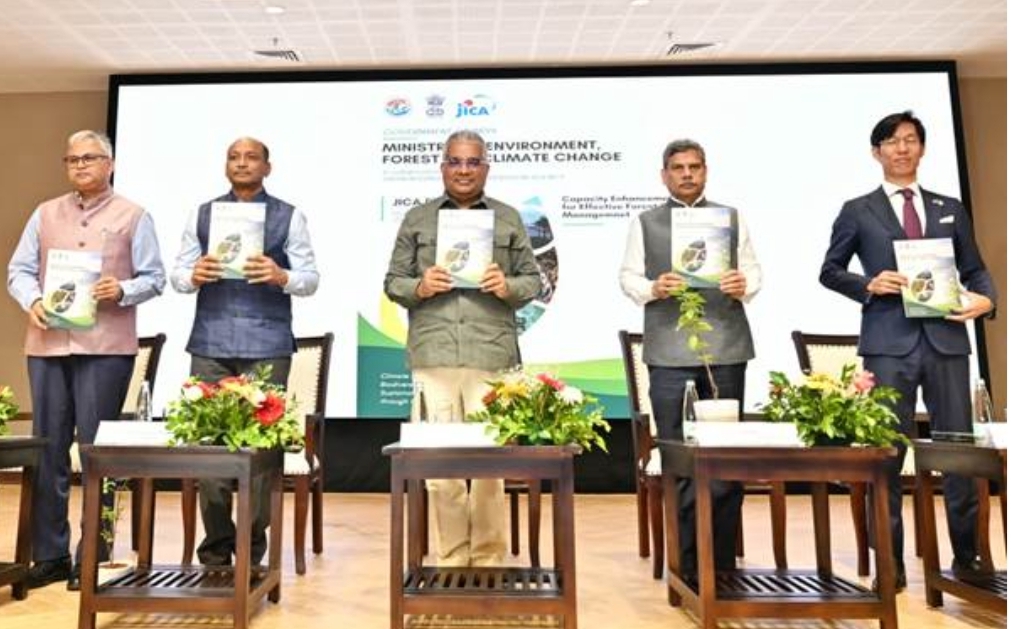
Project brochure released
The workshop also witnessed the release of the Project Brochure, outlining the major objectives, activities and areas of cooperation under the initiative.
During the technical session, the Ministry made a presentation on the objectives and scope of the project. JICA representatives shared their perspectives on the initiative, followed by an interactive session involving representatives from State Forest Departments, research institutions and Central Training Institutes.
The workshop highlighted the importance of strengthening institutional capacity, promoting practical research and technology adoption, and ensuring that forest management strategies remain responsive to changing environmental, climatic and field-level challenges.