PM Modi Calls for Future-Ready Civil Services as UPSC Marks 100 Years; Stresses ‘Nation First’ and ‘Citizen First’.
New Delhi:
Prime Minister Narendra Modi on Thursday called for a future-ready recruitment and examination system for India’s civil services, saying that the Union Public Service Commission (UPSC) and State Public Service Commissions would play a crucial role in building the governance framework needed for a developed India.
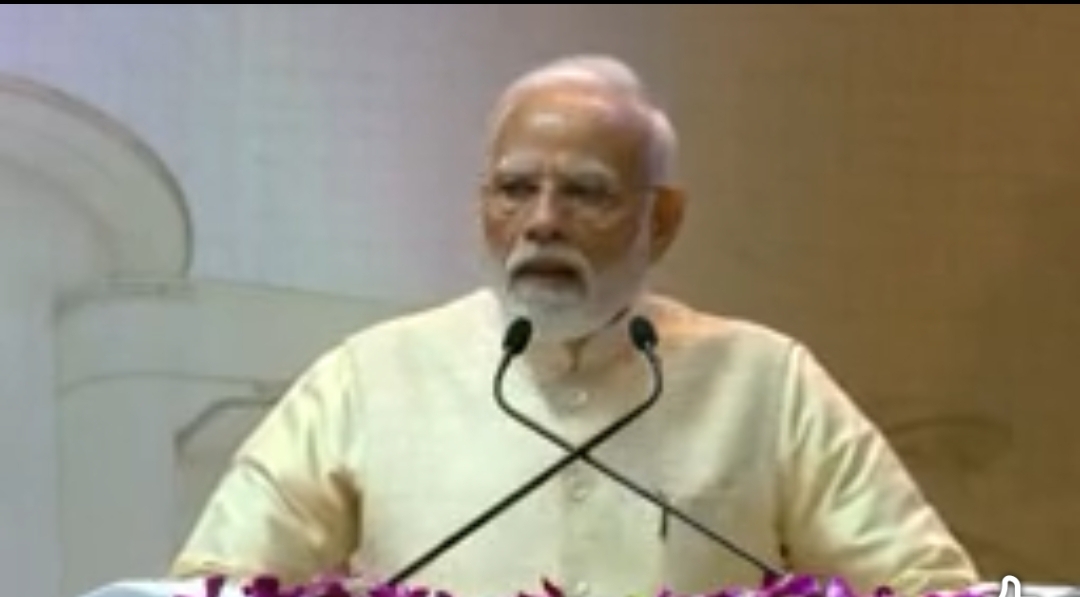
Addressing the centenary celebrations of the UPSC, Modi said the commission’s 100-year journey represented not only an institutional milestone but also the aspirations of millions of young Indians who seek to enter public service and the trust that citizens place in the institution.
The Prime Minister said that while generations, governments, technology and examination syllabi had changed over the past century, public confidence in the UPSC had remained strong.
Modi pays tribute to UPSC’s century-long journey
During the event, a commemorative postage stamp and coin marking the UPSC’s centenary were released, along with a compilation of 100 important case laws. Modi also visited an exhibition showcasing milestones from the commission’s history.
Referring to the historical evolution of the examination system, he recalled that freedom fighter Subhas Chandra Bose had gone through the civil service selection process in 1920. He noted that Sanskrit was among the examination subjects at the time and that Bose had taken the Sanskrit paper.
The Prime Minister also paid tribute to former Deputy Prime Minister and Home Minister Sardar Vallabhbhai Patel, crediting him with strengthening the institutional foundations of India’s civil services after Independence.
According to Modi, Patel provided the “steel frame” required for nation-building and helped establish the civil services as an important pillar of independent India.
Focus on ‘Nation First’ and ‘Citizen First’
Looking ahead to the next 20-25 years, Modi said the requirements of governance would change significantly as India became more urbanised and citizens—particularly young people—developed higher expectations.
He identified “Nation First” and “Citizen First” as two key principles that should guide the selection of future public servants.
The Prime Minister said recruitment should increasingly identify candidates who are motivated by public service rather than merely by holding public office.
He suggested that examinations should not only test what candidates know but should also examine why they want to join the civil services.
Modi said he often asks trainee officers to write down why they entered public service and retain that note as their responsibilities evolve. He suggested that UPSC and State Public Service Commissions could consider developing similar mechanisms to help officials periodically reconnect with their original motivation for entering public service.
‘Citizen Devo Bhava’ and a new governance culture
Modi said India had moved beyond an era in which government was viewed as the “maai-baap” or all-powerful provider and was now moving towards a philosophy of “Nagrik Devo Bhava”, under which citizens are placed at the centre of governance.
He outlined a governance approach based on three principles: Pro-People, Pro-Active and Good Governance.
According to the Prime Minister, a pro-people administration should prioritise citizens’ interests rather than administrative convenience. A proactive administration should anticipate problems and prepare solutions before they become crises.
He said good governance should ensure that government neither remains absent when needed nor creates unnecessary pressure or interference in citizens’ lives.
Modi said future civil servants should possess empathy for the difficulties faced by poorer sections, the initiative to act proactively, innovative problem-solving abilities and an understanding of the country’s changing requirements.
He also stressed that officials should be capable of enforcing laws while assessing whether implementation is making people’s lives easier or unintentionally creating obstacles.
AI, deepfakes and climate challenges to shape future recruitment
The Prime Minister said technological and social changes would create new challenges for civil servants.
Referring to the rapid development of artificial intelligence, he highlighted issues including information warfare, deepfakes, algorithmic bias and climate justice.
He said recruitment processes would therefore need to place greater emphasis on complex problem-solving and the ability to think ahead.
The Prime Minister argued that the civil services of the future would have to operate in circumstances substantially different from those faced by previous generations, requiring recruitment systems to evolve accordingly.
PM calls for shorter examination cycles
Modi also called for reforms to reduce the time taken to complete competitive examinations.
He said examinations should not be treated merely as administrative events because delays can directly affect the lives and finances of candidates.
Candidates preparing for competitive examinations often face expenses related to coaching, accommodation and transportation, he said, adding that prolonged examination cycles can impose a significant burden on families.
The Prime Minister urged UPSC and other selection commissions to adopt the principle of “Time Certainty” while maintaining examination standards.
He noted that the UPSC had already reduced the examination timeline by around 100 days and congratulated the commission for the progress.
Modi described faster examination cycles not only as an administrative reform but also as an “equity reform”, arguing that reducing uncertainty and waiting periods can help lessen the burden on candidates.
Greater cooperation between UPSC and State PSCs
The Prime Minister also called for stronger institutional cooperation between the UPSC and State Public Service Commissions.
He referred to national-level conferences involving chief secretaries and Director Generals of Police as examples of platforms through which states can exchange best practices.
Modi said the annual National Conference involving UPSC and State Public Service Commissions could be further expanded and made more productive.
He suggested that such forums should examine international best practices, the use of technology to improve efficiency, and greater cross-learning among recruitment institutions.
He also called for consideration of greater standardisation of processes and procedures across selection commissions, saying this could provide additional support to candidates.
Capacity building and use of technology
The Prime Minister emphasised the need for continuous capacity building within UPSC and State Public Service Commissions.
He suggested that the Mission Karmayogi framework and the iGOT platform could be used to strengthen the capabilities of personnel working within these institutions and improve their internal systems.
He said recruitment institutions themselves must continuously upgrade their skills and processes in response to technological and administrative changes.
Rising participation from rural areas and women
Highlighting changes in the composition of civil service aspirants, Modi said access to public service opportunities had expanded beyond major cities and privileged educational institutions.
He noted that young people from villages and small towns were increasingly entering public service and that women’s participation had also grown significantly.
According to figures cited by the Prime Minister, women constituted around 3% of civil service candidates in 1952, compared with more than 30% today.
He also pointed out that UPSC has had four women chairpersons in its history, three of whom were appointed after 2014.
Modi said these developments reflected the widening pool of opportunities available to Indians from different backgrounds.
45-fold increase in examination participation
The Prime Minister said the number of people appearing for UPSC examinations had increased by more than 45 times compared with the period when the commission completed 50 years in 1976.
He described the resulting talent pool as a major national asset while stressing the responsibility placed on the selection commission.
According to Modi, UPSC is not simply selecting individual candidates. Those selected eventually become representatives of the government at different levels, meaning that citizens may perceive the public servant they encounter as the face of government itself.
He therefore emphasised the importance of maintaining a rigorous and credible selection process.
Preserving UPSC’s core values while modernising
Concluding his address, Modi said the UPSC’s second century should focus on addressing new opportunities and challenges while preserving the values that have underpinned its credibility.
He identified independence, impartiality, merit, confidentiality and fairness of process as core characteristics of the institution.
The Prime Minister said these values should remain intact even as the commission upgrades its systems to meet the requirements of the future.
He said the next phase should build on the institution’s century-long credibility while preparing the recruitment system for the governance challenges of the coming decades.
The centenary celebrations thus centred on the evolution of India’s public-service recruitment system—from its historical foundations to the emerging requirements of technology-driven, citizen-centric governance in the years ahead.