Fragile Ceasefire Brings Hope but Gaza’s Children Still Face Grave Risks: UNICEF Official.
New York:
UNICEF Deputy Executive Director Ted Chaiban said that a fragile ceasefire in Gaza has begun to improve the lives of children, but warned that the humanitarian situation remains extremely precarious, with many children still facing hunger, cold, displacement and violence.
Speaking at today’s UN noon briefing after his fifth visit to Gaza and the West Bank, including East Jerusalem, Chaiban said the ceasefire, though imperfect, has led to measurable humanitarian gains for more than one million children.
“For the first time in many months, there are signs that an imperfect, fragile but vital ceasefire is making a difference,” he said, while cautioning that the scale of need remains overwhelming.
Humanitarian Gains Since Ceasefire
Chaiban noted that since the ceasefire took effect, more truckloads of life-saving aid have entered Gaza, commercial goods have returned to markets, and food availability has improved significantly in several areas. Vegetables, fruits, chicken and eggs are again available, and famine conditions have been reversed.
UNICEF and its partners have reached over 1.6 million people with clean drinking water, provided blankets and winter clothing to 700,000 people, and restored essential paediatric intensive care services at Al-Shifa Hospital in Gaza City. A Gaza-wide catch-up immunization campaign is currently underway to vaccinate children who missed routine vaccines during the war.
Since October, 72 UNICEF-supported nutrition facilities have been established, bringing the total to 196 facilities across Gaza, helping children suffering from acute malnutrition.
Children Still Paying the Highest Price
Despite these improvements, Chaiban stressed that the situation remains deadly for children. More than 100 children have reportedly been killed since the ceasefire began, and 100,000 children remain acutely malnourished, requiring long-term care.
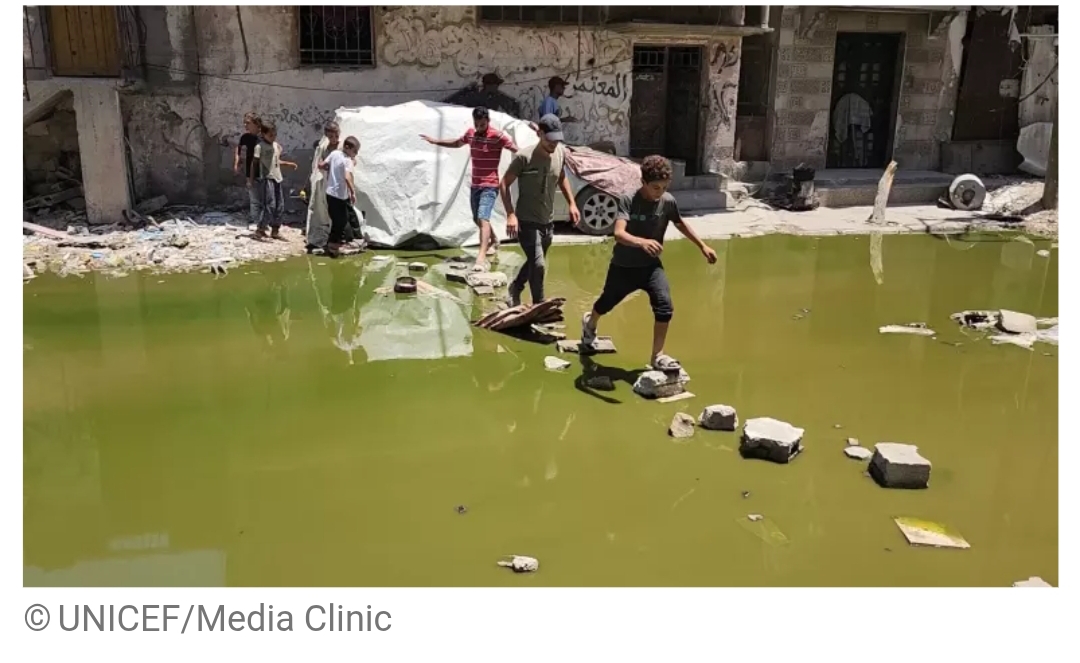
Around 1.3 million people, many of them children, urgently need proper shelter. Families are living in tents and bombed-out buildings amid freezing winter temperatures. At least 10 children have reportedly died from hypothermia since winter began.
“This is still an extremely precarious situation with survival at the edge,” Chaiban said.
He also expressed deep concern over the de-registration of international NGOs, warning that it could undermine humanitarian operations and severely limit the delivery of life-saving assistance across Gaza and the West Bank.
Education as a Path to Healing
Amid the destruction, Chaiban highlighted signs of hope, particularly in education. UNICEF and partners are supporting more than 250,000 children to resume learning through temporary learning centres.
He shared the story of Aya, a young girl studying at a UNICEF-run Temporary Learning Centre in Deir El Balah, who dreams of becoming a nurse and helping rebuild a peaceful Gaza.
“For children in Gaza, returning to classrooms is not only about learning,” Chaiban said. “It is a critical element of mental health and psychosocial support.”
More than 700,000 school-aged children have been out of formal education since October 2023. UNICEF plans to launch a major Back to Learning campaign this week.
Call for Action and Phase Two of Ceasefire
Chaiban emphasized that UNICEF and the World Food Programme (WFP) have delivered more than 10,000 aid trucks into Gaza since the ceasefire, accounting for 80 per cent of all humanitarian cargo. Together, the agencies are leading nutrition responses, education initiatives, and digital cash assistance reaching over one million people.
To secure lasting improvements, Chaiban outlined three urgent priorities:
1. The ceasefire must hold and move into Phase Two, enabling reconstruction and a safer environment for children.
2. Improved humanitarian access, including reopening all border crossings and safe corridors, especially for medical evacuations.
3. Predictable humanitarian operations, allowing essential supplies, including water, sanitation and education materials, to enter Gaza and support early recovery.
He called for reopening key crossings such as Rafah, Kerem Shalom, Erez East and West, and restoring major transport routes within Gaza to improve aid delivery.
“A Window We Cannot Waste”
Chaiban concluded by urging political leaders to act decisively.
“The children of Gaza do not need sympathy,” he said. “They need decisions now that give them warmth, safety, food, education and a future.”
“We have an opportunity — a window — to change the trajectory for these children. We can’t waste it.”