PM Narendra Modi Launches Development Projects Worth Rs. 18,800 Crore in Surat, Highlights Green Growth and Self-Reliance.
Surat:
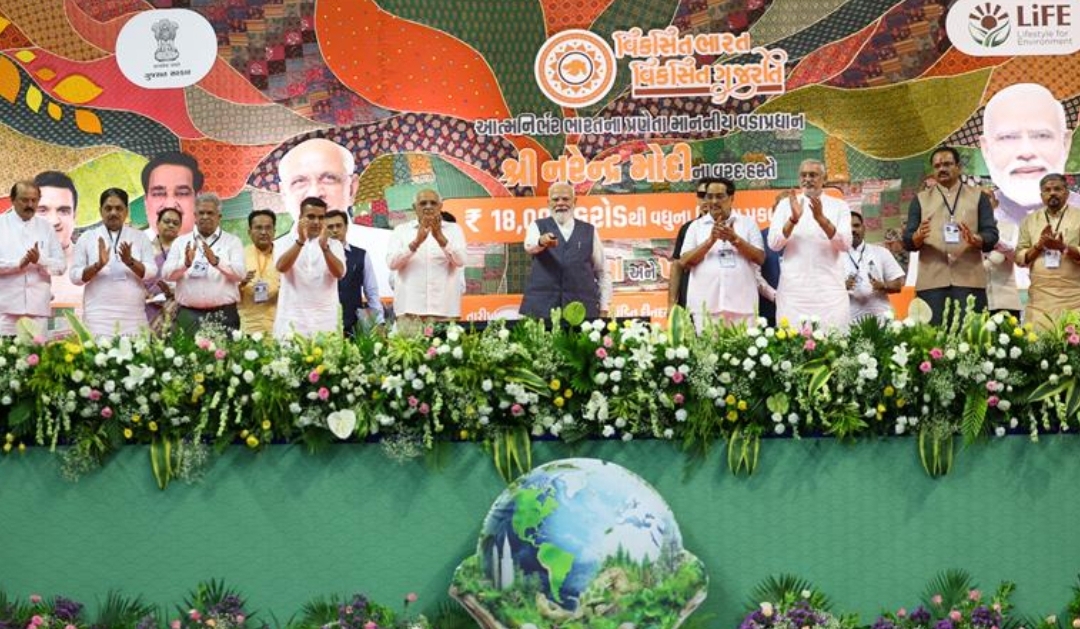
Prime Minister Narendra Modi inaugurated, dedicated to the nation, and laid the foundation stone for multiple development projects worth over Rs. 18,800 crore in Surat, Gujarat, on Thursday. The projects span key sectors including road infrastructure, power, industry, healthcare, and connectivity, aiming to boost economic growth, strengthen infrastructure, and improve the ease of living for citizens.
Addressing a large gathering, Prime Minister Modi thanked the people of Gujarat for their continued support and congratulated newly elected local body representatives from Surat and Navsari. He said the overwhelming public mandate reflects people’s faith in development and service-oriented governance.
“Our resolve is to build a Viksit Gujarat and a Viksit Bharat. This goal can only be achieved through the development of every village, district, and city of the country,” he said.
Environment Day and Surat’s Transformation
Marking World Environment Day, the Prime Minister expressed pride in visiting Surat, one of India’s cleanest cities. Recalling the city’s remarkable journey from being affected by a plague epidemic in the 1990s to becoming a model of cleanliness and urban management, he praised the efforts of citizens, municipal authorities, employees, and public representatives.
He highlighted that India is progressing with the guiding principle of “development in harmony with nature” and emphasized the importance of sustainable growth.
Gujarat Leading India’s Green Transition
The Prime Minister pointed out Gujarat’s pioneering role in climate action, recalling the establishment of India’s first Climate Change Department in 2009 and the development of the Charanka Solar Park.
He noted that Surat has become a model city by successfully implementing a Circular Water Economy, where treated wastewater is reused for industrial purposes. He also referred to the nationwide “Waste to Wealth” movement, which has significantly improved urban sanitation and environmental sustainability over the past twelve years.
Modi announced that the Tapi Barrage Project will help ensure long-term drinking water and drainage security for the region. He also highlighted Surat’s growing electric mobility network, expanding metro infrastructure, and plans for green steel production in the Hazira Industrial Area using renewable energy.
“These initiatives will strengthen Surat’s identity as a truly green city and set an example for sustainable urban development,” he said.
Focus on Energy Self-Reliance
Discussing global challenges such as the pandemic, geopolitical conflicts, and energy supply disruptions, Modi emphasized the need for energy self-reliance.
He noted that Gujarat contributes nearly one-fifth of India’s renewable energy capacity, generating around 50 GW out of the country’s total 250 GW renewable energy production. He added that the state is emerging as a leader in future-focused sectors such as Green Hydrogen and Green Ammonia.
The Prime Minister highlighted the government’s investments in solar power, ethanol blending, railway electrification, nuclear energy, modern transmission systems, gas pipelines, and port infrastructure over the past decade.
“The ongoing global uncertainty has demonstrated the importance of energy security and self-reliance,” he remarked.
Hazira Emerging as a Maritime-Industrial Powerhouse
Earlier in the day, the Prime Minister visited Hazira and described it as much more than an industrial zone. He called it a thriving ecosystem integrating energy, steel manufacturing, defense production, and international maritime trade.
According to Modi, Hazira represents the vision of Aatmanirbhar Bharat and showcases India’s growing industrial capabilities. He stressed that a self-reliant nation can achieve greater economic strength and global competitiveness.
Major Connectivity Projects to Drive Growth
The Prime Minister underlined the government’s commitment to building modern infrastructure through projects such as the Dedicated Freight Corridor, Mumbai-Ahmedabad Bullet Train, and newly inaugurated sections of the Vadodara-Mumbai Expressway.
He said these projects would significantly improve logistics, industrial growth, and trade opportunities.
Special emphasis was placed on extending modern road connectivity to tribal and rural regions. New four-lane highways in Chhota Udepur, Narmada, Bharuch, and Tapi districts are expected to reduce travel time, lower transportation costs, and improve access to education, healthcare, and tourism destinations such as the Statue of Unity and Saputara.
“Modern connectivity is transforming rural and tribal regions by creating better opportunities for education, healthcare, employment, and economic growth,” Modi stated.
Healthcare Boost for Workers and Families
Among the projects inaugurated was a modern ESIC Hospital in Surat, designed to provide quality healthcare services to industrial workers and migrant families residing in the region.
The Prime Minister said improved healthcare facilities are essential for supporting the workforce that contributes significantly to India’s economic development.
Call for Collective Nation-Building
Concluding his address, Modi expressed confidence in India’s future and praised the aspirations and determination of its citizens.
He said that despite global challenges, India continues to move forward with optimism and resilience due to the collective efforts of its 140 crore citizens.
“India is a nation driven by aspirations and confidence. When the people are united in purpose, no goal is beyond reach,” he said.
The development projects launched from Surat are expected to accelerate industrial growth, strengthen infrastructure, promote sustainability, improve connectivity, and contribute significantly to the vision of a developed India by 2047.