PWD to Be Strengthened and Made Technology-Driven to Meet Future Challenges: CM Sukhu.
Government Considering Expansion of PWD’s Mandate into Emerging Infrastructure Sectors.
Shimla:
Chief Minister Sukhvinder Singh Sukhu today emphasized the need to transform the Public Works Department (PWD) into a modern, technology-driven institution capable of addressing future infrastructure challenges, particularly those arising from climate change and natural disasters. He also indicated that the state government is contemplating expanding the traditional mandate of the department to include emerging sectors such as dam construction and advanced infrastructure development.
The Chief Minister was addressing the North Zone Inter-State Interactive Session on “Quality Assurance in Public Works Departments,” which brought together senior officers and engineers from Himachal Pradesh, Jammu & Kashmir, Haryana, Punjab, Uttarakhand, and Rajasthan.
Speaking on the occasion, Sukhu said the state government has initiated comprehensive reforms within the Public Works Department to strengthen its capabilities and prepare it for future challenges. He praised the department for its commendable role in restoring connectivity and infrastructure during the natural disasters that have affected Himachal Pradesh over the last three years.
Highlighting the growing impact of climate change, the Chief Minister said that Himachal Pradesh is already witnessing the adverse effects of extreme weather events, a trend that is likely to affect other states in the coming years. Given that nearly 90 percent of the state’s geographical area is mountainous, maintaining road connectivity remains a critical necessity for residents and economic activities.
“The Public Works Department must now evolve beyond conventional road construction and maintenance. It needs to adopt advanced technologies and take up projects such as tunnel construction, high-rise buildings, and other modern infrastructure initiatives. While embracing new technologies may present challenges initially, it is essential for ensuring sustainable development,” he said.
Sukhu warned that rebuilding infrastructure damaged by disasters would emerge as one of the biggest challenges in the future. He pointed out that currently around four percent of the Gross Domestic Product (GDP) is spent on disaster reconstruction, a figure that could increase to as much as 14 percent by 2050. This, he said, underscores the urgency of adopting innovative technologies and enhancing the department’s operational capabilities.
The Chief Minister further suggested that the PWD should broaden its scope of work and explore opportunities in sectors traditionally outside its mandate. Referring specifically to dam construction and other large-scale infrastructure projects, he said the government would seriously consider expanding the department’s responsibilities in the future.
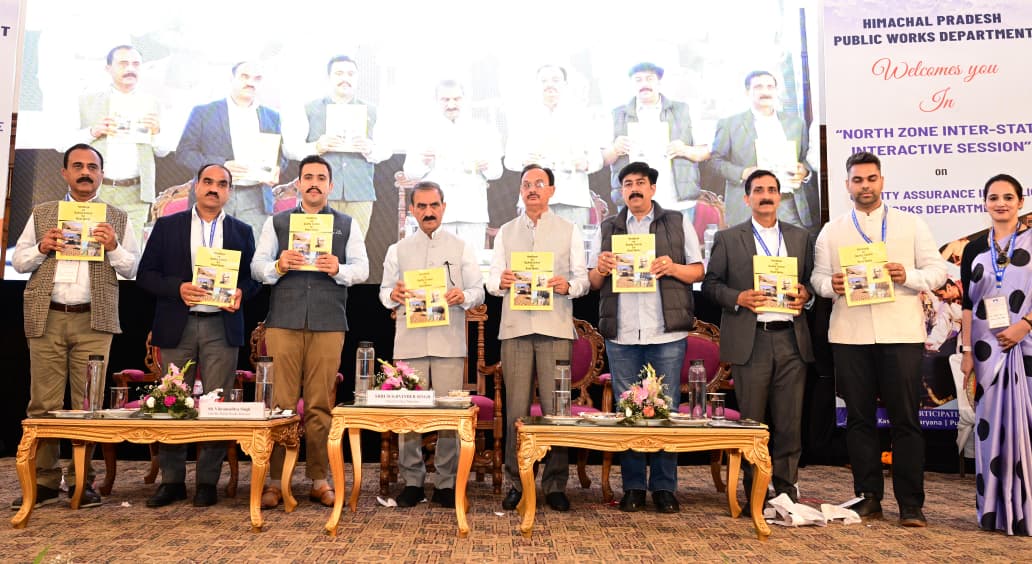
On the occasion, Sukhu also released a book titled “Quality Control for Road Works,” aimed at promoting best practices and higher standards in road construction and maintenance.
Addressing the gathering, Public Works Minister Vikramaditya Singh stressed that capacity building and the adoption of modern technologies are crucial for meeting the demands of the rapidly evolving infrastructure sector. He said that interactive sessions such as these provide engineers with valuable exposure to innovative technologies, contemporary engineering practices, and successful models adopted by other states.
Referring to the challenges posed by global warming and changing climatic conditions, the minister emphasized the need for developing innovative and sustainable solutions across northern India. “Sustainable development is no longer an option but a necessity. Infrastructure planning and execution must incorporate resilience and environmental considerations at every stage,” he said.
Vikramaditya Singh highlighted that Himachal Pradesh has developed an extensive road network of nearly 45,000 kilometres, with most panchayats now connected by road. However, maintaining and preserving this vast network in a sustainable manner remains a significant challenge for the department.
To address these concerns, he said the state government has introduced a new drainage policy designed to improve road maintenance and enhance the longevity of road infrastructure by preventing water-related damage.
The minister also pointed out that ongoing geopolitical tensions in the Middle East have led to a rise in the prices of construction materials, placing additional financial pressure on development projects. Managing these emerging challenges while ensuring uninterrupted infrastructure development remains a key focus of the government, he added.
The interactive session witnessed participation from senior engineers, policymakers, and technical experts from several northern states, providing a platform for exchanging ideas on quality assurance, infrastructure resilience, and adoption of modern engineering technologies.
Industries Minister Harshwardhan Chauhan, MLA Vivek Sharma, Special Secretary (GAD) Harbans Singh Brascon, Engineer-in-Chief PWD S.P. Jagota, along with senior engineers and officials from participating states, were present on the occasion.
The event underscored the growing importance of innovation, technology adoption, and inter-state collaboration in building resilient infrastructure systems capable of meeting the challenges of the future.