PM Modi Sets Out Seven-Stream Roadmap for ‘Viksit Bharat’ by 2047 in 80th Independence Day Address.
New Delhi:
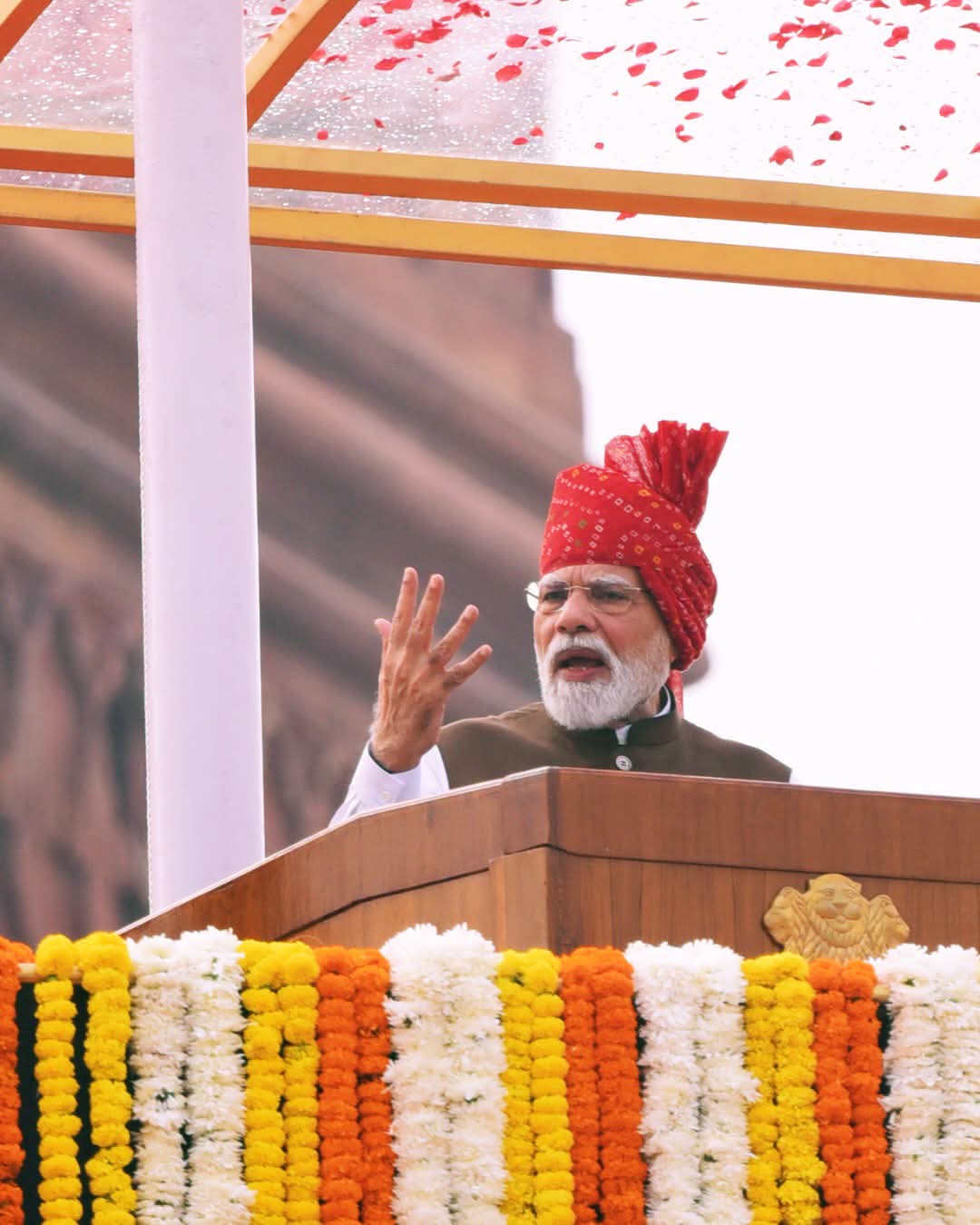
Prime Minister Narendra Modi, addressing the nation from the ramparts of the Red Fort on the occasion of India’s 80th Independence Day, laid out an ambitious roadmap for building a “Viksit Bharat” by 2047, with emphasis on self-reliance, manufacturing, agriculture, technology, energy security, defence, infrastructure, youth, women’s empowerment and India’s global soft power.
Beginning his address with a tribute to freedom fighters and the sacrifices made during the freedom struggle, Modi said India was celebrating the 150th anniversary of Vande Mataram. He also expressed solidarity with families affected by recent floods and landslides across the country.
The Prime Minister said India’s goal of becoming a developed nation by 2047 would be achieved through the collective resolve and capabilities of 140 crore citizens. He highlighted the progress made over the past 12 years, including the lifting of 25 crore people out of poverty, rapid economic growth and expansion in manufacturing and digital infrastructure.
According to Modi, defence production has increased nearly fourfold, Khadi and Village Industries production nearly fivefold, electronics manufacturing nearly sevenfold and mobile phone production 35-fold. Production of modern railway coaches has risen 21 times, while digital transactions have increased 100-fold and patents granted have quadrupled.
He also highlighted faster delivery of basic services, saying tap-water connections have been provided at 15 times the earlier annual rate, gas connections at six times the rate, toilets for the poor at four times the rate and houses for the poor at three times the earlier pace.
Seven streams of strength
Modi outlined a seven-pronged framework, or Sapt Dhara, to strengthen India’s capabilities.
Manufacturing was identified as a key priority under the self-reliance agenda. The Prime Minister urged MSMEs and manufacturers to use opportunities created by Free Trade Agreements with nearly 40 countries and make Indian products globally competitive. He called for complete domestic value chains, from design and components to final products, and stressed the mantra of “Quality, Quality, Quality.”
Agriculture and food production formed the second stream. Modi called for greater food processing, chemical-free farming and expansion of agricultural exports. He cited government support for fertiliser prices, noting that urea costing around ₹3,000 in global markets is made available to farmers for ₹300, while DAP costing about ₹5,000 is supplied at ₹1,350.
Technology and innovation was the third stream. Modi said India must become a global innovation hub rather than merely a market for technology. He highlighted UPI, Digital Public Infrastructure, AI, quantum technology, robotics, space and data centres, and set the goal of taking Made-in-India 6G technology to the world.
The fourth stream, Gati Shakti, focuses on seamless connectivity through high-speed rail, highways, inland waterways, airports and multimodal logistics.
Defence power, the fifth stream, will focus on next-generation technologies, drones, counter-drone systems, hypersonic defence and cybersecurity. Modi said defence exports have increased nearly 50-fold and Indian defence equipment is now reaching around 100 countries.
The sixth stream, Green and Blue Economy, includes renewable energy, green hydrogen, energy storage, green mobility, green manufacturing, fisheries, coastal tourism and ocean technology. Modi announced a target of 100 GW of nuclear power capacity by 2047 and said India’s solar capacity had risen from 2 GW to 160 GW.
The seventh stream is India’s soft power, encompassing yoga, Ayurveda, culture, handicrafts, films, animation, VFX, gaming, digital content and creative industries.
Semiconductor and energy push
The Prime Minister said three semiconductor plants had already been initiated and another five to eight plants were expected to come up in the next seven to eight years. He described semiconductor manufacturing as critical to India’s technological self-reliance.
On energy, Modi highlighted the expansion of piped gas from 70 cities in 2014 to 700 cities today and an increase in household piped-gas connections from around 20–22 lakh to 1.75 crore.
He said India was targeting 100 GW of nuclear power capacity by 2047 and planned to commission five new nuclear reactors during the current decade. He also highlighted India’s progress in Fast Breeder Reactor technology.
Railways, infrastructure and clean mobility
Modi said nearly the entire railway network had now been electrified, compared with around 30% before 2014. He also highlighted India’s first hydrogen-powered train and said the country was emerging as a global leader in hydrogen train technology.
Electric mobility was another focus, with Modi noting that EV sales had risen from around 1.5 lakh in 2009-10 to 25 lakh in 2025-26.
Youth and AI at the centre
A major announcement concerned artificial intelligence. Modi said the government would train one crore young people in AI skills over the next year, aiming to prepare India’s youth to lead in the global AI ecosystem.
He also highlighted more than 2.5 lakh registered startups, a ₹1 lakh crore Innovation Fund, over 10,000 Atal Tinkering Labs and the growth of India’s bioeconomy from ₹60,000 crore before 2014 to ₹20 lakh crore.
On sports, he said India was preparing to host the Commonwealth Games in 2030 and seeking to host the 2036 Olympics. A nationwide talent hunt for children aged five to 15 was also proposed to identify and develop future sporting talent.
Women’s representation and Lakhpati Didis
Modi said the target of creating three crore Lakhpati Didis had been surpassed and announced a new goal of six crore Lakhpati Didis. He also appealed to political parties to implement 33% reservation for women in state legislatures and the Lok Sabha at the earliest.
Education, health and social security
The Prime Minister highlighted the expansion of universities, medical education, foreign university partnerships and the National Education Policy. He said India was moving towards having nearly 1,000 universities and had established more than 10,000 Atal Tinkering Labs.
On healthcare, he highlighted Ayushman Bharat and said citizens aged 70 and above were eligible for free treatment and medicines up to ₹5 lakh. He also called for Indian pharmaceutical companies to enter the world’s top five.
Security and civil defence
Modi said Naxalism and Maoist violence had declined substantially but warned that the “Naxal mindset” remained a challenge. He announced plans to build a vibrant civil defence network equipped with modern systems and technologies to prepare citizens for emerging security threats.
Global ambitions
The Prime Minister set several ambitious economic and corporate goals, including having 50 Indian companies among the Fortune 500 within the next decade, placing an Indian bank among the world’s top five and creating globally recognised Indian technology, pharmaceutical and consulting companies.
He also called for continued reforms, saying outdated laws and policies could not meet the aspirations of 21st-century India.
Concluding his address, Modi urged citizens to place the national interest above personal interests and transform dreams into resolve, resolve into strength and strength into success. He called for collective efforts to build a developed, self-reliant and globally influential India by 2047.