PM Narendra Modi Inaugurates International Conference on Future of Environment and Climate Dynamics.
Says India is demonstrating that rapid development and environmental sustainability can go hand in hand.
New Delhi:
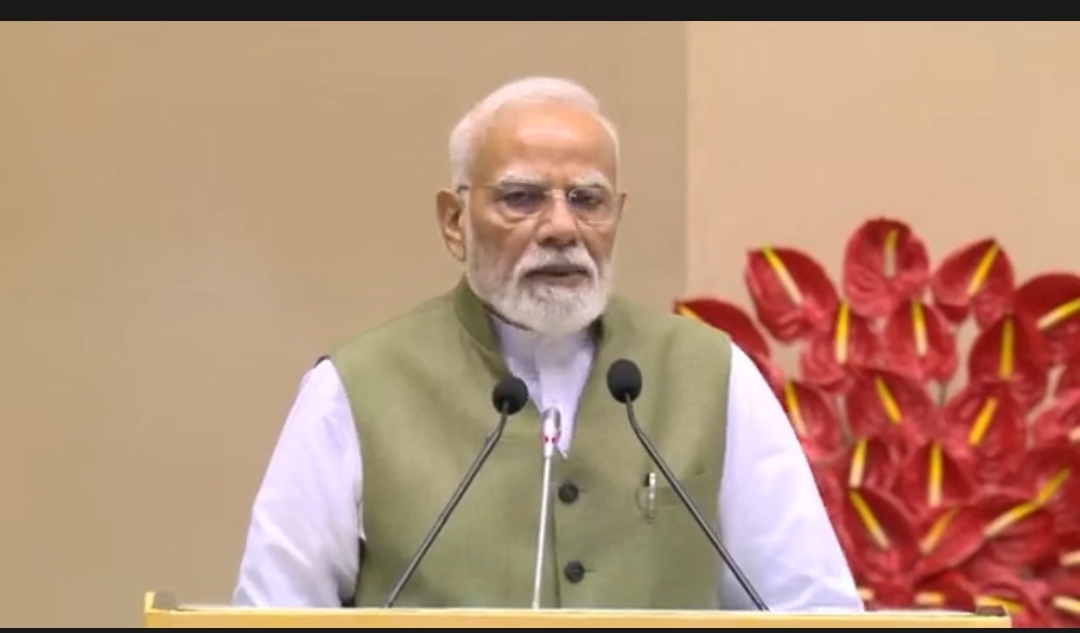
Prime Minister Narendra Modi on Saturday inaugurated the International Conference on “The Future of Environment and Climate Dynamics” at Vigyan Bhawan in New Delhi, highlighting India’s efforts to balance economic development with environmental protection and climate action.
Addressing the conference, Modi underlined India’s longstanding cultural and civilizational relationship with nature and said that traditional environmental wisdom is increasingly being integrated with modern solutions to address global climate challenges.
He also commended the National Green Tribunal for its contribution to environmental protection and congratulated the organisers of the international conference.
India’s contribution to global climate action
Modi said developing countries have often been unfairly blamed for global carbon emissions, while historical and per-capita emission patterns need to be taken into account. He stated that India’s per-capita carbon emissions remain less than half the global average and said India continues to highlight this perspective on international platforms.
He also referred to several global initiatives associated with India’s climate diplomacy, including One Sun, One World, One Grid, the International Solar Alliance, the Coalition for Disaster Resilient Infrastructure (CDRI), the Global Biofuel Alliance and the International Big Cat Alliance.
According to Modi, these initiatives reflect India’s approach of pursuing environmental protection while working with other countries to develop collective solutions to climate challenges.
Renewable energy at the centre of India’s environmental efforts
The Prime Minister said India has made substantial progress across environmental sectors over the past 12 years, with renewable energy emerging as a major area of focus.
He said India has achieved its commitments under the Paris Agreement adopted at COP-21 ahead of schedule and has recorded significant growth in non-fossil fuel and solar energy capacity.
Highlighting the expansion of solar power, Modi said India’s solar capacity has increased from around 2 gigawatts about 12 years ago to more than 160 gigawatts today.
He also highlighted the PM Surya Ghar Muft Bijli Yojana, under which more than 50 lakh homes have been solarised, with financial assistance of up to Rs 80,000 available per household.
The Prime Minister said around 30 lakh farmers have received solar pumps under the PM-KUSUM scheme, while the completion of the One Nation-One Grid project has contributed to preventing an estimated 200 million tonnes of carbon emissions.
Expansion of clean energy
Modi pointed to the increase in India’s wind power capacity, expansion of hydropower and renewed emphasis on nuclear energy. He said the country’s non-fossil energy capacity has increased substantially over the past decade.
He also highlighted initiatives such as coal gasification and other clean-energy technologies, saying India is continuing to expand its clean-energy portfolio.
Hydrogen train marks new phase in green mobility
Speaking about clean transportation, Modi referred to the recent launch of India’s first hydrogen-powered train and described it as an important milestone for green mobility.
He also highlighted the rapid growth of electric vehicles in the country. According to the Prime Minister, annual EV sales have increased dramatically from fewer than 3,000 before 2014 to around 25 lakh in the previous year.
He said the expansion of electric mobility represents an important opportunity for reducing dependence on conventional fuels and lowering emissions from the transport sector.
The Prime Minister also cited the FASTag system as an example of technology helping to reduce fuel consumption by cutting waiting times at toll plazas.
Metro and railway expansion
Modi highlighted the expansion of India’s metro rail network. He contrasted the approximately 250-kilometre network across five cities in 2014 with the metro system operating across more than 20 cities today.
He said India has now joined the group of countries with more than 1,000 kilometres of operational metro network.
The Prime Minister also highlighted the near-complete electrification of Indian Railways, saying it has reduced diesel consumption and contributed to environmental protection.
He referred to the Dedicated Freight Corridor, including the use of double-stack container trains, as another major development aimed at improving freight efficiency and reducing dependence on road transport.
Inland waterways and sustainable transport
Modi said approximately 5,000 kilometres of inland waterways are now operational across the country. He noted that inland vessels can transport substantially larger quantities of cargo than individual trucks, helping improve fuel efficiency and reduce the environmental impact of freight movement.
He said developments across India’s transport sector demonstrate that economic growth and environmental sustainability can progress together.
“Our development is speedy as well as sustainable,” Modi said.
Focus on water conservation
The Prime Minister also highlighted India’s efforts to conserve water. He said more than 70,000 Amrit Sarovars have been constructed and around 1.5 crore rainwater-harvesting structures have been created under the Catch the Rain campaign.
He said modern irrigation techniques under the Pradhan Mantri Krishi Sinchayee Yojana and the ‘Per Drop, More Crop’ initiative are helping conserve water for more than 2 crore farmers.
Millets and climate-resilient agriculture
Modi highlighted India’s efforts to promote millets, or Shree Anna, as a water-efficient and climate-resilient agricultural option.
He said India’s promotion of millets has contributed to increased domestic production and exports, with millet exports reaching around 1.5 lakh tonnes. He also linked India’s efforts to the global observance of 2023 as the International Year of Millets.
The Prime Minister further highlighted the establishment of 24,000 natural farming clusters covering 12.5 lakh hectares under the National Mission on Natural Farming.
He said India has also developed around 3,000 climate-resilient crop varieties and is promoting agroforestry to improve environmental sustainability and reduce carbon footprints.
Forest cover and tree plantation
Modi said India’s very dense forest cover has increased by more than 22 per cent over the past 12 years.
He also referred to the ‘Ek Ped Maa Ke Naam’ campaign, under which citizens across the country have been encouraged to participate in large-scale tree plantation drives.
Tackling plastic and waste
Addressing the issue of plastic pollution, the Prime Minister reiterated India’s efforts to curb single-use plastics and promote a circular economy based on reducing, reusing and recycling waste.
He cited the GOBARdhan initiative as an example of converting rural organic waste into useful resources and promoting a “Waste to Wealth” approach.
Modi said the objective is to treat waste not merely as a problem but as a potential resource that can contribute to economic and environmental sustainability.
India’s environmental progress as a contribution to humanity
The Prime Minister said India’s environmental achievements should not be viewed only as domestic milestones but also as contributions to the broader global effort to secure a sustainable future.
He said India’s approach combines development with environmental responsibility and called for continued international cooperation to address climate and ecological challenges.
Concluding his address, Modi expressed confidence that deliberations at the international conference would generate innovative ideas and practical solutions for environmental protection and climate action.
He said India is committed to building a responsible and sustainable future while continuing on its development path.