India and European Union Enter Historic Free Trade Agreement, PM Calls It a Blueprint for Shared Prosperity.
New Delhi:
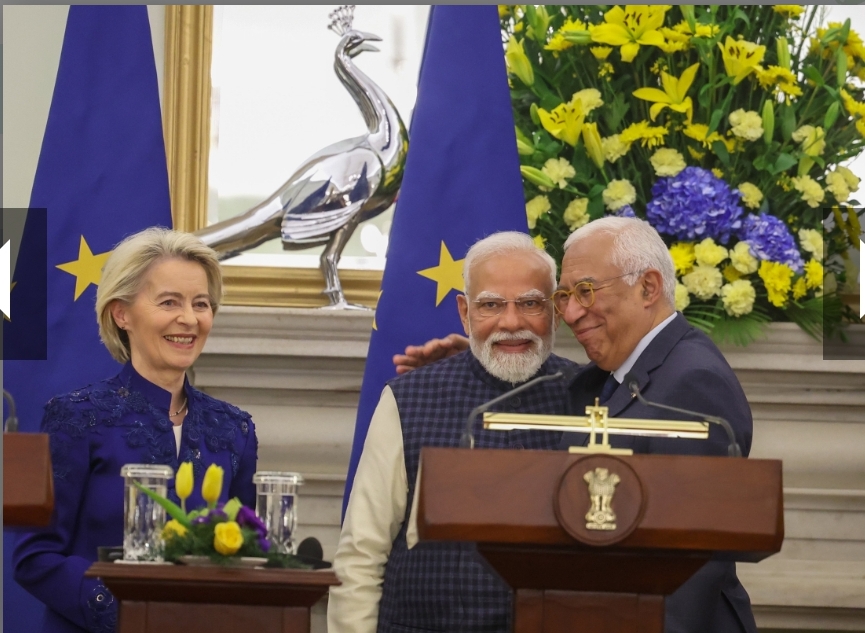
Prime Minister Narendra Modi on Tuesday described the India–European Union partnership as a “partnership for global good” while addressing the joint press statement following the India–EU Summit in New Delhi. The Prime Minister welcomed European Council President Antonio Costa and European Commission President Ursula von der Leyen, terming their visit historic and transformative for bilateral relations.
Welcoming the leaders, the Prime Minister praised President Costa for his simplicity and social commitment, referring to him as the “Gandhi of Lisbon,” and lauded President von der Leyen as a global inspiration for being the first woman Defence Minister of Germany and the first woman President of the European Commission.
The Prime Minister noted that the previous day marked a historic moment when, for the first time, European Union leaders attended India’s Republic Day celebrations as Chief Guests. He said the summit added another decisive chapter to relations between the world’s two largest democratic entities.
Highlighting the rapid progress in India–EU ties over recent years, the Prime Minister said the partnership is anchored in shared democratic values, economic synergy, and strong people-to-people connections. He pointed out that bilateral trade has reached €180 billion, while more than 800,000 Indians currently live and work across EU countries, making meaningful contributions to their host societies.
The Prime Minister announced that India and the European Union have concluded India’s largest-ever Free Trade Agreement, calling it a landmark achievement. He described it as a “historic coincidence” that on the 27th day of the month, India signed an FTA with all 27 EU member countries.
He said the agreement would significantly benefit Indian farmers and small industries by improving access to European markets, create new manufacturing opportunities, strengthen cooperation in services sectors, boost investment flows, promote innovation partnerships, and reinforce global supply chains. “This is not merely a trade agreement, but a new blueprint for shared prosperity,” the Prime Minister said.
Alongside the FTA, India and the EU have agreed to establish a new mobility framework, which will open greater opportunities for Indian students, workers, and professionals in Europe. Cooperation in science and technology, which has been a longstanding pillar of the relationship, will also be further strengthened.
Emphasizing the strategic dimension of the partnership, the Prime Minister announced the formalization of a Security and Defence Partnership. He said this would deepen cooperation in counter-terrorism, maritime security, and cyber security, strengthen commitment to a rules-based international order, and expand collaboration in the Indo-Pacific region. The partnership will also enable new opportunities for co-development and co-production between defence industries of both sides.
Building on these achievements, the Prime Minister said India and the EU have launched an ambitious and holistic Strategic Agenda for the next five years, aimed at enhancing shared prosperity, accelerating innovation, strengthening security cooperation, and deepening people-to-people ties in a complex global environment.
The Prime Minister reiterated that India–EU cooperation extends beyond bilateral interests. He said both sides would expand trilateral projects from the Indo-Pacific to the Caribbean, focusing on sustainable agriculture, clean energy, and women empowerment. He also emphasized joint efforts to establish the India–Middle East–Europe Economic Corridor (IMEC) as a vital link for global trade and sustainable development.
Addressing global challenges, the Prime Minister said the partnership between India and the European Union would contribute to stability in a time of significant global uncertainty. He noted that discussions were held on key international issues, including Ukraine, West Asia, and the Indo-Pacific. Both sides agreed on the importance of multilateralism, respect for international norms, and the urgent need for reforms in global institutions to effectively address contemporary challenges.
Concluding his remarks, the Prime Minister said moments arise in international relations when history itself signals the beginning of a new era. He described the India–EU Summit as one such defining moment and expressed gratitude to Presidents Costa and von der Leyen for their friendship, commitment to India, and shared vision for the future.