
Vallabh Government College’s Dr. Chaman Presents Research on Satellite-Based GLOF Early Warning Systems at International Himalayan Seminar.
Shimla:
The Head of the Department of Journalism and Mass Communication at Vallabh Government College, Flying Officer Dr. Chaman, presented his research paper online at an International Seminar on “Environmental Issues of the Himalayas and Disaster Risk: A Multidisciplinary Perspective” organized at Dr. Yashwant Singh Parmar College.
His paper, titled “Satellite-Based Early Warning System for GLOF Risk Reduction in the Himachal Himalayas: An Analytical Media Study,” critically examined the growing threat of Glacial Lake Outburst Floods (GLOFs) in the Himalayan region and emphasized the vital role of media in disaster risk communication.
Highlighting the importance of media, Flying Officer Dr. Chaman stated that community radio, mobile alerts, public awareness campaigns, and environmental journalism play a crucial role in effective risk communication. He observed that the Himachal Himalayas are currently passing through a serious phase of climatic transition. Therefore, urgent policy measures are required, including the rapid establishment of early warning systems in high-risk areas, continuous satellite monitoring, Geographic Information System (GIS)-based risk mapping, community training programs, and regulation of hydropower projects.
He also proposed the establishment of a “Himalayan Cryosphere Monitoring Centre” in Himachal Pradesh to strengthen scientific monitoring and policy interventions.
Describing the Himalayan region as the “Third Pole,” he noted that it is experiencing rapid glacial retreat due to anthropogenic climate change. This process has led to the rapid expansion of glacial lakes, significantly increasing the risk of sudden and highly destructive GLOF events.
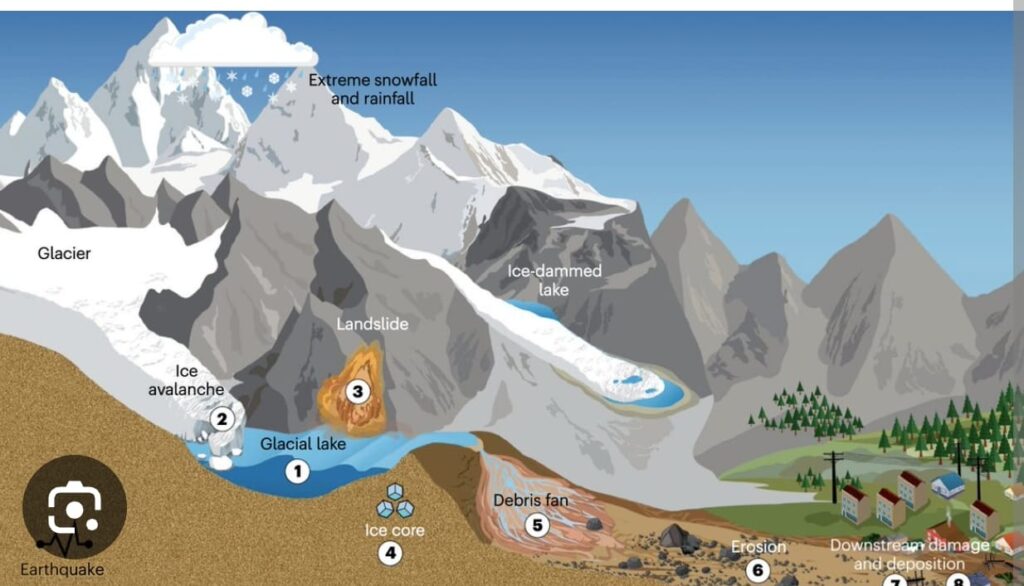
Dr. Chaman pointed out that four glacial lakes in Himachal Pradesh—Vasuki Lake (Kullu), Ghepan Lake (Lahaul-Spiti), Baspa Lake (Kinnaur), and Kalak Lake (Kashang Basin, Kinnaur)—have been identified as high-risk lakes. These pose potential threats to downstream regions along the Chenab, Parvati, and Sutlej river valleys.
According to the National Disaster Management Authority (NDMA), out of more than 7,500 glacial lakes mapped in the Indian Himalayas, 195 have been categorized as potentially highly dangerous, reflecting the severity of the escalating climate crisis.
In his research, Dr. Chaman presented a critical analysis of GLOF risks in Himachal Pradesh and evaluated the effectiveness of satellite-based early warning systems. The study adopted a mixed-method research approach, incorporating secondary data analysis, interpretation of remote sensing techniques, spatial risk assessment, and policy review.
The findings indicate that if satellite-based monitoring is effectively integrated with ground-level sensors, institutional coordination, and community disaster preparedness, significant reductions in human casualties and infrastructural damage can be achieved.
He emphasized that technological solutions must be integrated within broader climate adaptation policies, media-based risk communication strategies, and sustainable mountain governance frameworks.
Referring to the Himalayas as one of the world’s most ecologically sensitive regions and the “Water Tower of Asia,” he noted that rivers originating from this region serve as a primary water source for millions of people. Due to global warming, accelerated glacial melting is leading to the formation of unstable moraine-dammed lakes, which can trigger catastrophic floods at any time.
Mentioning the identification of 14 moraine-dammed lakes in the Sutlej Basin, he cautioned that higher lake density in certain basins increases cumulative risk. In such circumstances, satellite-based early warning systems, automatic water-level recorders, telemetry mechanisms, meteorological integration, and district-level alert systems play a pivotal role.
Dr. Chaman further underscored that effective GLOF risk mitigation requires strong coordination among the Geological Survey of India, the Meteorological Department, and state and district disaster management authorities.
He expressed his gratitude to the Organizing Secretary Dr. Jagdish Chand, Principal Dr. V. K. Shukla, and Dr. Jagpal Singh Tomar of the Department of Geography for successfully organizing the international seminar.
The Principal of Vallabh Government College, Dr. Sanjeev Kumar, congratulated Flying Officer Dr. Chaman for presenting his research paper at the international seminar.
Scholars and researchers from various countries also presented their papers at the seminar, engaging in meaningful deliberations on contemporary global challenges.