International Symposium in Hamirpur Showcases Ambedkar’s Legacy in Economics, Culture, and Nation-Building.
Shimla:
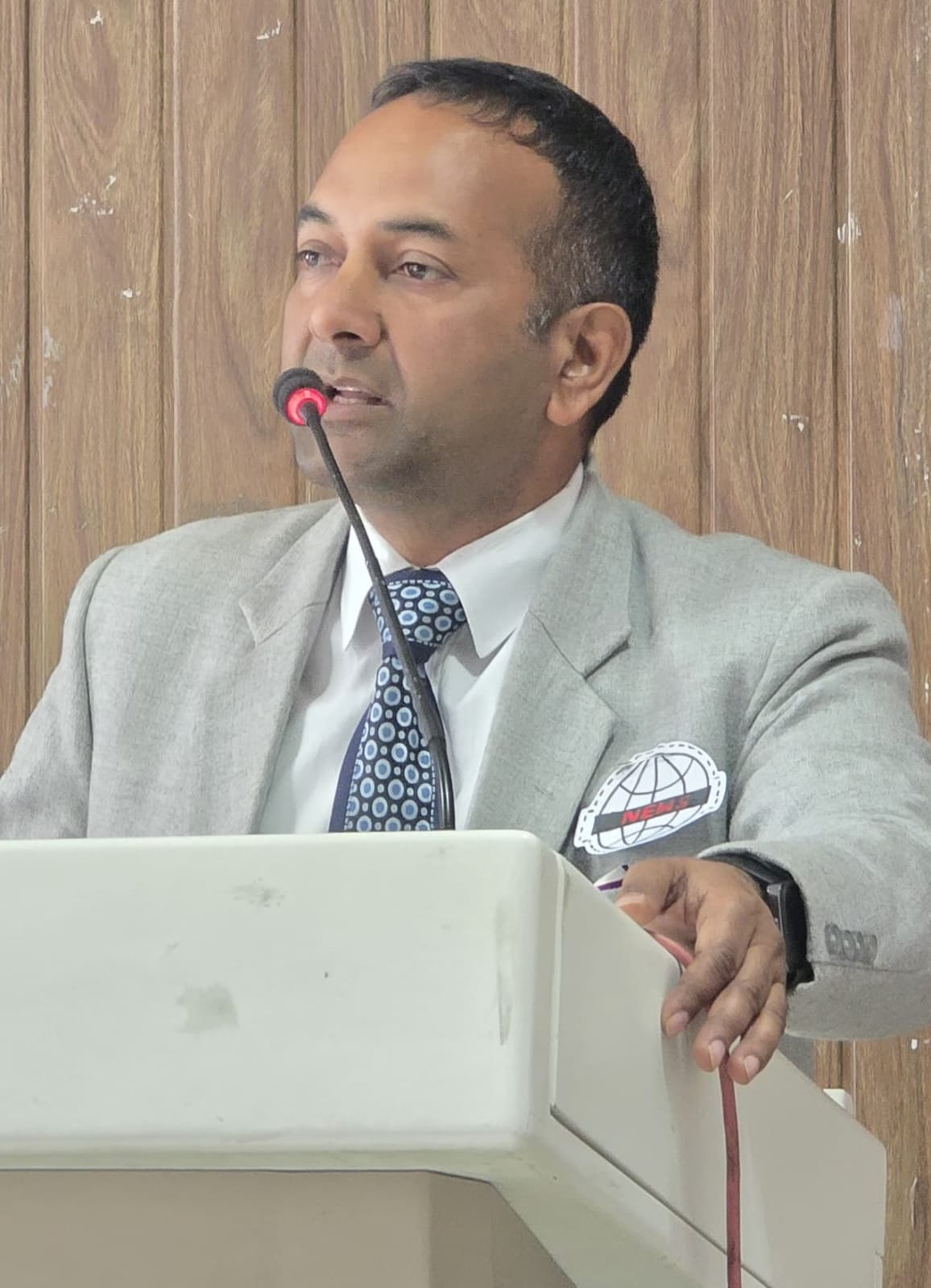
On the occasion of the Mahaparinirvan Diwas of Bharat Ratna Dr. Bhimrao Ambedkar, an international two-day symposium titled “Environment, Culture and Spirituality” and “Life and Contribution of Dr. B.R. Ambedkar” was organized by Netaji Subhash Chandra Bose College, Hamirpur. In this symposium, Dr. Chaman Lal Kranti Singh, Flying Officer and Head of the Department of Journalism & Mass Communication, Vallabh Government College, Mandi, presented his research paper through the online mode.
Dr. Chaman presented his paper titled “The Contribution of Economist Bharat Ratna Dr. B.R. Ambedkar’s Economic Thought to Inclusive Development and Sustainable Nation-Building in Modern India: A Media Perspective.” He stated that Dr. Ambedkar is often remembered as a constitution-maker, jurist, and social reformer, but he was equally a profound and visionary economic thinker. He highlighted that Nobel Laureate Prof. Amartya Sen and renowned economist Prof. J.N. Jandare have both drawn deep inspiration from Ambedkar’s inclusive economic philosophy.
Dr. Chaman emphasized that Dr. Ambedkar’s academic brilliance was exceptional. He earned four of the world’s highest academic degrees — Doctor of Economics, Doctor of Science, Doctor of Literature, and Doctor of Legislative Law — from Columbia University and the London School of Economics, establishing an unparalleled legacy in Indian intellectual history.
Citing Ambedkar’s seminal work “The Problem of the Rupee,” Dr. Chaman explained that the recommendations made in this book laid the foundation for the establishment of the Reserve Bank of India (RBI), demonstrating the practical applicability of his economic insights. As a member of the pre-independence cabinet, Ambedkar also played a decisive role in conceptualizing major development projects such as the Damodar Valley Project, the Son River Valley Scheme, and the Bhakra Nangal Project. These projects became milestones in India’s industrial development, agricultural reform, and energy generation.
In his paper, Dr. Chaman underlined that the core of Ambedkar’s economic vision rests on the idea that economic inequality is the root cause of social injustice. According to Ambedkar, political freedom becomes meaningful only when supported by social and economic equity. This philosophy forms the foundation of India’s modern inclusive growth model and sustainable nation-building policies.
He added that Dr. Ambedkar’s contributions to labour policy, industrialization, land reforms, water resource management, and the welfare role of the state were far ahead of their time. As Labour Minister, Ambedkar introduced progressive reforms such as minimum wages, maternity benefits, social security, and dignified working conditions, giving Indian labour policy a modern framework.
Dr. Chaman noted that Ambedkar’s philosophy of inclusive economic planning is still alive in India’s development schemes, including MGNREGA, Jan Dhan Yojana, social security initiatives, and education empowerment programs — all reflecting his vision of equitable and people-centric development. He also highlighted that Ambedkar’s famous message, “Educate, Agitate, Organize,” is not only a formula for social transformation but also a roadmap for economic liberation.
In the context of media discourse, Dr. Chaman said that media generally portrays Ambedkar in the context of social justice, while his economic ideas receive comparatively less attention. As a result, a significant dimension of his personality remains overlooked. He urged media organizations to give due attention to Ambedkar’s economic thought, especially in today’s globalized era where inclusive growth, financial stability, and human-centric policymaking have become more relevant than ever.
Concluding his presentation, Dr. Chaman stated that as India advances toward the vision of “Developed India 2047,” Ambedkar’s economic principles — equitable distribution of opportunities, dignity of labour, just management of resources, and human-centric development — offer invaluable guidance for national policymaking.
The symposium, organized by Netaji Subhash Chandra Bose College, Hamirpur, aimed to meaningfully highlight the interrelationship between environment, culture, spirituality, and the global relevance of Dr. Ambedkar’s life, ideas, and economic contributions.